

Table of Contents
- What Third-Party Testing Means for Research Peptides
- How to Verify Peptide Purity: Key Testing Methods
- Understanding Peptide Certificate of Analysis
- Independent Peptide Testing Labs and Verification
- Selecting Third-Party Tested Peptides: What to Check
- Frontline Peptides: Research-Grade Compounds with Verified Quality
- Frequently Asked Questions
Last Updated: September 3, 2026
What Third-Party Testing Means for Research Peptides
Third-party tested research peptides eliminate guesswork by introducing independent verification into the supply chain. Instead of relying solely on a manufacturer's internal quality control, external laboratories with no financial stake in the sale analyze purity, potency, and contamination independently.
This matters because the research peptide market operates in a gray zone. Unlike pharmaceutical-grade compounds regulated by the FDA, research peptides exist in a "research only" designation that places responsibility on the end user (the FDA). At Frontline Peptides, we've made independent verification a cornerstone of our operations because qualified researchers deserve to know exactly what they're working with.
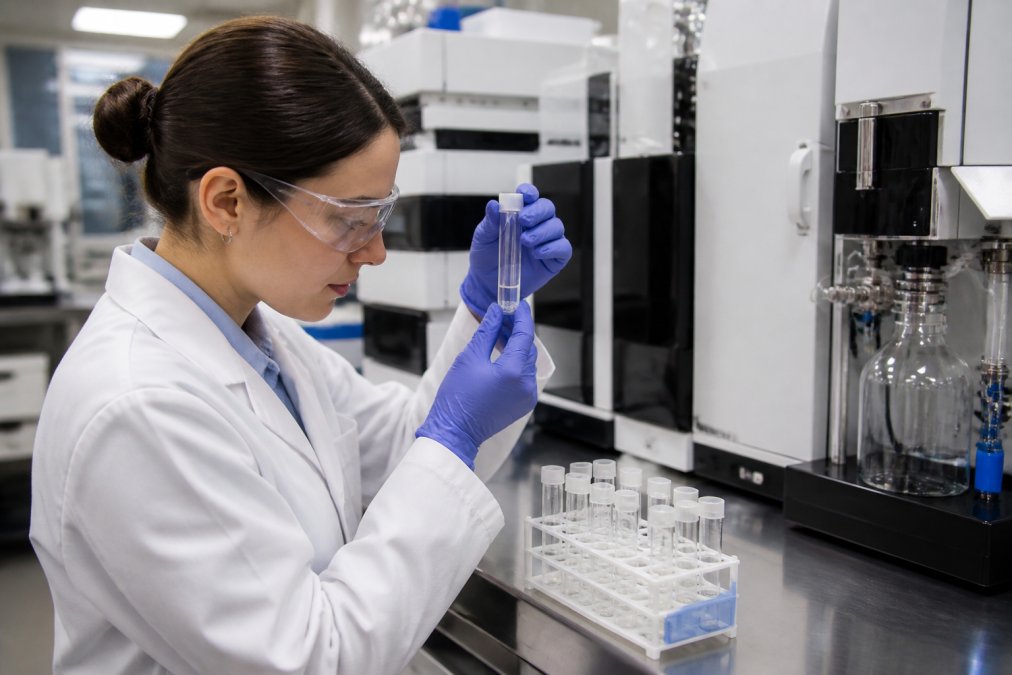
A third-party laboratory receives a sample from a batch, performs analytical testing using standardized methods, and issues a Certificate of Analysis (CoA) that documents the results. This CoA becomes your proof that the peptide meets stated specifications.
How to Verify Peptide Purity: Key Testing Methods
Peptide purity verification relies on two primary analytical techniques: HPLC (High-Performance Liquid Chromatography) and Mass Spectrometry. These methods work differently but complement each other.
HPLC and Mass Spectrometry Explained
HPLC separates peptide molecules based on their chemical properties as they move through a column. Different peptides exit at different times, creating a chromatogram that shows peaks representing different compounds. The larger the peak for your target peptide, the higher the purity. A pure peptide shows one dominant peak; contaminated samples show multiple peaks.
Mass Spectrometry ionizes peptide molecules and measures their mass-to-charge ratio, revealing the exact molecular weight and confirming it matches the theoretical weight of your target peptide. It also identifies contaminants by their distinct molecular weights. Where HPLC tells you "something else is in here," mass spec tells you "here's exactly what that something is."
Together, these methods create a complete picture. HPLC confirms purity percentage; mass spec confirms identity and identifies contaminants. A complete CoA includes results from both methods.
Contaminant Screening and Endotoxin Testing
Beyond purity and identity, third-party testing screens for specific contaminants that could compromise your research. Endotoxin testing is particularly important. Endotoxins are bacterial lipopolysaccharides that trigger inflammatory responses in biological systems (peer-reviewed research). The LAL (Limulus Amebocyte Lysate) test measures endotoxin levels in EU/mL (endotoxin units per milliliter).
Most quality research peptides carry endotoxin levels below 0.1 EU/mL (the FDA). Your CoA should specify the endotoxin level tested. If it doesn't list endotoxin results, the supplier either didn't test for it or the results were problematic.
Other contaminant screens depend on the peptide's source and intended use. Residual solvents, heavy metals, and microbial contamination all appear on comprehensive CoAs. These screens ensure your research compound won't introduce variables that compromise your experimental design.
Understanding Peptide Certificate of Analysis
A Certificate of Analysis is your proof of purchase and quality guarantee. It's a formal document issued by the testing laboratory that documents what was tested, how it was tested, and what the results showed. Every legitimate third-party tested research peptide comes with a CoA.
The CoA structure is standardized but varies by laboratory. You'll typically find sample identification (lot number, date received), test methods used, numerical results for purity and potency, identity confirmation via mass spec, contaminant screening results, and the testing laboratory's certification.
Reading Lab Reports for Non-Scientists
The first thing to verify is the lot number. Your CoA's lot number must match your invoice and the vial label. Next, check the analysis date. A recent CoA indicates fresh material; older certificates suggest extended storage.
Purity percentage appears as a single number, typically expressed as a percentage. For research applications, anything above 95% is generally acceptable. Below 90% raises questions about supplier quality control. Molecular weight confirmation appears in the mass spec section. You'll see a theoretical molecular weight and an observed molecular weight. These should match within 0.1 Da (Daltons).
What Purity Levels and Batch Testing Tell You
Purity levels correlate directly with research reliability. A 99% pure peptide gives you cleaner results than a 95% pure sample. However, the cost difference is substantial. Most researchers choose 95-98% as a balance between quality and budget.
Batch testing means analyzing every production batch independently. You want batch-specific results, not generic certificates claiming "all our BPC-157 is 98% pure." Batch-specific testing means the CoA you receive reflects your actual material. Look for lot numbers on CoAs that correspond to your purchase. If the supplier provides a generic CoA without a matching lot number, they're not batch testing.

| Testing Method | What It Measures | Why It Matters | Typical Threshold |
|---|---|---|---|
| HPLC | Purity percentage | Identifies how much of your sample is target peptide vs. contaminants | 95-99% |
| Mass Spectrometry | Molecular weight and identity | Confirms you received the correct compound | Within 0.1 Da |
| Endotoxin Testing | Bacterial contamination (EU/mL) | Prevents inflammatory responses that skew results | Below 0.1 EU/mL |
| Residual Solvent Screen | Leftover manufacturing solvents | Ensures solvents won't interfere with your research | Lab-specific limits |
Independent Peptide Testing Labs and Verification
Not all testing laboratories are equal. When evaluating third-party tested research peptides, the reputation and credentials of the testing laboratory matter as much as the peptide itself.
Accredited laboratories typically hold ISO 17025 certification, which means they've been independently verified to operate accurate, reliable testing procedures. This certification signals serious commitment to quality. Labs with ISO 17025 maintain detailed quality assurance protocols, participate in proficiency testing, and undergo regular audits.
The relationship between peptide suppliers and testing labs matters too. Independent testing means the lab has no financial incentive to inflate purity numbers or hide contamination. Red flags appear when a supplier owns the testing lab or when the same lab tests all samples without external verification.
Why Supply Chain Transparency Matters
Supply chain transparency means you can trace your peptide from synthesis to your lab. This includes knowing where it was manufactured, which lab tested it, and whether the testing was truly independent. Transparent suppliers provide this information readily and make CoAs available before purchase.
Opaque suppliers make you request CoAs after ordering or claim they're "confidential." They don't disclose manufacturing locations or testing lab relationships. This opacity allows suppliers to cut corners. Without transparency, contamination, mislabeling, and quality degradation go undetected.
Frontline Peptides maintains complete supply chain transparency. Our third-party tested research peptides come with CoAs that specify the testing lab, analysis date, and lot-specific results. We disclose our manufacturing partners and testing relationships upfront.
Selecting Third-Party Tested Peptides: What to Check
Choosing the right third-party tested research peptides requires evaluating multiple factors beyond price. Start with the CoA. Request one before ordering and verify it includes lot numbers, recent analysis dates, both HPLC and mass spec results, and endotoxin screening.
Next, verify the testing lab's credentials. Ask the supplier which lab performs their testing and confirm it holds ISO 17025 certification. Check whether the lab is independent or owned by the supplier.
Price comparison reveals a lot about supplier quality. If one supplier's third-party tested research peptides cost significantly less than competitors, ask why. Suspiciously low pricing warrants investigation.
Regulatory Compliance and Quality Standards
Research peptides operate in a regulatory gray zone, but standards still apply. FDA regulations classify peptides as research chemicals, which means they're not approved for human consumption or medical use. Legitimate suppliers clearly mark products "For Research Use Only."
The United States Pharmacopeia (USP) publishes standards for peptide purity, identity, and testing methods. Many research suppliers voluntarily meet USP benchmarks as a quality commitment.
GLP (Good Laboratory Practice) compliance is another quality signal. Suppliers who work with GLP-compliant manufacturers ensure their peptides are produced under documented, audited procedures.
Lot Number Traceability and Storage Protocols
Every batch of third-party tested research peptides should carry a unique lot number. This ties your material to a specific production run, specific testing results, and specific storage conditions. Traceability means you can contact the supplier with questions about your specific batch.
Storage protocols affect peptide stability over time. Lyophilized (freeze-dried) peptides are more stable than reconstituted solutions. Most suppliers ship lyophilized powder, which remains stable at room temperature in a dry environment for months. Your CoA should include storage recommendations specific to your peptide.
Ask suppliers about their storage conditions before shipment. Cold chain management prevents degradation.
Frontline Peptides: Research-Grade Compounds with Verified Quality
Frontline Peptides supplies third-party tested research peptides with verified purity, full batch traceability, and transparent quality documentation. Every product carries a CoA with lot-specific results from independent testing labs. We maintain complete supply chain transparency.
Our commitment to third-party testing means higher costs than suppliers who rely on internal quality control alone. We accept that trade-off because qualified researchers deserve certainty. When you order from Frontline Peptides, you have documented proof of purity and identity.
We stock research-grade peptides ranging from $24 to $50 per 10mg vial, depending on compound complexity. This pricing reflects the cost of genuine independent testing, batch-specific documentation, and supply chain transparency.
Featured Third-Party Tested Options
BPC-157 is our most ordered peptide for tissue repair research. At $30.00 per 10mg vial, it's accessible while maintaining rigorous quality standards. Every batch comes with a CoA showing HPLC purity results, mass spec confirmation, and endotoxin screening. The peptide is supplied as lyophilized powder, stable at room temperature until reconstitution.
TB-500 serves researchers investigating tissue regeneration. At $48.00 per 10mg vial, it's priced at the premium end because TB-500 synthesis is complex. Our third-party testing confirms molecular weight to within 0.1 Da and screens for contaminants that could interfere with tissue repair research.

GLP-2TZ (Tirzepatide) is our research-grade dual-receptor agonist compound at $50.00 per 10mg vial. Our third-party testing includes dual confirmation of GIP and GLP-1 receptor activity markers. The CoA documents amino acid sequence verification and batch-specific purity confirmation.
KPV at $24.00 per 10mg represents our most affordable third-party tested option without compromising quality. Despite the lower price point, KPV includes the same rigorous testing: HPLC purity analysis, mass spec identity confirmation, and endotoxin screening.
MOTS-C at $35.00 per 10mg is ideal for metabolic research requiring documented mitochondrial signaling compound verification. Our third-party testing confirms molecular weight and purity through independent analysis.
Epitalon at $35.00 per 10mg serves researchers studying cellular signaling pathways. Our testing confirms sequence integrity and purity through independent laboratory analysis.
SELANK at $25.00 per 10mg is our entry-level neuroregulatory peptide with full third-party testing included. Every batch undergoes independent HPLC and mass spec analysis.
DSIP at $45.00 per 10mg is our premium neuroregulatory compound. Our third-party testing exceeds standard requirements.
SS-31 at $40.00 per 10mg serves mitochondrial research with documented cellular energy system verification. Independent testing confirms this peptide's identity and purity through HPLC and mass spectrometry.
Every peptide in our catalog comes with batch-specific documentation, independent testing verification, and full supply chain transparency. All Frontline Peptides products ship within 24 hours of order placement. Most orders arrive within 2-3 business days via expedited shipping. Our customer service team responds to questions within 2 hours during business hours.
Choosing third-party tested research peptides means accepting that quality costs more upfront. You're paying for independent verification, batch-specific documentation, and supply chain transparency. Frontline Peptides delivers all three. Our research-grade compounds come with verified purity, complete traceability, and responsive customer support. When your research depends on knowing exactly what you're working with, third-party testing is essential.
Frequently Asked Questions
How do I know if research peptides are actually third-party tested?
Legitimate third-party tested peptides come with a Certificate of Analysis (CoA) from an independent laboratory, not the supplier. The CoA should list the testing lab's name, the specific tests performed (HPLC, mass spectrometry), purity percentages, lot number, and batch testing results. Ask your supplier for the CoA before purchase, reputable vendors provide it immediately.
What should I look for in a Certificate of Analysis to verify peptide purity?
A reliable CoA shows purity percentage (typically 95% or higher for research-grade peptides), molecular weight confirmation, and the testing methods used. Look for specific test results like HPLC chromatography data showing impurity profiles and mass spectrometry confirmation of the peptide's molecular structure. The document should include the lot number, testing date, and the independent laboratory's contact information.
Why is independent laboratory testing critical for research compounds?
Independent testing removes bias, the supplier has no financial incentive to falsify results. Third-party labs use standardized analytical chemistry methods (HPLC, mass spectrometry) that provide objective purity and potency data. This is essential for reproducible research, especially in peer-reviewed studies where data integrity is non-negotiable. Suppliers testing their own products can manipulate results; independent verification ensures the peptide composition actually matches what's labeled.
What's the difference between research-grade and reagent-grade peptides?
Research-grade peptides typically meet higher purity standards (95%+ purity) and come with comprehensive testing documentation suitable for peer-reviewed studies and biotech applications. Reagent-grade compounds are lower purity (often 80-90%) and intended for less critical applications. For academic research or GLP-compliant work, research-grade is necessary. Always check the CoA to confirm the purity level matches your study requirements.