

Table of Contents
- Defining High Purity Peptides for Academic Research
- Why Third-Party Peptide Testing Verification Matters
- Reading HPLC and Mass Spectrometry Reports
- Interpreting Certificates of Analysis (COAs)
- Your Peptide Supplier Vetting Checklist
- Navigating the Buying Research Grade Peptides Online Process
- Storing and Handling Peptides for Batch Consistency
- Conclusion
- Frequently Asked Questions
Last Updated: September 5, 2026
Defining High Purity Peptides for Academic Research
Sourcing high purity peptides for universities begins with a precise definition of what "pure" actually means in a research context. A high purity peptide is a synthesized amino acid chain, typically exceeding 98% purity, that has been verified through analytical methods rather than simply claimed by the manufacturer (peer-reviewed research). This distinction matters because impurities, even at seemingly minor levels, can confound experimental results and waste valuable grant funding.

The term "research-grade" is often used loosely across the industry, which creates genuine risk for academic buyers. Unlike reagent grade chemicals that serve general lab functions, research peptides intended for cell culture or in vivo studies demand rigorous verification of their sequence integrity and contaminant profile. At Frontline Peptides, we routinely advise university procurement teams that the purity percentage stated on a product page is meaningless without the analytical data to back it up. The documentation trail, not the marketing copy, determines whether a compound is suitable for peer-reviewed work.
Most academic labs now recognize that sourcing high purity peptides requires looking beyond the certificate to understand what methods produced it. The gold standard involves reverse-phase HPLC for purity assessment paired with mass spectrometry for molecular weight confirmation (PubMed). These two techniques together confirm both the identity of the peptide and the absence of truncated sequences or deletion impurities that commonly arise during synthesis.
Why Third-Party Peptide Testing Verification Matters
Third-party peptide testing verification is the single most reliable safeguard against supplier bias in quality claims. When a manufacturer tests its own products, the conflict of interest is obvious: the entity profiting from the sale also certifies the quality. Independent analytical laboratories remove that bias by running samples through standardized protocols without a financial stake in the outcome.
The practical implications for university researchers are substantial. A peptide that fails third-party testing may contain bacterial endotoxins, residual trifluoroacetic acid from the cleavage process, or heavy metal contamination from synthesis reagents (the FDA). Each of these contaminants can trigger unintended cellular responses, making it impossible to determine whether an observed effect comes from the peptide itself or from an impurity. Many labs have abandoned promising research lines after discovering that their results traced back to endotoxin contamination rather than the peptide under investigation.

The verification process typically includes HPLC analysis to determine purity percentage, mass spectrometry to confirm molecular weight, and endotoxin testing to ensure levels fall below acceptable thresholds for research applications. Each method addresses a different failure mode, which is why relying on a single analytical technique leaves dangerous gaps in quality assurance.
Reading HPLC and Mass Spectrometry Reports
HPLC and mass spectrometry reports are the raw evidence of peptide quality, and learning to read them is essential for anyone managing lab supply chains. A high-performance liquid chromatography report displays a main peak representing your peptide, with the purity percentage calculated from the area under that peak relative to all other peaks detected. Any additional peaks indicate impurities, including truncated sequences or oxidation byproducts that can alter bioactivity.
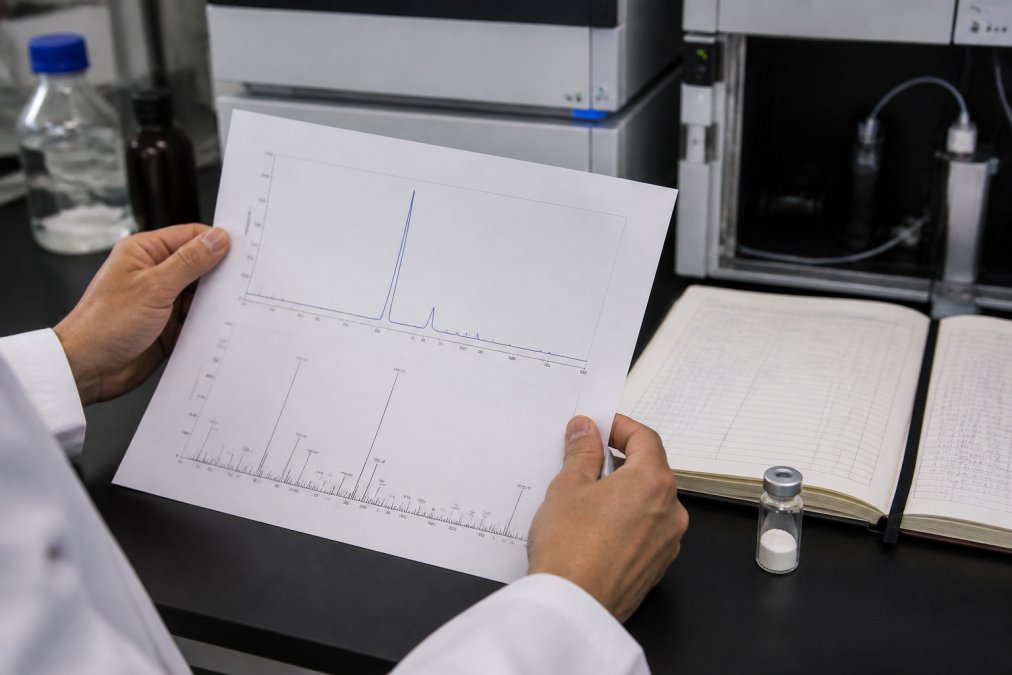
Mass spectrometry data tells a complementary story. The observed molecular weight should match the theoretical molecular weight of your peptide sequence within a tight tolerance, typically plus or minus 0.5 Da. A mismatch here suggests the wrong peptide was synthesized or that significant post-translational modification occurred. The report should show a single dominant species, not a distribution of masses that indicates a heterogeneous product.
When evaluating these reports, pay attention to the counterion specified in the analysis. Most peptides are supplied as acetate salts or TFA salts depending on the purification method. The counterion affects both solubility and biological activity, so the report should clearly state which salt form you are receiving. This detail matters more than most buyers realize, as TFA can interfere with cell-based assays even at residual levels.
Interpreting Certificates of Analysis (COAs)
A certificate of analysis is the document that ties a specific batch of peptide to its analytical data, and it should accompany every order you receive. A proper COA lists the peptide sequence, batch number, molecular weight, purity percentage, and the specific analytical methods used to generate those values. It should also include the date of analysis and the signature or credentials of the analyst who performed the testing.
University procurement teams should verify that the COA corresponds to the exact batch number on the product vial. Some suppliers maintain generic COAs that describe their standard manufacturing process rather than the specific batch shipped, which provides no real assurance. The batch-specific COA is the only document that proves your vial, not a representative sample from some other production run, met the stated specifications.
The most informative COAs include chromatograms and spectra, not just summary numbers. Seeing the actual HPLC trace allows you to assess peak shape and baseline stability, which reveals column performance and potential co-elution issues that a simple purity percentage would miss. If a supplier only provides a summary table without the underlying analytical data, request the full report before committing to a purchase.
Your Peptide Supplier Vetting Checklist
Evaluating a peptide supplier requires a structured approach that goes beyond comparing prices and delivery times. The checklist below covers the critical questions that separate reliable research partners from vendors who may compromise your work.
| Vetting Criterion | What to Look For | Red Flag |
|---|---|---|
| Third-party testing | Independent lab COAs for every batch | In-house testing only |
| Documentation | Batch-specific COAs with chromatograms | Generic or templated certificates |
| Synthesis capabilities | Custom synthesis and peptide modifications offered | Catalog-only supplier |
| Communication | Direct access to technical staff | Email-only support with slow responses |
| Inventory stability | Consistent stock of catalog peptides | Frequent backorders or discontinuations |
Transparency about synthesis and testing methods is another critical differentiator. Suppliers should clearly state whether peptides are produced through solid-phase synthesis, what purification methods they employ, and how they handle quality assurance across production runs. Batch consistency matters enormously for longitudinal studies, as subtle variations between batches can introduce noise that obscures treatment effects.
Turnaround time for custom synthesis requests reveals how well a supplier manages its production pipeline. A vendor that promises unrealistic timelines may be cutting corners on purification or skipping critical quality checks. Conversely, a supplier with honest lead times and clear communication about production schedules demonstrates operational maturity.
Navigating the Buying Research Grade Peptides Online Process
The process of buying research grade peptides online has become more accessible, but that accessibility brings new risks for academic buyers. Start by confirming that the supplier requires proof of research purpose and institutional affiliation, as legitimate vendors verify their customers to maintain compliance with research regulations. A supplier that sells to anyone without qualification questions should raise immediate concerns about their overall standards.
Verifying the purity percentage of a peptide before purchase requires looking at batch-specific data rather than marketing claims. When you identify a candidate peptide, request the COA for the current batch and compare the reported purity against your experimental requirements. For most academic applications, peptides at 98% purity or higher are appropriate, though certain sensitive assays may demand 99% or greater.
For university labs, Frontline Peptides offers a practical balance of rigorous third-party testing and competitive pricing. Our U.S.-based operation ensures fast shipping and direct access to knowledgeable staff who can answer technical questions about peptide solubility, storage, or experimental design. We understand the budget constraints of academic research and structure our catalog to accommodate labs of all sizes.
Storing and Handling Peptides for Batch Consistency
Proper storage and handling protocols are the final link in maintaining peptide quality from receipt through experimental use. Lyophilized peptides, which are supplied as dry powders, generally remain stable at room temperature for short periods but should be stored frozen for long-term preservation. Most manufacturers recommend storage at -20°C, protected from moisture and light, to maintain stability over months or years.
Reconstitution introduces the greatest risk of degradation. The solubility of a peptide depends on its sequence, net charge, and the counterion present. Many researchers default to sterile water, but peptides with hydrophobic regions may require a small amount of acetic acid or DMSO to achieve complete dissolution. Always consult the supplier's solubility data, which should accompany the product documentation.
Once reconstituted, peptides are far more susceptible to degradation through microbial growth, oxidation, and repeated freeze-thaw cycles. Aliquot your stock solution into single-use portions before freezing to avoid subjecting the entire supply to repeated temperature changes. Each freeze-thaw cycle can reduce activity and introduce variability that compromises batch consistency across your experiments.
Conclusion
Sourcing high purity peptides for universities ultimately comes down to verification at every stage of the procurement cycle. The purity percentage on a product page means nothing without third-party analytical data, and a COA only provides assurance when it is batch-specific and independently generated. University labs that build a rigorous vendor vetting process around these principles protect their research integrity and their grant funding.
The procurement workflow we have outlined, from defining purity standards through interpreting analytical reports to implementing proper storage protocols, creates a defensible quality assurance framework. Applying this framework consistently across all peptide purchases ensures that experimental results can be attributed to the compound under investigation rather than unknown contaminants.
Frontline Peptides supports academic researchers with third-party tested products, U.S.-based fast shipping, and direct access to technical staff who understand the demands of peer-reviewed research. Our commitment to competitive pricing and exceptional customer service makes us a reliable partner for university labs seeking verified quality without procurement headaches. Continue shopping with Frontline Peptides and bring the confidence of rigorously tested research compounds to your next study.
Frequently Asked Questions
What purity percentage should I require for research-grade peptides?
For most university-level studies, a purity of 98% or higher, verified by HPLC, is the standard benchmark. This ensures that the primary peptide sequence is present in sufficient concentration and that the results of your assays are not confounded by significant impurities. Always check the certificate of analysis for the exact purity percentage and the method used to determine it, such as HPLC-verified at 214 nm.
How do I verify a supplier's third-party testing documentation?
Request the certificate of analysis (COA) before purchasing. A valid COA should be on the testing laboratory's letterhead, not the supplier's, and include the lot number, the peptide sequence, the tested purity percentage, and the analytical methods used like HPLC and mass spectrometry. You can also contact the testing lab directly to confirm the report's authenticity, though many suppliers will provide this documentation upon request.
What are the red flags when buying research grade peptides online?
Red flags include a supplier that cannot or will not provide a certificate of analysis, prices that are significantly below the market average, and a lack of transparent contact information. Be wary of vendors who sell peptides for human consumption, as this signals a disregard for research compliance. A professional supplier will clearly state that their products are for laboratory use only and will have a defined procurement process.
Why is batch consistency important for university research projects?
Batch consistency ensures that the results from a multi-phase study are reproducible and reliable. Variations in purity or peptide content between different vials of the same product can introduce variables that compromise your data. When sourcing, ask suppliers if they provide batch-specific COAs and if they can guarantee a consistent supply from the same synthesis run for the duration of your project.