

Table of Contents
- What Reliable US Peptide Shipping Times Actually Look Like
- Buying Research Grade Peptides Online: What Changes Your Delivery Window
- Peptide Shipping Temperature Requirements and Cold-Chain Packaging
- How to Verify Peptide Purity Certificates Before You Order
- Tracking, Insurance, and Carrier Reliability Compared
- Domestic Delivery vs. International Shipping Logistics
- Frequently Asked Questions
Last Updated: September 20, 2026
What Reliable US Peptide Shipping Times Actually Look Like
Reliable US peptide shipping times are the predictable window between placing an order and receiving a verified, intact compound, governed by same-day dispatch cutoffs, transit time, and cold-chain handling. This guide covers what determines your delivery window, how packaging protects compound stability, and how to read a certificate of analysis before you commit to a supplier.
Order Cutoff Times and Time Zones
Order cutoff is the daily deadline after which your order moves to the next business day. Miss it by an hour and your transit time effectively doubles.
- Standard cutoff: usually early-to-mid afternoon Eastern
- Expedited cutoff: often later, sometimes with a surcharge
- Weekend orders: typically processed the next business day
Standard vs. Expedited Shipping Methods
Standard shipping trades speed for cost, while expedited shipping buys a shorter transit time and often a firmer delivery guarantee. For time-sensitive research, express courier service is worth the premium because it reduces handling points where a package can be delayed or exposed to temperature swings.
| Method | Typical Transit Time | Best For | Tracking Level |
|---|---|---|---|
| Standard shipping | 3-5 business days | Non-urgent restocks | Basic tracking number |
| Expedited shipping | 1-2 business days | Time-sensitive projects | Real-time tracking |
| Express courier | Overnight to 1 day | Urgent, temperature-sensitive orders | Real-time tracking + signature |
Buying Research Grade Peptides Online: What Changes Your Delivery Window
Buying research grade peptides online introduces variables a local pickup never has: order processing time, payment verification, and inventory availability all sit between you and dispatch. A supplier with deep, verified stock ships the same day; a drop-shipper adds days you can't see.
- Is the compound in stock, or is it backordered?
- How long does order processing take before dispatch?
- Does the supplier ship from a domestic facility or route through a partner?
Peptide Shipping Temperature Requirements and Cold-Chain Packaging
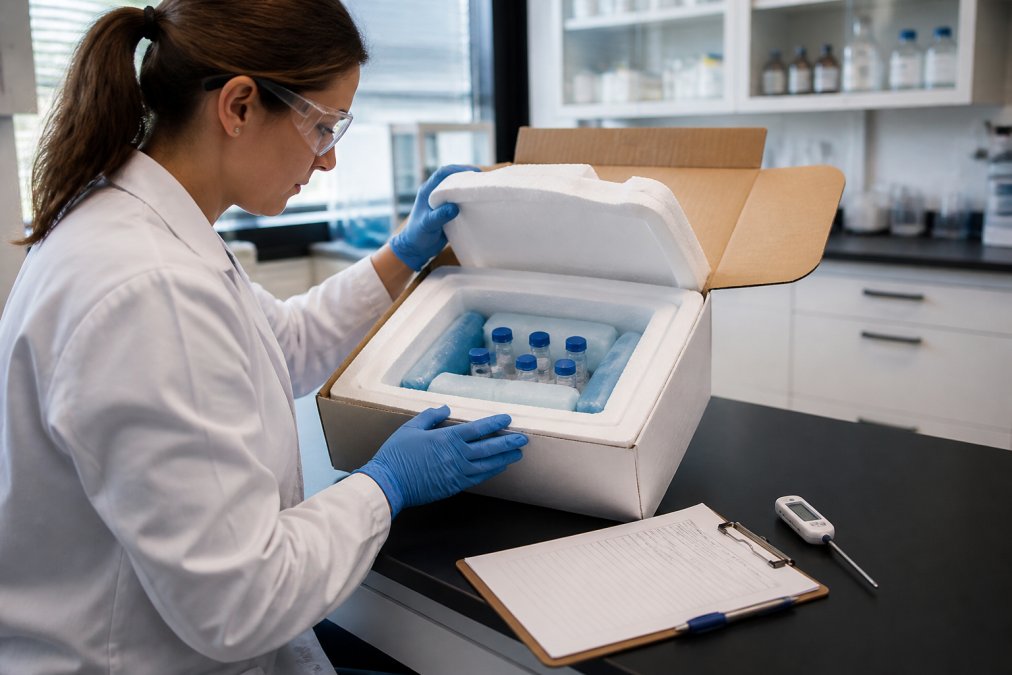
Peptide shipping temperature requirements vary by compound, but many research peptides need protection from heat and freeze-thaw cycles during transit. Cold-chain packaging pairs insulated liners with gel packs or dry ice to hold a stable internal temperature from dispatch to delivery.
The Science Behind Cold-Chain Packaging
Cold-chain packaging works on a simple principle: a phase-change material absorbs heat as it transitions between states, holding internal temperature near a target range for a measurable period. Gel packs are water-based and hold near refrigerator temperatures. Dry ice sublimates at roughly -109°F and holds frozen temperatures, but requires vented packaging so the gas can escape.
The variables that determine hold time are:
- Insulation thickness and type: A 1-inch expanded polystyrene (EPS) liner holds far less than a 2-inch polyurethane or vacuum-insulated panel. Thicker, denser insulation extends hold time but adds weight and cost.
- Payload-to-coolant ratio: A small vial in a large box with one gel pack warms faster than the same vial packed tightly with multiple packs. Air space is the enemy.
- Ambient temperature: A system rated for 48 hours at 75°F may hold only 24 hours at 95°F. Summer shipments need more coolant, not just faster shipping.
- Transit time: Hold time must exceed total transit time with margin. A 48-hour hold on a 3-day ground shipment is a failed design.
How Temperature Excursions Degrade Peptides
Stability is cumulative. A brief temperature excursion may not ruin a compound, but repeated swings during a long transit time add up:
- Heat exposure: Accelerates hydrolysis and oxidation, which can cleave peptide bonds or alter side chains. The rate roughly doubles for every 10°C rise for many degradation pathways, which is why a few hours on a hot dock matters.
- Freeze-thaw cycling: Ice crystal formation can disrupt secondary structure and cause aggregation. Each cycle adds stress. A shipment that partially thaws and refreezes in transit has undergone at least one full cycle.
- Sustained freezing of compounds meant for refrigeration: Some peptides are stable frozen, others are not. The supplier's stated storage condition is the target, and packaging should hold that target, not simply "cold."
How to Verify Your Shipment Arrived Within Spec
Here is a practical verification protocol:
- Inspect the outer box before opening for crush damage, water stains, or evidence of a thaw leak.
- Open immediately and check the coolant state. Gel packs should still be partially frozen or cold to the touch. Fully melted and warm gel packs mean the hold time was exceeded.
- Use a probe or infrared thermometer to check the internal box temperature at the vial level, not the air at the top. Record the reading.
- Look for condensation or compromised seals on vials. Condensation inside the liner suggests a temperature swing.
- Check for discoloration or cloudiness in reconstituted solution compared to a known-good batch.
- Document everything with photos and timestamps if any step fails, and contact the supplier before using the material.
What to Ask a Supplier About Cold-Chain Packaging
- What is the rated hold time of your packaging at summer and winter ambient temperatures?
- Do you use gel packs, dry ice, or phase-change panels, and why?
- Does the packaging change seasonally, or is it the same year-round?
- Can you provide the insulation specification (thickness and material)?
A supplier that can answer these treats cold-chain packaging as an engineering problem, not a checkbox, the difference between a shipment that arrives cold and one that arrives within spec.
How to Verify Peptide Purity Certificates Before You Order
Verifying peptide purity certificates means matching the certificate of analysis to the exact batch number on your vial, not just the product name. A COA listing a different lot number tells you nothing about what's in your hands.
Here's a practical checklist for reading a COA:
- Batch or lot number matches the vial label exactly
- Third-party laboratory is named, not just "independent testing"
- Purity percentage is stated with the analytical method used
- Date of analysis is recent relative to your order
- Certificate is downloadable before purchase, not only after
Tracking, Insurance, and Carrier Reliability Compared
Tracking, insurance, and carrier reliability determine what happens when something goes wrong. A tracking number gives you visibility, shipping insurance gives you recourse, and carrier reliability determines how often you need either.
Carrier-by-Carrier Reliability for Temperature-Sensitive Parcels
Carrier performance diverges sharply by service level, not brand reputation. The brand on the label matters less than the network your parcel travels through.
- USPS Priority Mail: Broadest residential reach and the lowest cost for 1-3 day service, but tracking scans are less granular and the final mile is handled by a mix of letter carriers and contractors. Parcels can sit in a delivery vehicle for hours before the stop is made, the single biggest exposure window for a gel-pack shipment in summer. Priority Mail Express adds a money-back guarantee and firmer delivery commitments.
- UPS Ground and UPS Next Day Air: UPS Ground is reliable for 1-5 business day transit with dense scan coverage, but ground parcels move through regional hubs where a missed sort can add a full day. Next Day Air is the strongest option for urgent cold-chain shipments because it moves through the air network with fewer handoffs and earlier morning delivery, shortening the final-mile exposure window.
- FedEx Express and FedEx Ground: FedEx Express offers strong overnight and 2-day performance with detailed tracking, and FedEx Ground is competitive with UPS Ground on transit. FedEx's residential network has historically shown more variability in rural ZIP codes than UPS, which matters if your lab is outside a metro area.
How to Choose a Carrier for Your Region
The right carrier depends on where you are, not which brand advertises the most.
- Dense metro areas: Any of the three performs well. Choose on cost and cutoff time.
- Rural or low-density ZIP codes: Express air services from UPS or FedEx generally beat ground and USPS for predictability, because they bypass regional ground hubs.
- Hot-weather months: Prefer services with morning delivery commitments so the parcel is not riding in a delivery vehicle through the afternoon heat.
- High-value orders: Choose a service that supports signature required and full declared-value insurance.
Tracking, Insurance, and Signature Requirements
- Real-time tracking: confirms movement, not just label creation. A label created at 9 a.m. that shows no origin scan by evening has not physically shipped.
- Shipping insurance: covers loss or damage in transit. Confirm the declared value and claim window before you order, because default coverage on some services is far below the value of a research order.
- Signature required: prevents porch theft on high-value shipments, but it also means a missed delivery if no one is available. For lab addresses with receiving hours, this is usually a net positive.
- Delivery guarantee: defines the supplier's responsibility if the window is missed. Not every service level includes one.
No carrier is perfect. What separates reliable suppliers is how they handle a delay or damaged shipment, not whether one ever happens. Ask what the claim process looks like before you need it.
Domestic Delivery vs. International Shipping Logistics
Domestic delivery keeps your order inside U.S. borders, removing customs clearance, import paperwork, and the unpredictable hold times of international shipping logistics. For research timelines, that predictability is often worth more than a lower headline price.
Frequently Asked Questions
How long does it take for peptides to be delivered in the US?
Most domestic peptide orders arrive within 2 to 5 business days after same-day dispatch, depending on the order cutoff time and carrier. Standard shipping typically lands in 3 to 5 business days, while expedited shipping can shorten that to 1 to 2 business days. Processing time before dispatch usually runs a few hours to one business day. Always check the order cutoff for your time zone, since a late-afternoon order may not ship until the next business day.
What factors influence shipping times for laboratory-grade compounds?
Several factors affect reliable US peptide shipping times: order cutoff times and time zones, order processing duration, chosen shipping method, carrier reliability, and whether cold-chain packaging is required. Temperature-controlled compounds may need special handling that adds a day. Weather disruptions and carrier backlogs also play a role. Choosing a supplier with transparent logistics and real-time tracking helps you anticipate delays before they affect your project timeline.
How should peptides be packaged to ensure stability during transit?
Peptides should ship in insulated packaging with gel packs or dry ice when temperature control is required. Vials need secure cushioning to prevent breakage, and packaging integrity must hold through transit time. A certificate of analysis and purity verification documents should accompany the shipment. Discreet packaging protects privacy without compromising cold-chain function. If you are buying research grade peptides online, confirm the supplier's temperature-controlled protocol before ordering.
How can researchers verify the reliability of a supplier's shipping claims?
Start by checking whether the supplier provides a tracking number, shipping confirmation, and a clear delivery guarantee. Look for published order cutoff times, carrier partnerships, and insurance options. Request a certificate of analysis to confirm purity verification and check that cold-chain packaging is used where needed. A supplier that offers real-time tracking, insured shipping, and responsive customer service demonstrates a commitment to logistics transparency.