

Table of Contents
- Peptide Testing Standards for Labs: What Actually Matters
- How to Verify Peptide Purity Before You Trust a Batch
- Peptide Certificate of Analysis Interpretation: Reading a CoA Line by Line
- Acceptable Purity Levels for Research Peptides
- Endotoxin, Sterility, and Heavy Metal Testing Requirements
- Research-Grade vs. Therapeutic-Grade: What the Labels Mean
- Peptide Content vs. Purity: The Number Most Labs Misread
- What to Ignore When Comparing Peptide Testing Standards
- Frequently Asked Questions
Last Updated: September 15, 2026
Peptide Testing Standards for Labs: What Actually Matters
Peptide testing standards for labs are the documented analytical benchmarks a supplier must meet before a batch is released: identity confirmation, purity measurement, and contamination screening, each tied to a specific method and acceptance criterion. At Frontline Peptides, every lot ships against a third-party certificate of analysis. This guide covers what those standards require, where suppliers cut corners, and how to read the paperwork before you commit a grant budget.
"99% pure" means almost nothing without context: purity measured by one method can read very differently under another, and a number without a method, column, and detection wavelength is marketing, not data. Below, we walk the verification chain from chromatogram to certificate so you can audit a supplier's claims.
How to Verify Peptide Purity Before You Trust a Batch
Verification starts with the certificate of analysis, not the product page. A legitimate certificate reports the analytical method, instrument conditions, observed result, and acceptance criteria. If any of those four is missing, you cannot verify the claim.
A practical verification sequence:
- Request the lot-specific certificate before ordering, not a generic sample document
- Confirm the certificate lists the exact lot number you are purchasing
- Check that purity is reported with the method named (typically high-performance liquid chromatography)
- Verify molecular weight by mass spectrometry matches the theoretical value
- Confirm the testing laboratory is named and, ideally, accredited
A common mistake is accepting a certificate that reports purity but omits the chromatographic method. Without knowing whether the lab used high-performance liquid chromatography or ultra-performance liquid chromatography, you cannot compare that number to another supplier's figure.
Peptide Certificate of Analysis Interpretation: Reading a CoA Line by Line
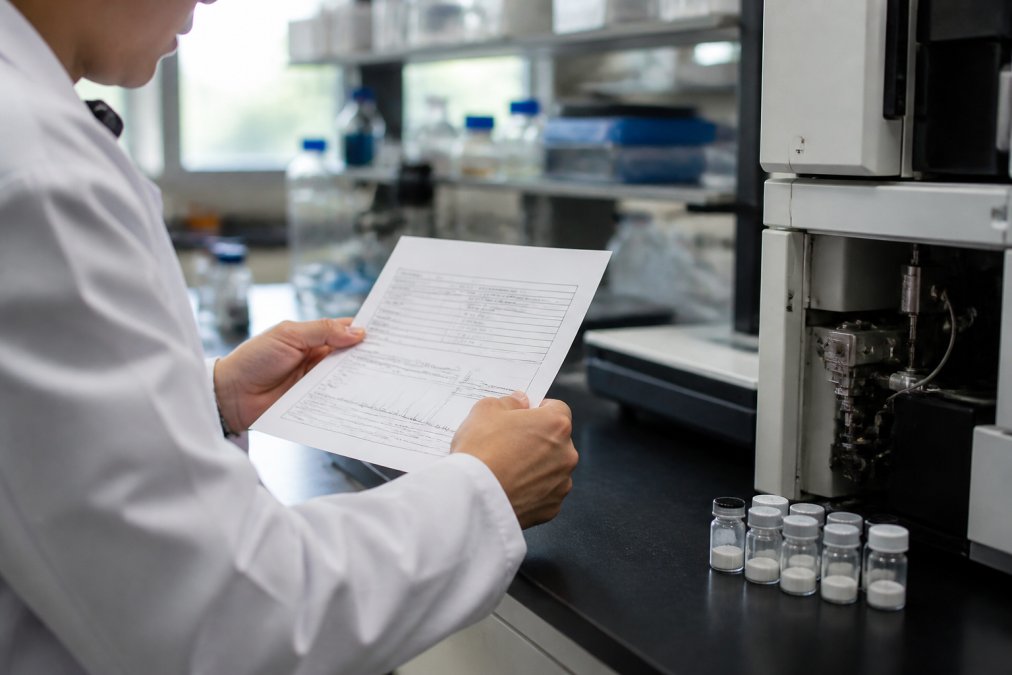
A peptide certificate of analysis is a lot-specific document recording identity, purity, and contamination results alongside the methods used. Reading it line by line separates suppliers who test from suppliers who claim.
HPLC and UPLC Results: Reading the Chromatogram
The chromatogram is where purity lives. High-performance liquid chromatography separates components by retention time, and the main peak's area relative to total peak area gives the purity figure. Ultra-performance liquid chromatography does the same with smaller particles and higher pressure, producing sharper peaks and better resolution in less time.
A single broad peak at 95% can hide co-eluting impurities a sharper method would resolve. Ask what column and detection wavelength were used; a purity number without that context is not comparable across suppliers.
Mass Spectrometry Data: Confirming Molecular Identity
Purity tells you how much of the material is your peptide; mass spectrometry tells you whether it is the right one. The observed mass-to-charge ratio must match the theoretical molecular weight calculated from the sequence, usually within a tight tolerance.
Sequence verification by mass spectrometry catches errors purity testing cannot: a truncated chain, missing residue, or incorrect amino acid substitution can all produce a clean-looking chromatogram. Any certificate reporting purity without mass confirmation is incomplete.
Acceptable Purity Levels for Research Peptides
Acceptable purity for research peptides typically falls between 95% and 98% for general work, with 98% or higher for sensitive assays where trace impurities could skew results. The right threshold depends on what you are measuring, not what sounds impressive.
| Research Application | Typical Purity Threshold | Why It Matters |
|---|---|---|
| General screening assays | 95% or higher | Tolerates minor impurities |
| Cell culture work | 98% or higher | Impurities can affect viability |
| Reference standards | 98% or higher | Comparability across batches |
| Structural studies | 98% or higher | Trace contaminants obscure data |
Endotoxin, Sterility, and Heavy Metal Testing Requirements
Contamination screening covers three separate risks, each with its own assay, units, and acceptance criterion. A certificate reporting a single "purity" figure without these panels answers a different question than your protocol asks.
Endotoxin Testing
Endotoxin is lipopolysaccharide (LPS) from gram-negative bacterial cell walls and the contamination most likely to silently ruin cell-based work. The standard method is the Limulus Amebocyte Lysate (LAL) assay, run as gel-clot (qualitative pass/fail), turbidimetric (kinetic, by increasing turbidity), or chromogenic (kinetic, by color development from a released chromophore).
Results are reported in endotoxin units per milligram (EU/mg) or EU/mL. For research-grade cell culture material, a common internal threshold is below 1 EU/mg, though the right limit depends on exposure level and assay sensitivity (the FDA). The FDA's 1987 LAL validation guideline (21 CFR 610.12 context) and USP Chapter <85> Bacterial Endotoxins Test are the reference standards most labs work against. A certificate reporting "endotoxin: pass" without a method, unit, or numeric result cannot be compared to any other batch.
Sterility and Bioburden Testing
Sterility testing confirms the absence of viable microorganisms. USP Chapter <71> Sterility Tests is the reference method, using direct inoculation into growth media or membrane filtration followed by incubation. For non-sterile research-grade peptides, the relevant test is often bioburden (USP <61> and <62>), which quantifies total aerobic microbial count and screens for organisms like E. coli, Salmonella, and Pseudomonas aeruginosa.
Bioburden is reported in colony-forming units per gram (CFU/g). A typical research-grade criterion is under 100 CFU/g with absence of specified pathogens, but the number that matters is what your protocol requires. Sterility testing takes 14 days for a full incubation cycle, which is why many suppliers skip it on research-grade lots, ask whether the panel was run at all.
Heavy Metal and Elemental Impurity Profiling
The current standard for elemental impurities is USP <232> (limits) and <233> (procedures), replacing the older <231> sulfide precipitation method (usp.org). The modern approach uses inductively coupled plasma mass spectrometry (ICP-MS) or optical emission spectrometry (ICP-OES) to quantify residual catalysts and environmental contaminants.
Class 1 elements (arsenic, cadmium, mercury, lead) are the highest concern because they are human toxicants with no therapeutic benefit. Class 2A elements (cobalt, nickel, vanadium) are also monitored because they appear in synthesis catalysts. Results are reported in parts per million (ppm) or micrograms per gram (µg/g), with USP <232> permitted daily exposure (PDE) limits as reference thresholds. A certificate reporting heavy metals as "none detected" without naming the method and detection limit is not a result, it is a claim.
What a Complete Contamination Panel Looks Like
A defensible certificate for cell-culture-grade material should report, at minimum: endotoxin in EU/mg with the LAL method named, bioburden in CFU/g with the incubation method named, and heavy metals in ppm with the instrument named and detection limits stated. If any of those three is missing, you are accepting an incomplete risk picture, acceptable for basic structural work, not for living cells, long-term stability studies, or downstream assays where one contaminated batch invalidates months of work.
Research-Grade vs. Therapeutic-Grade: What the Labels Mean
Research-grade material is manufactured and tested for laboratory use only.
What Changes at the Therapeutic Grade
The Accreditation Question
GLP Compliance and What It Actually Requires
Chain of Custody: The Documentation Competitors Skip
Peptide Content vs. Purity: The Number Most Labs Misread
What to Ignore When Comparing Peptide Testing Standards
Frequently Asked Questions
What is the most accurate lab test for peptide purity?
Reverse-phase HPLC paired with mass spectrometry is the standard combination. HPLC separates the peptide from impurities and degradation products based on retention time, while MS confirms the molecular weight matches the expected mass-to-charge ratio. Neither test alone is enough. HPLC tells you how much is there; MS tells you what it is. A CoA that reports only one of the two leaves a gap in sequence verification.
What is a good purity level for peptides?
For most research applications, 95% or higher by HPLC is the accepted floor. Peptides used in sensitive assays or reference standards often require 98% or above. The right target depends on your assay sensitivity. If your experiment can tolerate trace impurities, 95% works. If you are running quantitative work or calibrating instruments, push for 98%+ and confirm the impurity profile looks clean.
Why is HPLC and mass spectrometry critical for peptide verification?
HPLC and mass spectrometry cover two different failure modes. HPLC catches poor synthesis, truncated sequences, and degradation products by measuring chromatographic resolution and retention time. Mass spectrometry catches misidentified or misfolded material by verifying the molecular weight. Without both, a certificate of analysis can show high purity on a peptide that is not the compound you ordered.
What is considered an acceptable purity level for research peptides?
The common benchmark is 95% minimum by HPLC, with 98% or higher for reference-grade work. Anything below 95% introduces too much variability for reproducible results. When evaluating a supplier, check whether the CoA reports both the purity percentage and the analytical method used. An unverified purity claim without a chromatogram attached is not a standard; it is a marketing line.
Verifying peptide testing standards for labs is not optional if your results need to hold up to scrutiny. Frontline Peptides supplies third-party tested research compounds with lot-specific documentation, competitive pricing, and fast shipping, backed by a team that answers real questions about certificates and content figures. Get started with Frontline Peptides and put a verifiable testing chain behind every batch you run.