

Table of Contents
- Why Peptide Purity Matters for In Vivo Research
- Defining Peptide Purity Levels and Thresholds
- Impact of Peptide Impurities on Biological Activity
- Peptide Purity Analysis Methods and Verification
- Research-Grade vs Clinical-Grade Peptides
- Batch Consistency and Reproducibility in In Vivo Studies
- Storage, Stability, and Peptide Degradation
- Troubleshooting Failed In Vivo Studies
- Frequently Asked Questions
Last Updated: October 4, 2026
Why Peptide Purity Matters for In Vivo Research
When in vivo studies fail, impure peptides are often the culprit, contaminating results before the experiment begins. Research teams frequently spend months troubleshooting failed studies only to discover their peptide source was the problem.
Peptide purity requirements for in vivo studies are hard biological constraints, not vendor pricing justifications. Truncated sequences, counter-ions, and synthesis byproducts interfere with receptor binding, trigger immunological responses, and compromise bioavailability, making results unreproducible and invalid.
In living systems, peptides encounter complex biological matrices, metabolic degradation, and immune recognition. Low-purity peptides fail silently, producing false positives or masking real activity, either way, conclusions are wrong.
Defining Peptide Purity Levels and Thresholds
Peptide purity exists on a spectrum; the grade you choose determines whether your results are valid.
Crude, Desalted, and HPLC-Purified Peptides
Crude peptides (30-60% purity) contain truncated sequences and synthesis intermediates. Legitimate only for library screening. For in vivo work, crude peptides are disqualifying, you cannot attribute biological responses to your target sequence.
Desalted peptides (70-85% purity) remove salts but leave truncated sequences intact. Suitable for preliminary in vitro screening only; truncated sequences create too much biological noise for in vivo work requiring clean dose-response relationships.
HPLC-purified peptides (90-98% purity) isolate your target sequence from truncated variants and byproducts. This is the minimum acceptable grade for in vivo work; the cost difference from desalted material is the cost of experimental validity.
Minimum Purity Standards for In Vivo Work
For standard in vivo studies, target 95% purity minimum, high enough to eliminate truncated sequence interference, yet achievable through routine HPLC.
For immunology studies or known immunological epitopes, push to 98% purity. A 3% contamination in a 10 mg dose means 300 micrograms of unknown sequences circulating, enough to become the signal in immune readouts.
For GLP-compliant or clinical-grade work, 99% purity is standard. If your work will support pharmaceutical filing, start with GLP-grade material from the beginning to avoid redoing studies later.
FDA guidance on analytical methods for drug characterization
Impact of Peptide Impurities on Biological Activity
This is where purity stops being abstract and becomes a practical problem in your data.
How Truncated Sequences and Counter-Ions Affect Results
Truncated sequences are byproducts of incomplete coupling during synthesis. A 15-amino acid peptide might contain 2-5% 14-amino acid truncations; in crude material, truncations can represent 20-40% of total mass.
Truncated sequences often retain partial biological activity (e.g., 40% affinity of full sequence). In vivo, they create secondary dose-response curves, producing biphasic kinetics or unexpected plateaus that don't match in vitro data, leading to weeks of misdiagnosed troubleshooting.
Counter-ions are equally problematic. A peptide 95% pure by mass might be 92% pure by molar count if it contains 5% residual TFA.
Toxicological and Bioavailability Concerns
Truncated sequences have uncharacterized toxicological profiles. A 3% contamination with aggregating truncations could trigger unexpected immune responses or off-target binding your primary peptide doesn't exhibit.
Truncated sequences degrade faster in serum than full-length peptide, creating a moving target for pharmacokinetic modeling. Measured half-life reflects a mixture of target and truncations, biasing tissue exposure estimates low and preventing doses from reaching target tissue.
High TFA content increases hydrophilicity, reducing CNS penetration. Brain-targeted models may fail not because the peptide doesn't work, but because impurities blocked tissue access.
Peptide Purity Analysis Methods and Verification
Knowing your peptide is pure requires measurement. The Certificate of Analysis is only as good as the methods behind it.
High-Performance Liquid Chromatography (HPLC)
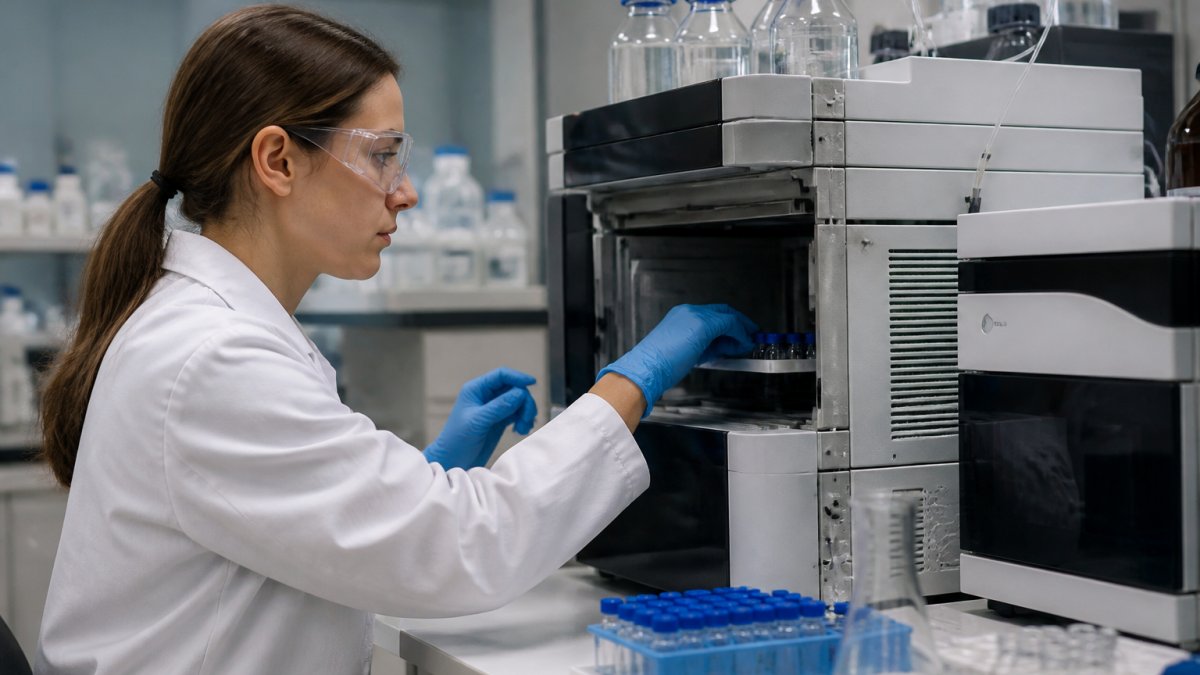
HPLC is the gold standard for peptide purity assessment, separating target peptide from truncations and byproducts using C18 reversed-phase columns with acetonitrile gradients. Detection occurs at 214 nm (peptide bonds) or 280 nm (aromatic amino acids).
Critical detail: HPLC purity is mass percentage, not molar percentage. A 95% pure peptide by mass might contain 5% counter-ions. Reputable suppliers report both mass and molar purity or specify counter-ion content separately. If CoA lists only mass purity, request molar percentage and counter-ion composition.
Mass Spectrometry and Molecular Weight Confirmation
Mass spectrometry confirms your peptide is the correct sequence. HPLC shows a dominant peak; mass spec confirms that peak is the correct molecular weight using ESI or MALDI.
ESI-MS is more quantitative for multiple charge states; MALDI-MS is faster and better for detecting modifications or unexpected truncations.
The Certificate of Analysis should list observed molecular weight and the theoretical value. A deviation greater than 0.1% suggests synthesis error or contamination. For in vivo work, this is a red flag. Request a full mass spectrum, not just the reported m/z value.
Certificate of Analysis and Third-Party Validation
A complete Certificate of Analysis (CoA) includes: peptide sequence and molecular weight (theoretical and observed), HPLC purity (mass and molar percentage), counter-ion and residual solvent content, mass spectrometry confirmation, batch number, synthesis date, and storage conditions.
Third-party validation matters. Independent testing labs have no financial incentive to report optimistic values. Frontline Peptides provides third-party tested products with complete analytical documentation.
Before accepting a shipment, verify the CoA matches specifications. Confirm HPLC shows a single dominant peak and mass spec confirms molecular weight within 0.1%. Do not use material with missing or incomplete CoA in in vivo studies.
USP Chapter 621 on chromatography standards
Research-Grade vs Clinical-Grade Peptides
The difference between research-grade and clinical-grade peptides isn't just purity, it's documentation and consistency.
Immunological Grade and GLP Compliance
Clinical-grade peptides are manufactured under GLP conditions with batch-to-batch consistency, comprehensive analytical testing, and documented chain of custody. Every batch is independently tested; analytical data is retained for years.
Research-grade peptides are pure enough for scientific work, but manufacturing may vary between batches. Documentation is retained but not to regulatory standards.
Immunological grade is clinical-grade material tested for endotoxin, sterility, and immunogenic contaminants. Recommended for immune-focused studies or immunocompromised animals.
For most academic in vivo studies, research-grade HPLC-purified peptides (95%+ purity) suffice. For regulatory filings or clinical translation, start with GLP-grade material to avoid costly redoing studies later.
Documentation and Batch Consistency Requirements
Peer-reviewed journals require Methods sections to specify peptide purity and source. Reviewers increasingly request CoA documentation; missing documentation risks rejection or major revisions.
Batch-to-batch variation in purity or counter-ion content can shift dose-response curves enough to make replication appear to fail. Document batch numbers for every study and include them in supplementary materials so other labs can verify they're using identical material.
Batch Consistency and Reproducibility in In Vivo Studies
Reproducibility is the foundation of scientific validity. Batch-to-batch variation in peptide purity is a hidden reproducibility killer.
Consider a hypothetical study: you test a 10 mg/kg dose of a peptide and observe a 35% reduction in tumor growth. You publish. Another lab attempts replication with a different batch from the same supplier and observes only 15% reduction.
This scenario is common. Most labs don't investigate batch purity differences as a source of replication failure. They assume experimental technique varies. Often, it's the peptide.
Reputable suppliers maintain batch-to-batch consistency through validated manufacturing processes and comprehensive analytical testing. Frontline Peptides documents every batch and maintains standard operating procedures to minimize variation.
Storage, Stability, and Peptide Degradation
Peptide stability begins the moment synthesis ends.
Peptides are stable as lyophilized powders at room temperature for years, but only if they're protected from moisture and light.
Storage at 4°C extends solution stability to weeks. Freezing at -20°C extends it to months. For long-term storage of reconstituted peptides, -80°C or lyophilization is necessary.
Lyophilized peptides should be stored in sealed vials under inert atmosphere (nitrogen or argon) to prevent oxidation.
Prepare fresh solutions immediately before in vivo administration when possible. If you must prepare solutions in advance, freeze them and thaw only once before use.

Peptide storage best practices from the American Peptide Society
Troubleshooting Failed In Vivo Studies
When your in vivo study produces unexpected results, peptide purity is a diagnostic tool, not just a preventive measure.
If your dose-response curve is flat when in vitro data predicts clear activity, check peptide purity first.
If your results show high variability between animals despite identical dosing, batch heterogeneity is a likely culprit.
If your assay shows biphasic kinetics or unexpected plateau effects, truncated sequences are a strong hypothesis.
Frontline Peptides provides complete analytical documentation with every order, making it straightforward to trace purity back to batch specifications.
Reproducibility in in vivo research depends on controlling every variable, including the ones that seem minor.
| Purity Grade | HPLC Purity Range | Best Use | In Vivo Suitability |
|---|---|---|---|
| Crude | 30-60% | Library screening only | Not suitable |
| Desalted | 70-85% | In vitro preliminary screening | Marginal, not recommended |
| HPLC-purified (standard) | 90-98% | Most in vivo studies | Suitable (95%+ minimum) |
| GLP-grade | 99%+ | Clinical translation, regulatory filings | Suitable (required for pharma) |
| Immunological grade | 99%+ | Immune-focused studies, immunocompromised models | Suitable (recommended for immune work) |
Frequently Asked Questions
What is the minimum purity level required for in vivo peptide studies?
Most in vivo studies require peptides at 90-95% purity as a baseline, with 95% or higher recommended for rigorous pharmacokinetic and efficacy research. The exact threshold depends on your study design, animal model, and regulatory requirements. Higher purity reduces confounding variables from impurities and improves assay sensitivity. Always verify your specific protocol requirements and consult your institutional review board or regulatory guidance before purchasing peptides for in vivo work.
How do impurities in research peptides affect in vivo results?
Peptide impurities, including truncated sequences, trifluoroacetic acid residues, and counter-ion content, can trigger unintended immune responses, reduce bioavailability, and introduce toxicological effects that skew your data. Even small impurity percentages can dominate results in sensitive receptor binding assays or in vivo experiments. Contaminant profiles directly impact experimental validity, making it impossible to isolate the true biological activity of your target peptide. This is why third-party analytical verification is critical for reproducible research.
What are the common methods for verifying peptide purity?
High-performance liquid chromatography (HPLC) is the gold standard for peptide purity analysis, separating compounds by molecular properties and quantifying purity percentage. Mass spectrometry confirms molecular weight and identifies unexpected impurities. Together, these analytical methods provide a complete contaminant profile and verify peptide sequence integrity. A Certificate of Analysis from a reputable supplier documents these results. Always request and review the CoA before use to confirm batch consistency and analytical verification meet your study requirements.
How do research-grade and clinical-grade peptides differ in purity standards?
Research-grade peptides typically meet 90-98% purity standards and require standard analytical documentation via HPLC and mass spectrometry. Clinical-grade (or GLP-grade) peptides must exceed 99% purity, include extensive batch consistency records, and comply with Good Laboratory Practice standards and quality control procedures. Clinical-grade also requires detailed stability data, lyophilization documentation, and third-party validation. For in vivo studies with regulatory intent or pharma partnerships, clinical-grade compounds ensure the documentation and reproducibility needed for compliance.
Why is a Certificate of Analysis important for in vivo research?
A Certificate of Analysis (CoA) provides third-party verification of peptide purity percentage, molecular weight confirmation, and contaminant profiles specific to your batch. It documents the analytical methods used (HPLC, mass spectrometry) and serves as proof of quality control standards. For reproducible in vivo studies, the CoA allows you to identify batch-to-batch variability, troubleshoot failed experiments, and defend your results to peer reviewers. Always request the CoA before purchase and verify it matches your purity requirements and study protocol.
Can peptide degradation during storage affect my in vivo study results?
Yes. Peptide degradation increases impurity levels over time, reducing effective purity and introducing unpredictable contaminant profiles that compromise experimental validity. Proper storage at recommended temperatures (typically 2-8°C or -20°C depending on formulation) and protection from light and moisture slows degradation. Lyophilized peptides are more stable than liquid formulations. Always check the stability data in the CoA, store peptides according to supplier instructions, and use them within the recommended shelf life to maintain batch consistency and assay sensitivity in your in vivo work.
What should I do if my in vivo study produces unexpected or failed results?
Start by reviewing your peptide's Certificate of Analysis to confirm purity percentage and check for unexpected impurities or counter-ion content that could explain the failure. Verify storage conditions and shelf life, peptide degradation is a common culprit. Confirm batch consistency by comparing your CoA to previous batches. If purity is below 95%, consider re-running with higher-purity material from a third-party validated supplier. Document all findings and consider consulting with your supplier's technical support to rule out handling or preparation errors before redesigning your protocol.