

Table of Contents
- What Peptide Purity Actually Means
- HPLC vs Mass Spectrometry for Peptides: Which Test Does What
- How to Read a Peptide COA Step by Step
- Why Third-Party Peptide Testing Labs Matter
- Visual Inspection and Home Testing: What They Can and Cannot Tell You
- Common Adulterants and Contaminants to Watch For
- How to Verify Peptide Purity Before You Order
- Frequently Asked Questions
Last Updated: August 31, 2026
What Peptide Purity Actually Means
Peptide purity is the percentage of the target peptide present in a sample relative to all other substances, including truncated sequences, deletion products, oxidized variants, and residual solvents. A synthetic peptide labeled "95% pure" means 95% of the material corresponds to the correct sequence with the correct molecular weight. The remaining 5% is everything else.
This distinction matters significantly. A peptide with incorrect purity can skew dose-response curves, introduce biological noise into cell assays, or produce results that cannot be replicated.
Understanding Purity Percentages
Purity percentages are reported as area percentage from HPLC chromatogram data. The main peak area is divided by the total integrated area of all detected peaks, then multiplied by 100. This is not the same as mass purity or biological activity. A peptide can have high HPLC purity and still contain endotoxins or heavy metals that chromatographic methods do not detect.
Research-grade peptides for in vitro applications typically require purity at or above a defined threshold. Always match the purity specification to the sensitivity of your assay.
Common Impurities Found in Synthetic Peptides
Synthetic peptides carry a characteristic impurity profile reflecting solid-phase synthesis chemistry. The most common contaminants include:
- Deletion sequences: Peptides missing one or more amino acids due to incomplete coupling
- Truncated sequences: Shorter chains from premature synthesis termination
- Oxidized residues: Methionine and cysteine oxidation during synthesis and storage
- Acetylated or deprotected side chains: Residual protecting groups not fully removed
- Residual solvents: Trifluoroacetic acid and acetonitrile from synthesis and purification
- Heavy metals: Trace contamination from reagents or equipment
Understanding likely impurities for a given sequence helps you know which tests to request and which COA fields to scrutinize.
HPLC vs Mass Spectrometry for Peptides: Which Test Does What
Most researchers treat HPLC and mass spectrometry as interchangeable quality checks. They are not. Each method answers a fundamentally different question, and a COA including only one tells you half the story.
| Test | What It Measures | What It Cannot Confirm |
|---|---|---|
| HPLC | Purity percentage by peak area | Correct molecular identity |
| Mass Spectrometry | Molecular weight (identity) | Relative abundance of impurities |
| Both combined | Purity and identity | Endotoxins, heavy metals, residual solvents |
How HPLC Measures Purity
High-Performance Liquid Chromatography is the standard method for quantifying peptide purity. The sample is dissolved and injected into a column where components separate based on their interaction with the stationary phase. A UV detector measures absorbance as each component elutes, and software integrates the area under each peak.
The main peak area as a percentage of total peak area is the key metric. A well-run HPLC analysis reports retention time, which should be consistent across batches for the same peptide. Baseline noise, peak symmetry, and shoulder peaks indicate sample quality beyond the summary percentage.
One limitation: HPLC purity is measured at a specific UV wavelength, usually 214 nm or 220 nm, which detects the peptide bond. Impurities absorbing poorly at that wavelength can be underrepresented in the purity calculation. This is a constraint you must account for when interpreting results.
How Mass Spectrometry Confirms Molecular Identity
Mass spectrometry answers a question HPLC cannot: is the molecule in the vial actually the peptide you ordered? The instrument ionizes the sample and measures the mass-to-charge ratio. Comparing the observed molecular weight against the theoretical molecular weight confirms identity.
For synthetic peptides, electrospray ionization is most common. A match within acceptable tolerance confirms the correct sequence was synthesized. A discrepancy points to a synthesis error, wrong product, or significant modification.
A critical insight: a sample can show a clean HPLC chromatogram with a single dominant peak and still be the wrong peptide. Mass spectrometry is the only routine analytical chemistry method that catches this. According to FDA guidance on analytical procedures for pharmaceutical testing, identity testing and purity testing serve distinct validation purposes and should not be conflated.
How to Read a Peptide COA Step by Step
A Certificate of Analysis connects a specific batch of peptide to its analytical testing results. Reading one correctly is a skill, and a fraudulent or incomplete COA is easier to spot than most researchers expect.
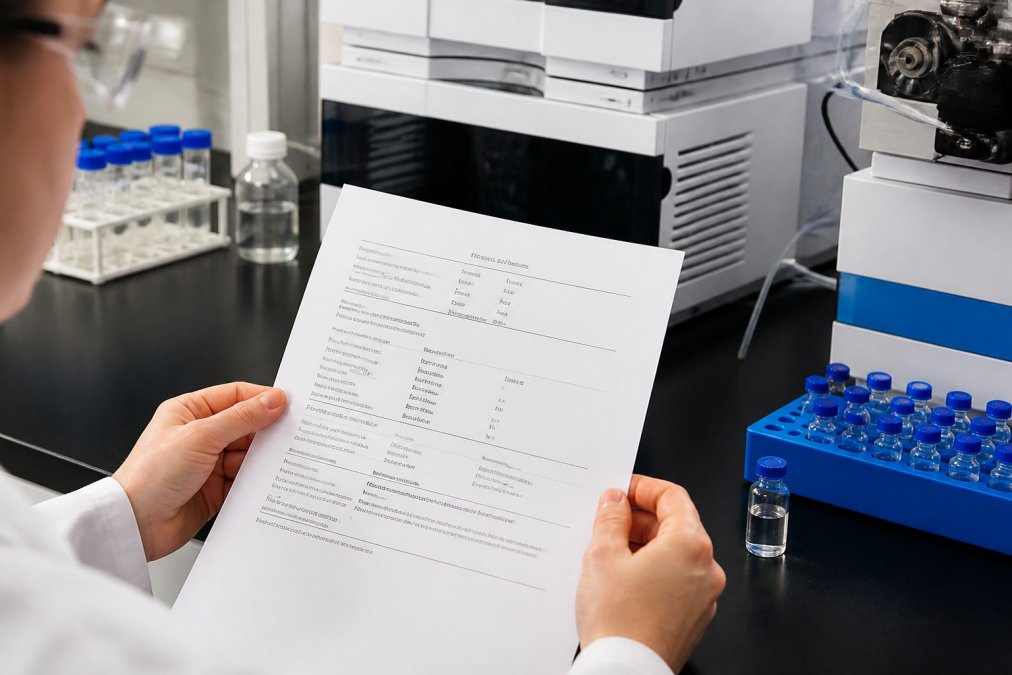
Key Fields on a COA and What They Tell You
Work through a COA in this sequence:
- Batch or lot number: Every legitimate COA is tied to a specific production batch. A generic COA with no lot number is not batch-specific.
- Peptide sequence and molecular formula: Confirm these match your order exactly, including any modifications such as amidation or acetylation.
- Theoretical molecular weight vs. observed molecular weight: The MS result should show observed mass alongside calculated theoretical mass. A match within 0.1 Da is standard.
- HPLC purity percentage: Look for the main peak area percentage and the chromatogram itself, ideally included or available on request.
- Analytical method details: The COA should specify HPLC column type, mobile phase, gradient, and detection wavelength. Absence of method details is a red flag.
- Testing date and expiration: Confirm analysis was performed on the actual batch, not recycled from a previous run.
- Endotoxin testing result: Essential for any in vivo application. Endotoxin contamination is invisible to HPLC and mass spectrometry.
Red Flags That Indicate a Fraudulent or Incomplete COA
Common signs of a problematic COA include a missing lot number, purity values without a supporting chromatogram, mass spectrometry data showing only a single m/z value with no isotope pattern, and testing dates predating batch production. Be skeptical of COAs listing suspiciously round purity numbers like exactly 99.0% with no decimal variation across multiple products.
Legitimate COAs reflect natural analytical measurement variability. Real data has decimal places, batch-specific retention times, and method-specific detection limits.
Why Third-Party Peptide Testing Labs Matter
Third-party testing is the single most important quality assurance factor for any research peptide purchase. An in-house COA produced by the synthesizing organization carries an inherent conflict of interest. Third-party labs have no financial stake in the outcome and their results are more credible.
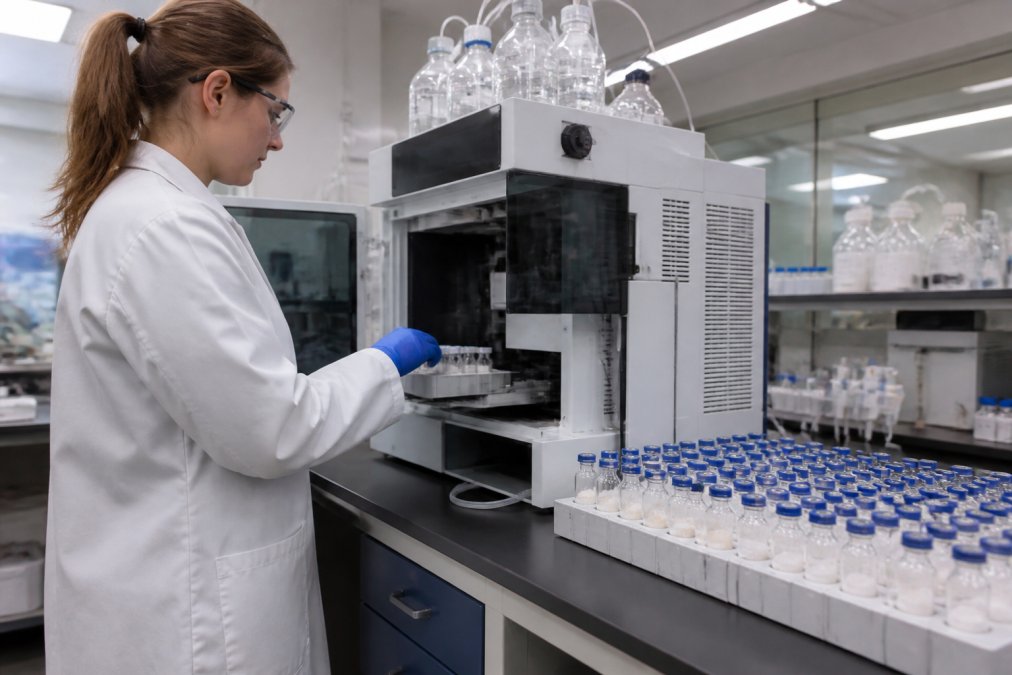
Third-party labs operate under standardized quality control frameworks. Many are accredited to ISO/IEC 17025 general requirements for testing and calibration laboratories, which sets requirements for competence, impartiality, and consistent operation. Accreditation means the lab's methods have been independently validated and results carry a traceable chain of custody.
For peer-reviewed studies, the provenance of analytical data matters. A COA from an accredited third-party lab is defensible. An in-house certificate is not. Frontline Peptides provides third-party tested products because independent verification is what qualified researchers require for reproducible science.
Visual Inspection and Home Testing: What They Can and Cannot Tell You
Visual inspection is the most widely used and least reliable method for assessing peptide quality. Lyophilized peptides typically appear as white to off-white powders. Color variation, clumping, or unusual odor can indicate degradation or contamination, but their absence tells you almost nothing about purity or identity.
A sample can look perfectly normal and be the wrong peptide, contain significant impurities, or be contaminated with endotoxins. Visual inspection is a screening step, not a quality test.
Home testing options are similarly limited. Colorimetric tests can confirm the presence of certain amino acid classes but cannot quantify purity or confirm sequence identity. Portable UV spectrophotometers can measure absorbance, but without a reference standard and controlled environment, results are not comparable to laboratory-grade spectrophotometry.
Visual inspection and home testing are useful for detecting obvious problems, but they cannot substitute for HPLC and mass spectrometry data. Any researcher making decisions based solely on appearance is working without adequate information.
Common Adulterants and Contaminants to Watch For
The impurity profile of a research peptide depends on its source and manufacturing. Beyond synthesis-related impurities, broader categories of adulterants and contaminants can enter the supply chain.
Common adulterants in low-quality peptide products include:
- Mannitol and other excipients: Added as bulking agents, inflating apparent mass without increasing active content
- Albumin or other proteins: Used to pad weight, detectable by protein assays but not always by standard HPLC
- Unrelated peptides or amino acids: Substituted for the target sequence
- Endotoxins: Bacterial cell wall components causing inflammatory responses; require Limulus Amebocyte Lysate testing
- Heavy metals: Lead, arsenic, and cadmium from synthesis reagents; require inductively coupled plasma mass spectrometry
- Residual solvents: Trifluoroacetic acid residues affecting cell-based assays; detectable by ion chromatography or nuclear magnetic resonance
According to USP general chapter on residual solvents in pharmaceutical products, residual solvent limits are defined by toxicological risk class and apply directly to research-grade synthetic peptides used in biological assays.
How to Verify Peptide Purity Before You Order
Verifying peptide purity before committing to a purchase is a structured process. Use this sequence:
- Request the COA for the specific batch you will receive, not a sample COA or generic certificate.
- Confirm HPLC data is present, including purity percentage, chromatogram or summary, retention time, and analytical method.
- Confirm mass spectrometry data is present, with observed molecular weight compared against theoretical value.
- Check the third-party lab name and accreditation status. Search independently to verify existence and relevant accreditation.
- Review endotoxin testing results if your application involves cell-based or in vivo work.
- Assess batch consistency by comparing the current COA against previous batch COAs. Significant variation signals a manufacturing standardization problem.
- Evaluate supplier transparency. A supplier making COAs available before purchase and answering specific questions about analytical methods demonstrates the quality control culture that produces reliable products.
Frontline Peptides makes third-party COA data available to researchers, reflecting our commitment to the transparency that qualified research demands. For researchers on tight timelines, verifying documentation before ordering prevents delays from receiving an unusable product.
| Verification Step | What It Confirms | Can Be Done Pre-Order |
|---|---|---|
| Review HPLC COA | Purity percentage and chromatogram | Yes |
| Review MS data | Molecular identity | Yes |
| Check third-party lab accreditation | Independent validation | Yes |
| Confirm endotoxin results | Biological safety | Yes |
| Request batch-specific documentation | Lot-level traceability | Yes |
| Compare batch consistency | Manufacturing standardization | Yes, if prior COAs available |
How to verify peptide purity before you order ultimately comes down to documentation quality and supplier transparency. A supplier that cannot provide complete, batch-specific, third-party analytical data before purchase is not a supplier whose products belong in rigorous research.
Research integrity depends on compound integrity. When source material is unreliable, every downstream result is suspect. Frontline Peptides addresses this directly with rigorously third-party tested products, batch-specific COA documentation, and a U.S.-based team available to answer technical questions about testing methods, purity specifications, and documentation requirements. Researchers who need verified compounds on tight timelines can rely on our fast shipping and exceptional customer service to keep projects moving. Visit Frontline Peptides to review current product listings and documentation standards before your next order.
Frequently Asked Questions
How do I know if my peptides are pure?
The most reliable way to confirm peptide purity is to review a Certificate of Analysis (COA) from an independent, third-party laboratory. A valid COA will include an HPLC chromatogram showing the main peak area and purity percentage, along with a Mass Spectrometry result confirming the correct molecular weight. Without both tests documented, there is no reliable way to confirm what you actually have.
What is a Certificate of Analysis (COA) for peptides?
A COA is a formal document issued by an analytical laboratory that records the test results for a specific peptide batch. For research peptides, a complete COA should include the HPLC purity percentage, the chromatogram showing peak integration, the Mass Spectrometry result verifying molecular weight, and ideally results for endotoxins, residual solvents, and heavy metals. The COA should reference the batch number, the testing date, and the name of the laboratory that performed the analysis.
Is there a way to test peptide purity at home?
No reliable home-testing method exists for verifying peptide purity. Visual inspection of lyophilized powder can reveal obvious contamination such as unusual color or clumping, but it cannot detect chemical impurities, incorrect molecular weight, or low-level contaminants. Accurate purity verification requires HPLC and Mass Spectrometry instruments found only in certified analytical chemistry laboratories. Researchers should always rely on supplier-provided third-party COAs rather than attempting home-based verification.
Why is third-party testing important for research peptides?
Third-party testing removes the conflict of interest that exists when a supplier tests its own products. An independent laboratory has no financial incentive to report favorable results, which makes its COA far more credible than in-house data. For researchers running peer-reviewed studies or working toward GLP compliance, third-party validation is often a documentation requirement. It also provides batch-to-batch consistency data, which is critical for reproducing experimental results across multiple runs.