

Table of Contents
- Why the Certificate of Analysis Is Your First Line of Defense
- Anatomy of a Peptide COA: What Each Section Actually Means
- Peptide HPLC vs Mass Spectrometry: Reading Both Correctly
- How to Verify Peptide Purity: A Step-by-Step Workflow
- Identifying Fake Peptide Testing Reports: Red Flags
- Lab Accreditation and Storage: What the COA Does Not Tell You
- Conclusion: Building a Verification Habit
- Frequently Asked Questions
Last Updated: September 6, 2026
A Certificate of Analysis is the single most important quality document attached to any research peptide, yet most researchers only glance at the purity number before reconstituting. Learning how to read peptide certificates of analysis properly separates rigorous science from guesswork, and it is the only way to confirm that the lyophilized powder in your vial matches what the supplier claims. At Frontline Peptides, we provide third-party tested products precisely because we know that a COA is only as valuable as your ability to interpret it. We ensure reliability and precision in your work through rigorously third-party tested products, delivering the confidence you need for scientific advancement. This guide walks through every section of a peptide COA, explains the analytical methods behind the numbers, and shows you how to spot documents that look legitimate but are not.

The stakes are practical, not theoretical. A peptide with a purity percentage that looks acceptable can still contain truncated sequences, residual trifluoroacetic acid (TFA), or elevated endotoxin levels that compromise your experimental data. Below, we break down the document line by line, then give you a repeatable verification workflow you can apply to any COA from any supplier.
Why the Certificate of Analysis Is Your First Line of Defense
A peptide certificate of analysis is the documented result of analytical testing performed on a specific batch, and it serves as the primary evidence that a product meets its stated specifications for identity, purity, and content. It is the only document that connects the physical vial in your hand to verifiable laboratory data. Without it, you are relying entirely on the supplier's word, which is not a sound basis for research involving controlled experiments.
The document works as a chain of custody. It links a unique batch number printed on the vial to a set of test results generated by an analytical method such as High-Performance Liquid Chromatography (HPLC) or Mass Spectrometry (MS). Each test answers a different question: HPLC measures how much of the sample is the target peptide, while MS confirms that the molecule present has the correct molecular weight for the claimed amino acid sequence. Reading both together gives you confidence that the product is both pure and correctly identified.
Most suppliers publish COAs, but the level of scrutiny applied to those documents varies enormously. A common mistake is accepting a COA at face value without checking whether the batch number on the document matches the batch number on the vial. Another is ignoring the impurity profile entirely, which can hide significant amounts of related substances that HPLC purity alone does not reveal.
Anatomy of a Peptide COA: What Each Section Actually Means
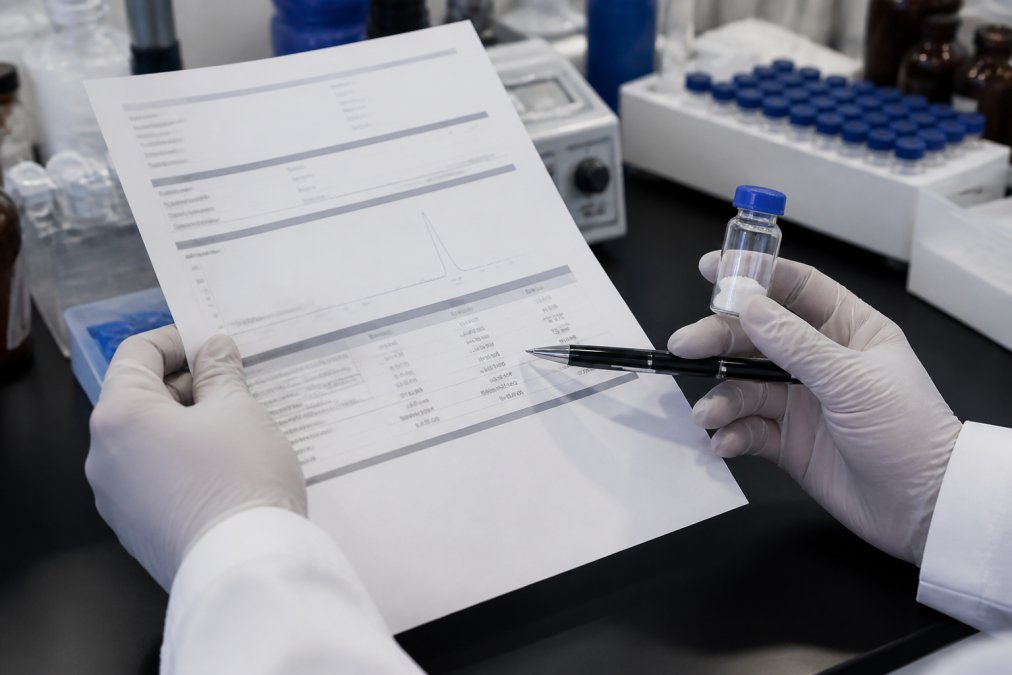
Standard peptide COAs share a common structure regardless of which laboratory produced them. Once you learn the layout, you can scan any document quickly and focus your attention on the fields that matter most. The document header typically lists the supplier, the product name, the batch number, the date of analysis, and the analytical methods used.
The body of the COA contains the test results organized by analytical method. Each result should include the specification, the measured value, and a pass or fail designation. The specification is the acceptance criteria set by the manufacturer, while the measured value is what the laboratory actually found. A result that passes specification means the batch met the predetermined quality threshold for that test.
Product Identity and Batch Number
The batch number, sometimes called the lot number, is the unique identifier that ties the COA to a specific production run. Every vial from that batch should carry the identical number, and it must match the number printed on the COA. Discrepancies here are an immediate red flag, because they indicate the document may have been reused for a different batch or generated without actual testing.
Product identity on a COA should state the full peptide name and often includes the molecular formula and the amino acid sequence. The sequence is critical because it defines the peptide itself. A COA for BPC-157, for example, should list the exact sequence of amino acids that constitutes that peptide. If the sequence is absent or abbreviated in a way that prevents verification, treat the document with suspicion.

Purity Percentage and Impurity Profile
The purity percentage is the headline number on most COAs, but it deserves more context than most researchers give it. HPLC purity is expressed as a percentage of the total peak area in the chromatogram, which means it measures relative purity, not absolute purity. A peptide reported at 98% HPLC purity contains approximately 2% other components that elute within the analytical window (PubMed).
The impurity profile provides detail on what those other components are. Common impurities include truncated peptides from incomplete synthesis, deletion sequences, oxidation products, and residual solvents. Acetate content and trifluoroacetic acid (TFA) counterion levels are often reported separately because they affect the actual peptide content by weight. A peptide that is 98% pure by HPLC can still have a significant mass of TFA or water, which changes how much peptide you are actually weighing when you reconstitute the vial.
Peptide HPLC vs Mass Spectrometry: Reading Both Correctly
Understanding the difference between peptide HPLC vs mass spectrometry is essential because the two methods answer different questions and neither alone is sufficient. HPLC provides quantitative analysis of purity, while mass spectrometry provides qualitative analysis of identity. A COA that includes both methods offers far stronger evidence of product quality than one relying on a single technique.
Understanding HPLC Purity Data
High-Performance Liquid Chromatography separates the components of a sample based on their interaction with a stationary phase. The resulting chromatogram displays peaks, where each peak represents a distinct component eluting at a specific retention time. The area under each peak correlates with the relative abundance of that component.
The purity percentage is calculated by peak integration, which sums the area of the main peptide peak and divides it by the total area of all peaks. When reading HPLC data, check that the main peak is sharp and symmetrical rather than broad or split, which can indicate degradation or co-eluting impurities. The retention time should be consistent with the reference standard for that peptide, and the chromatogram should be clean enough that the main peak dominates the profile.
Interpreting Mass Spectrometry and Molecular Weight
Mass spectrometry confirms that the molecule in the sample has the molecular weight expected for the claimed peptide. The peptide is ionized and its mass-to-charge ratio is measured, producing a mass spectrum with peaks corresponding to different charge states of the molecule.
The key value to check is the observed molecular weight against the theoretical molecular weight calculated from the amino acid sequence (peer-reviewed research). A close match, typically within one atomic mass unit, confirms the identity of the peptide. A significant deviation suggests the wrong peptide, a major impurity, or a synthesis error. The mass spectrometry section of a COA should report both the calculated and the observed molecular weight, and the two should align closely.
How to Verify Peptide Purity: A Step-by-Step Workflow
Verifying peptide purity is a systematic process that takes about five minutes once you know what to look for. Apply this workflow to every COA before you reconstitute a vial:
- Confirm the batch number on the COA matches the batch number printed on the vial label exactly. Any mismatch means the document does not apply to your product.
- Check the product name and amino acid sequence on the COA against the product you ordered. Verify the sequence matches the published literature for that peptide.
- Review the HPLC purity percentage and note whether it meets the supplier's stated specification. Most research-grade peptides are reported at 95% or higher.
- Examine the impurity profile for the presence of residual TFA, high acetate content, or elevated endotoxin levels, which can interfere with biological assays.
- Compare the observed molecular weight from mass spectrometry against the theoretical molecular weight for the claimed sequence. The values should match within one atomic mass unit.
- Confirm the COA includes a date of analysis and that the document corresponds to a recent testing date for the batch.
- Check the reporting laboratory's accreditation status, such as ISO/IEC 17025, which indicates the lab follows recognized quality management standards.
| Verification Step | What to Check | Why It Matters |
|---|---|---|
| Batch match | COA batch number vs vial label | Ensures the document applies to your vial |
| Identity | Amino acid sequence on COA | Confirms the correct peptide was tested |
| Purity | HPLC percentage vs specification | Quantifies relative purity of the sample |
| Impurities | TFA, acetate, endotoxin levels | Identifies components that affect bioactivity |
| Molecular weight | Observed vs theoretical MS value | Verifies the molecule matches the sequence |
| Accreditation | Lab ISO/IEC 17025 status | Confirms testing followed recognized standards |
Identifying Fake Peptide Testing Reports: Red Flags
Fake COAs are a real problem in the research peptide market, and they range from poorly edited forgeries to documents generated for batches that were never tested. Identifying fake peptide testing reports requires examining both the document itself and the data it contains. Many of the most common red flags are visible to the naked eye once you know what to look for.
Visual Red Flags on the Document
Start with the document layout. Legitimate COAs from accredited laboratories follow a consistent format that includes the laboratory's letterhead, contact information, and a unique report number. Look for pixelated logos, inconsistent fonts, or misaligned text, which suggest the document was assembled from multiple sources.
Check the dates on the document. A COA dated years before the product was manufactured, or one with a future date, is an obvious forgery. The batch number should also correspond to a realistic production timeline. A supplier that posts the same COA for every product, or reuses a single COA across many batches, has likely not tested each batch individually.
Cross-Referencing With Independent Databases
The most reliable way to validate a COA is to cross-reference the data against independent sources. Compare the reported molecular weight and amino acid sequence against published literature for the peptide in question. Databases like PubMed contain peer-reviewed studies that describe the characterization of most research peptides, providing reference values for molecular weight and expected purity profiles.
Cross-referencing also means checking the testing laboratory itself. Accredited laboratories maintain publicly accessible records of their accreditation status, and you can verify whether the lab named on the COA actually holds the claimed certification. A laboratory that cannot be found online, or whose accreditation cannot be confirmed, should raise immediate concern.
Lab Accreditation and Storage: What the COA Does Not Tell You
A COA describes the state of the peptide at the time of testing, not its state when it reaches your laboratory. Understanding chemical stability and storage impact is essential because peptides degrade over time, even when stored properly. The purity percentage on the COA reflects the batch at release, and your handling practices determine whether that quality persists.
Lab accreditation standards provide context for evaluating the reliability of the testing itself. ISO/IEC 17025 accreditation means the testing laboratory has demonstrated technical competence and follows internationally recognized quality management procedures (iso.org). When a COA comes from an accredited lab, you can have reasonable confidence that the analytical methods were validated and the results are accurate.
Storage conditions matter because lyophilized peptide powder is generally stable when kept dry and away from heat, but reconstituted peptides degrade rapidly. Moisture, temperature fluctuations, and repeated freeze-thaw cycles all accelerate degradation. Store lyophilized powder desiccated and refrigerated, and reconstitute only the amount you need immediately. The COA cannot guarantee the quality of your peptide after months of improper storage.
Conclusion: Building a Verification Habit
Reading a peptide COA thoroughly is a skill that rewards practice, and the five-minute verification workflow above becomes second nature with repetition. Make it a habit to check the batch number, confirm the amino acid sequence, review the HPLC purity and impurity profile, and verify the molecular weight from mass spectrometry before you reconstitute any vial. Cross-reference the data with independent sources and confirm the testing laboratory holds legitimate accreditation.
At Frontline Peptides, every product we ship is rigorously third-party tested, and we back our high-quality research compounds with the documentation you need to verify purity and identity for yourself. Our U.S.-based team provides fast shipping and exceptional customer service, so you can reach a real person when you have questions about a COA or a product. Continue shopping and put your verification workflow to work on peptides you can trust.
Frequently Asked Questions
How do I tell if a Certificate of Analysis is legit?
Check the lab's accreditation status under ISO/IEC 17025 and verify the batch or lot number on the lab's independent website. Legitimate reports include a detailed chromatogram, a clear mass spec spectra, and unambiguous product identity data. Cross-reference the document's date and batch number with the supplier's records. If the lab cannot be contacted or the report is a generic PDF without batch-specific data, treat it as a red flag.
What does a purity percentage of 98% mean on a peptide COA?
A 98% purity percentage from HPLC means that 98% of the total peak area in the chromatogram corresponds to the target peptide. The remaining 2% consists of impurities, which may include truncated sequences, oxidation products, or residual solvents. Always review the impurity profile section to see what the remaining percentage contains. High-quality research peptides typically show 98% or higher purity with a clear, single dominant peak on the chromatogram.
What is the difference between HPLC and mass spectrometry results on a COA?
HPLC (High-Performance Liquid Chromatography) measures purity by separating components and quantifying their relative abundance, reported as a purity percentage. Mass spectrometry (MS) confirms identity by measuring the peptide's molecular weight and comparing it to the theoretical value. HPLC tells you how much of the sample is your peptide; MS tells you whether that peptide is the correct one. Both are essential for complete verification.
How can I verify a batch number on a peptide COA?
Contact the testing laboratory directly using the contact information on the official report, not the supplier's website. Ask the lab to confirm the batch number, test date, and results. Many accredited labs maintain searchable databases or will respond to written verification requests. You should also confirm the batch number printed on the product vial matches the COA exactly. Any mismatch between the vial and the report is a serious red flag.