

Table of Contents
- Why a Consistent Research Peptide Supply Chain Matters
- Peptide Cold Chain Logistics: Temperature Control From Synthesis to Bench
- Third-Party Testing for Research Peptides: What a Real COA Proves
- Buying Research Grade Peptides Online Without Getting Burned
- Building a Procurement Strategy That Survives Real Timelines
- Post-Delivery Stability Testing and Environmental Trade-Offs
- Frequently Asked Questions
Last Updated: September 22, 2026
Why a Consistent Research Peptide Supply Chain Matters
A consistent research peptide supply chain is the difference between reproducible data and a wasted grant cycle. Below, we break down how to source, verify, and store research compounds so your experiments stay comparable month to month.
Peptide Cold Chain Logistics: Temperature Control From Synthesis to Bench
Cold chain logistics is the practice of keeping a compound within a defined temperature range from the moment it leaves synthesis until it reaches your bench. For lyophilized peptides, that usually means ambient-controlled shipping with excursion monitoring rather than dry ice, since the powder is stable when kept dry and cool. For reconstituted material, it means a continuous 2 °C to 8 °C path with no gaps.
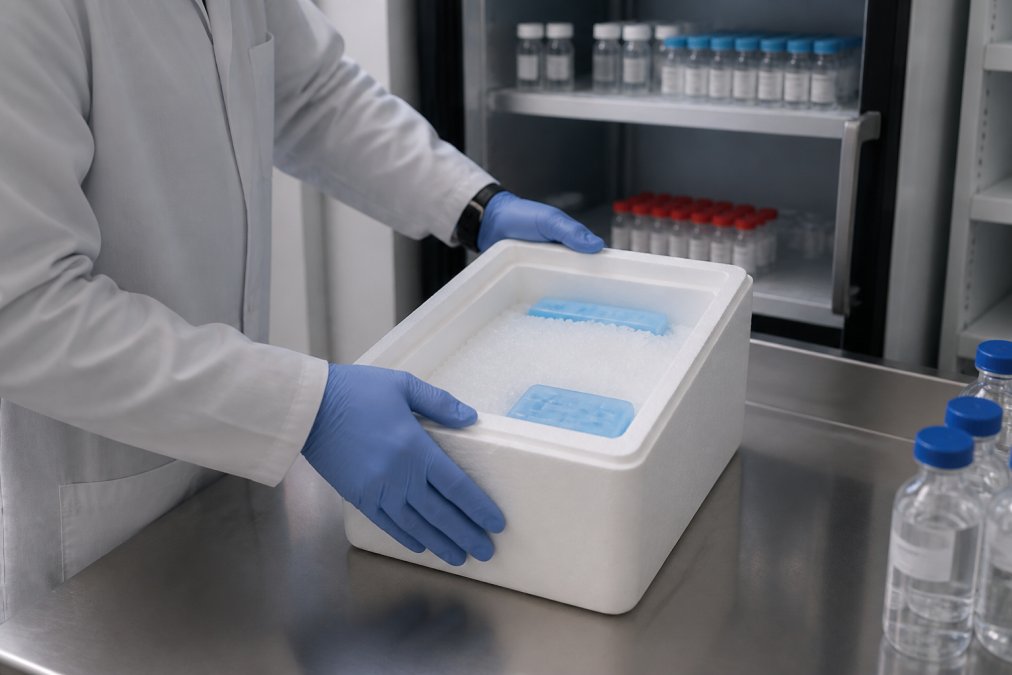
What the cold chain is actually protecting against
Temperature-controlled shipping protects peptide integrity through three distinct mechanisms, and each fails differently:
- Moisture ingress. Lyophilized powder is hygroscopic. Every time the vial warms above the dew point of the surrounding air, water vapor migrates past the stopper. Hydrolysis follows. This is why desiccant and a foil barrier matter more than the cold pack for dry powder.
- Freeze-thaw cycling. Reconstituted peptide in solution degrades with each freeze-thaw event. Aggregation and deamidation accelerate. A shipment that partially thaws and refreezes in transit can arrive looking fine and assay wrong.
- Thermal excursion above the stability window. Most lyophilized research peptides tolerate short ambient excursions. The problem is cumulative exposure, not a single spike.
Reading an excursion log like a reviewer would
A temperature data logger produces a time-series, not a pass/fail. When you review one, look for:
- Duration above threshold, not just peak temperature. A 30-minute spike to 30 °C is usually benign for dry powder; eight hours at 30 °C is not.
- Mean kinetic temperature (MKT), if the logger reports it. MKT collapses a variable temperature profile into a single equivalent constant temperature, which is the standard way pharmaceutical logistics evaluates cumulative thermal stress.
- Time at the dock. The gap between carrier scan-in and your signature is where most excursions happen. Ask the carrier for the delivery timestamp, not just the drop-off date.
Packaging choices that actually move the needle
- Insulated shipper with phase-change packs for reconstituted material. Phase-change packs hold a target temperature longer than gel packs, which drift as they melt.
- Desiccant plus heat-sealed foil for lyophilized powder. This is the moisture barrier, not the cold pack.
- Vial stopper integrity. A crimped aluminum seal with a silicone or butyl stopper is the last line of defense. Inspect for coring or partial crimps on arrival.
The handoff checklist
- Request the shipment's temperature record, not just a packing slip
- Confirm the desiccant and barrier packaging used
- Check the arrival temperature before signing for the delivery
- Log the time between delivery and freezer placement
- Photograph the logger readout and the vial seals on receipt
The gap between "delivered" and "stored" is where most labs lose consistency. A box sitting on a loading dock for four hours in summer undoes a well-built cold chain.
Environmental trade-off worth naming
Cold chain shipping carries a real footprint: insulated liners, refrigerant, and the dimensional weight that air freight penalizes. Consolidating orders into fewer, larger shipments reduces both cost and packaging waste, and it also reduces the number of handoffs where an excursion can occur. Fewer shipments is a consistency strategy, not just a sustainability one.
Third-Party Testing for Research Peptides: What a Real COA Proves
A certificate of analysis is only as good as the lab that issued it and the methods it used. Third-party testing for research peptides should confirm identity, purity, and mass, and it should name the analytical techniques: high-performance liquid chromatography for purity, mass spectrometry for molecular weight verification, and peptide sequence analysis where relevant.
| COA Element | What It Should Show | Why It Matters |
|---|---|---|
| Issuing lab | Independent, named facility | In-house testing is not third-party |
| Methods | HPLC, mass spectrometry listed | Confirms identity and purity claims |
| Lot number | Matches your vial | Links the result to your batch |
| Test date | Recent, within stability window | Old data may not reflect current stock |
| Purity figure | Specific percentage, not a range | Vague values hide batch variance |
Buying Research Grade Peptides Online Without Getting Burned
Buying research grade peptides online comes down to vendor qualification: verifying who you are actually buying from before money changes hands. Research-use-only labeling matters here, because it signals the supplier understands the regulatory boundary between research material and anything intended for human use.
A practical vendor qualification checklist:
- Can they provide a COA before you order, not after?
- Do they list a lot number and test date on every batch?
- Is there a named contact who answers questions about a specific compound?
- Do they disclose where synthesis happens?
- Can they confirm inventory before you commit to a timeline?
Building a Procurement Strategy That Survives Real Timelines
Procurement compliance is where good intentions meet grant deadlines. The strategy that survives is the one that assumes delays will happen and builds slack into the plan.
Domestic versus international procurement is a real trade-off:
- Domestic: faster shipping, simpler import regulations, easier chain of custody, higher unit cost
- International: lower unit cost, longer lead times, customs risk, harder to audit
Post-Delivery Stability Testing and Environmental Trade-Offs
Post-delivery stability testing is the step most labs skip, and it is the single highest-leverage habit for protecting a long study. The goal is not to re-run the supplier's COA. It is to confirm that the material in your freezer behaves like the material in your reference lot before you commit weeks of assay time to it.
A practical post-delivery protocol
You do not need a full analytical suite. You need a repeatable check that catches drift early:
- Visual inspection. Lyophilized cake should be a uniform plug or powder, not collapsed, discolored, or stuck to the stopper. A melted or shrunken cake is a moisture-event signal.
- Reconstitution behavior. Dissolve a small aliquot in the diluent your assay uses. Note time to clarity and any haze, particulates, or persistent foam. Compare against your reference lot side by side.
- Purity spot-check. If your lab has HPLC access, run a single gradient method against the reference lot. A shift in retention time or a new shoulder peak is a flag even if the reported purity figure matches.
- Functional check. Run one replicate of your standard assay at a single concentration. You are looking for a result inside your historical coefficient of variation, not a full curve.
- Document and quarantine. Record the lot, test date, and result. Hold the lot in quarantine status until the check passes.
Acceptance criteria you can defend
Set the criteria before you test, not after. A common pattern is:
- Visual and reconstitution match the reference lot
- Purity within the supplier's stated figure minus a defined tolerance
- Functional result inside the assay's historical CV band
Why this beats a blockchain pitch
Traceability technology is evolving. Some suppliers now explore blockchain-based provenance logging to record each handoff, and the principle is sound: every transfer should be recorded and verifiable. But provenance tells you where a vial has been, not whether the material still works. A logged handoff is not a stability result. For a working lab, a one-afternoon functional check on each new lot delivers more protection than any ledger, because it tests the thing you actually care about: does this batch behave like the last one.
The environmental counterweight
Cold chain shipping and single-use packaging carry a footprint that institutional procurement is increasingly asked to account for. The practical levers are the same ones that improve consistency:
- Consolidate orders to reduce shipment count, packaging waste, and handoff risk simultaneously
- Right-size packaging so you are not air-freighting void fill
- Return or recycle phase-change packs where your supplier offers a take-back program
- Buy domestic where timelines allow, since shorter routes mean less refrigerant and fewer transfer points
Run a small stability check on every new lot before it enters a long study. It costs an afternoon and can save a month of unusable data. Provenance logging is a nice-to-have; a functional check is the control.
Frequently Asked Questions
What are the risks of an inconsistent research peptide supply chain?
An inconsistent peptide supply chain exposes your work to batch variability, temperature excursions, and mid-project stockouts. When a vendor changes synthesis runs without warning, your assay baselines shift and results stop being comparable across timepoints. Cold chain failures introduce degradation that a certificate of analysis from the original batch will not capture. Stockouts force rushed reorders from unvetted sources, which is exactly when documentation gaps appear. The practical fix is qualifying at least two vendors, holding a small buffer of critical compounds, and reviewing batch consistency data before each reorder rather than after.
How do you verify the purity of research-grade peptides?
Start with the certificate of analysis and check that it names the specific lot, not just the catalog number. Purity should come from high-performance liquid chromatography, and identity should be confirmed by mass spectrometry against the expected molecular weight. Molecular weight verification catches sequence errors that a purity percentage alone will miss. Ask whether the testing was done in-house or by an independent lab, and request the raw chromatogram if your work is going into a publication. Batch consistency across lots matters as much as a single high purity figure.
Can you legally sell research peptides?
Research-use-only peptides occupy a narrow lane. They are sold for laboratory investigation, not for human consumption, and labeling must state that clearly. Products marketed as dietary supplements or drugs fall under FDA oversight and require approvals that research compounds do not carry. A vendor selling research peptides legally keeps documentation, ships with appropriate labeling, and does not make health claims. If a supplier's site reads like a consumer wellness store, that is a signal the compliance posture is thin, and your procurement records inherit that risk.
How can labs mitigate delays in peptide procurement?
Build lead time into the calendar rather than the purchase order. Custom synthesis and epitope mapping work can run weeks, so place orders against your next experiment, not the current one. Keep a qualified backup vendor on file with a completed vendor audit so a switch takes days instead of months. For temperature-controlled shipping, avoid Friday dispatch windows that leave shipments sitting in a depot over the weekend. Track lot numbers and reorder thresholds in a simple spreadsheet so nobody discovers a shortage mid-protocol.