

Table of Contents
- What Makes the Best Peptide Suppliers for Research Stand Out
- Third-Party Tested Research Peptides: Why Independent Testing Is Non-Negotiable
- How to Verify Peptide Purity Certificates Before You Order
- Storage Stability, Cold Chain, and Shipping Integrity
- Peptide Supplier Vetting Checklist for Researchers
- Frontline Peptides: Research-Grade Compounds at Competitive Prices
- Choosing the Right Peptide Suppliers for Research: Final Decision Framework
- Frequently Asked Questions
Last Updated: September 1, 2026
Choosing the wrong peptide supplier compromises your data. Contaminated batches, inconsistent purity, and missing documentation can invalidate months of research. At Frontline Peptides, we've built our operation around the quality standards serious researchers need. This guide breaks down what separates reliable suppliers from risky ones.
Most "best peptide suppliers" guides rank by price or popularity, neither indicates whether a compound performs reproducibly in your assay. What matters is the verification stack: HPLC purity, mass spectrometry confirmation, third-party testing, and traceable documentation.
Quick Picks:
- Best Overall for Research: Frontline Peptides, U.S.-based, third-party tested, competitive pricing
- Best Documentation Standard: Suppliers providing full CoA with HPLC and MS data per lot
- Best for Budget Labs: Suppliers offering research-grade compounds with transparent pricing
What Makes the Best Peptide Suppliers for Research Stand Out
The best peptide suppliers are defined by verifiable, documented, reproducible quality, not marketing claims or price.
Most researchers encounter two failure modes. The first is obvious: visibly degraded or mislabeled compounds. The second is far more dangerous: compounds that look fine but carry subthreshold purity, residual trifluoroacetic acid, or endotoxin contamination that silently skews results. Documentation matters more than price because it catches the second failure mode.
Purity Standards: HPLC and Mass Spectrometry Benchmarks
HPLC purity is the baseline measurement every serious supplier should provide. High-performance liquid chromatography separates the peptide from synthesis byproducts and measures what fraction is your target compound. Research-grade peptides require minimum 98% purity by HPLC.
Mass spectrometry confirms identity, not just purity. A compound can pass HPLC while still being the wrong amino acid sequence. Mass spectrometry verifies the molecular weight matches the expected value. Together, HPLC and MS form the minimum documentation standard.
Critical point: purity percentages mean nothing without the lot number attached. A supplier showing you a CoA from six months ago is not showing you the quality of the vial in your hand.
GMP and ISO Manufacturing: What the Certifications Actually Mean
GMP (Good Manufacturing Practice) and ISO certification are not interchangeable.
GMP manufacturing refers to quality control practices governing synthesis, testing, handling, and documentation. GMP compliance prevents contamination, mislabeling, and batch-to-batch variation, making reproducibility possible.
ISO certification (typically ISO 9001) certifies that a quality management system is in place and independently audited. ISO tells you processes are documented; GMP tells you they meet pharmaceutical-level standards.
A supplier claiming GMP compliance without documentation should be treated skeptically. Ask for the facility's GMP certification number and verify it independently.
Third-Party Tested Research Peptides: Why Independent Testing Is Non-Negotiable
Third-party tested research peptides have purity, identity, and safety verified by an independent laboratory with no financial stake in results. This distinction matters enormously.
An in-house CoA tells you what the supplier found. A third-party CoA tells you what an independent lab found. These are not the same thing.

According to FDA guidance on laboratory testing standards, independent verification is a cornerstone of quality assurance. While research peptides exist in a different regulatory category, the principle applies: self-reported testing creates an inherent conflict of interest.
Always ask which third-party laboratory performed testing and verify accreditation. A supplier who cannot name their testing laboratory is not providing genuine third-party verification.
Endotoxin Levels and Trifluoroacetic Acid Content
Two contamination markers receiving less attention than purity are endotoxin levels and residual trifluoroacetic acid (TFA) content.
Endotoxins are bacterial cell wall components triggering immune responses at very low concentrations. In cell culture work, endotoxin contamination produces false-positive inflammatory signals that invalidate results. Reliable suppliers report endotoxin levels in EU/mg and provide this data on request.
Trifluoroacetic acid is a common synthesis and purification reagent. Residual TFA in lyophilized powder is cytotoxic at elevated concentrations and interferes with biological assays. Suppliers using TFA removal steps and documenting TFA content demonstrate higher analytical rigor.
Batch Consistency and Lot Number Traceability
Batch consistency separates a supplier you can publish with from one you can only pilot with.
Every vial should carry a lot number linking directly to a specific CoA. That lot number is your audit trail. If results shift between experiments, lot traceability determines whether the variable is your protocol or your compound.
Supply chain traceability documents where raw amino acids originated, which synthesis run produced the batch, and what quality checkpoints were passed. The best suppliers can provide this on request.
How to Verify Peptide Purity Certificates Before You Order
Verifying peptide purity certificates takes about five minutes once you know what to look for.
Ask the supplier for a sample CoA for the specific compound you want before ordering. If they send a generic template or refuse, that tells you everything.
Reading a Certificate of Analysis: What Each Field Tells You
A Certificate of Analysis (CoA) records analytical results for a specific batch:
- Lot number: Links this CoA to a specific production batch. Cross-reference with your vial.
- Molecular weight: Should match theoretical weight for the stated amino acid sequence.
- HPLC purity (%): Percentage of sample that is target compound. Research-grade standard is 98%+.
- MS result: Confirms identity by matching observed molecular weight to expected value.
- Endotoxin level: Reported in EU/mg. Lower is better.
- TFA content: Should be below supplier's stated specification.
- Testing laboratory: Should be a named, accredited third-party facility.
- Test date: Should correspond to production lot, not be months old.
According to NIH guidelines on research compound quality standards, analytical validation requires traceable, reproducible documentation conducted by qualified personnel using calibrated equipment.
Analytical Validation Red Flags to Watch For
The biggest red flag is a CoA without a named third-party laboratory. The second biggest is a test date predating the lot number by more than a few weeks.
Watch for:
- HPLC data as a single number without a chromatogram
- MS data showing only nominal mass without isotope pattern
- No endotoxin data
- Purity listed as ">98%" without a specific value
- CoA issued by the same company selling the compound
Storage Stability, Cold Chain, and Shipping Integrity
Storage stability data is one of the most overlooked quality criteria when evaluating peptide suppliers.
Lyophilized peptides are stable at room temperature short-term, but long-term storage requires -20°C in dry, light-protected conditions. After reconstitution, 4°C refrigeration is standard. Peptide degradation can occur during shipping if cold chain integrity is not maintained.
Reputable suppliers address this with:
- Cold pack inclusion for temperature-sensitive compounds
- Shipping container validation data showing internal temperature ranges
- Clear documentation of storage conditions specific to each compound
Ask suppliers whether they provide storage stability data and what their cold chain protocol is. Suppliers answering specifically, not generically, demonstrate operational rigor that protects your research.
Shipping speed matters: the longer a compound spends in transit, the greater cumulative thermal exposure. Fast domestic shipping from a U.S.-based supplier is a quality control factor, not just convenience.
Peptide Supplier Vetting Checklist for Researchers
Use this checklist before placing any order with a new supplier:
| Criterion | What to Ask | Acceptable Standard |
|---|---|---|
| Third-party testing | Name of testing lab + accreditation | Named, accredited external lab |
| HPLC purity | Specific percentage per lot | 98%+ for research-grade |
| Mass spectrometry | MS confirmation per lot | Full MS data with molecular weight match |
| Endotoxin levels | EU/mg per batch | Lab-specific threshold, documented |
| TFA content | Residual TFA per lot | Documented removal process |
| Lot number traceability | CoA linked to specific lot | One-to-one lot/CoA correspondence |
| Storage stability data | Compound-specific stability profile | Available on request |
| Cold chain protocol | Shipping temperature controls | Cold pack or validated container |
| GMP/ISO certification | Facility certification documentation | Verifiable certification number |
| Customer support | Response time and contact method | Real person reachable by phone or email |
According to USP guidelines on analytical procedures for peptide characterization, proper characterization requires identity confirmation, purity assessment, and quantification, all reflected in supplier CoA documentation.
Frontline Peptides: Research-Grade Compounds at Competitive Prices
Frontline Peptides is a U.S.-based supplier of research-grade peptides and GLP research compounds, built for qualified researchers needing documented quality, fast domestic shipping, and support from people who understand the science.
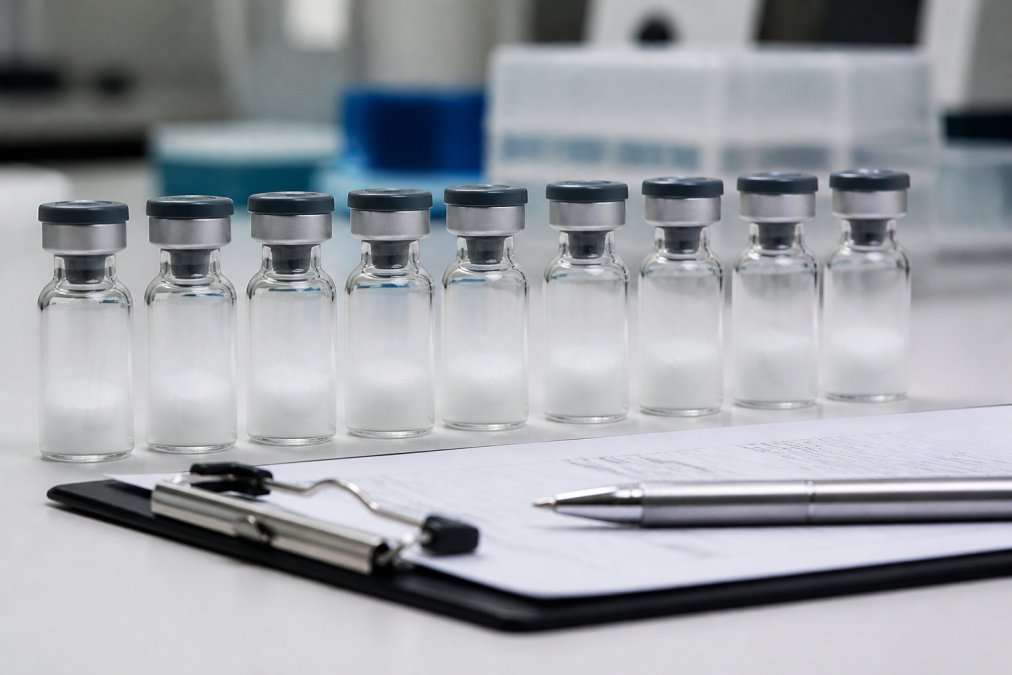
Every compound is supplied as lyophilized powder with third-party testing documentation. The catalog spans growth hormone secretagogues, GLP-receptor agonists, tissue repair peptides, and metabolic research compounds. Pricing is competitive and published transparently.
Featured Research Compounds and Pricing
| Compound | Research Focus | Price | Format |
|---|---|---|---|
| BPC-157 (10mg) | Cellular signaling, tissue repair models | $30.00 | Lyophilized powder |
| Ipamorelin (5mg) | GH secretagogue receptor activity | $25.00 | Lyophilized powder |
| Tesamorelin (5mg) | GHRH analog, metabolic signaling | $35.00 | Lyophilized powder |
| GLP-3RT / Retatrutide (10mg) | Tri-receptor agonist (GLP-1/GIP/glucagon) | $40.00 | Lyophilized powder |
| GLP-1SM / Semaglutide | GLP-1 receptor agonist research | $40.00 | Lyophilized powder |
| TB-500 (10mg) | Tissue repair, angiogenesis, inflammation | $48.00 | Lyophilized powder |
| GLP-2TZ / Tirzepatide (10mg) | Dual GIP/GLP-1 receptor agonist | $50.00 | Lyophilized powder |
| AOD-9604 | Fat metabolism, lipolysis research | $50.00 | Lyophilized powder |
| HGH | Growth hormone signaling, body composition | $50.00 | Lyophilized powder |
| CJC-1295 with DAC (5mg) | Long-duration GH signaling models | $56.00 | Lyophilized powder |
Research-grade quality is accessible without premium pricing. Frontline Peptides offers competitive rates with no minimum order requirements. For GLP-grade documentation, discuss requirements directly with the team.


Choosing the Right Peptide Suppliers for Research: Final Decision Framework
The best peptide suppliers are not necessarily the cheapest or most well-known. They're the ones whose quality documentation holds up under scrutiny and whose infrastructure protects your compound from synthesis to delivery.
If your priority is reproducibility across multi-experiment studies: Prioritize lot number traceability and batch consistency. Confirm every order ties to a specific CoA with HPLC and MS data.
If you work in cell-based assays: Endotoxin levels and TFA content are non-negotiable. Request this data explicitly before ordering.
If you have urgent timelines: U.S.-based suppliers with domestic inventory and fast shipping are the only viable option. International suppliers introduce customs delays and additional thermal exposure.
If you're evaluating a new supplier: Request a lot-specific CoA before ordering. Verify the testing laboratory is named and accredited. Place a small initial order and cross-check the CoA against your vial.
The number of suppliers genuinely meeting all criteria is smaller than the market suggests. Many offer price-competitive compounds with documentation that doesn't survive inspection. Suppliers worth returning to make verification easy, not difficult.
Research peptides are intended for laboratory and research use only. All compounds referenced are for use in controlled research environments by qualified researchers.
Selecting from the best peptide suppliers requires more than comparing price per milligram. Reproducible results depend on verified purity, traceable documentation, and a supply chain protecting compound integrity. Frontline Peptides provides third-party tested compounds, transparent pricing, U.S.-based fast shipping, and real customer support. Continue shopping at Frontline Peptides to find the research compounds your next study requires.
Frequently Asked Questions
Which is the most reputable peptide company for research use?
Reputation in the peptide supplier space comes down to documentation, not marketing claims. The most reputable peptide suppliers for research provide independently verified Certificates of Analysis with HPLC purity data and mass spectrometry confirmation for every batch, maintain GMP-compliant manufacturing, and offer responsive customer support. Frontline Peptides checks each of these boxes as a U.S.-based supplier with third-party tested compounds and transparent pricing starting at $25.00 per compound.
Why is third-party testing essential when choosing a peptide vendor?
In-house testing creates a conflict of interest: the supplier grades their own work. Third-party testing sends each batch to an independent laboratory, where HPLC purity, mass spectrometry confirmation of the amino acid sequence and molecular weight, and endotoxin levels are assessed without bias. For researchers who need reproducibility across experiments, independent CoA data is the only reliable way to confirm that what is labeled on the vial matches what is inside it.
How can I verify the authenticity of a peptide supplier's Certificate of Analysis?
Start by checking that the CoA includes a lot number that matches the vial, the name of the independent testing laboratory, HPLC purity percentage, mass spectrometry data confirming molecular weight, and endotoxin results. Contact the listed lab directly to confirm the report is genuine. Be cautious of CoAs that lack a lab name, show rounded purity figures, or cannot be matched to a specific batch. Reputable peptide suppliers for research make current CoA documents available before purchase.
What are the risks of purchasing research peptides from unverified sources?
Unverified suppliers frequently deliver compounds with lower purity than advertised, incorrect amino acid sequences, or elevated endotoxin levels that compromise experimental results. Peptide degradation from poor storage or broken cold chain conditions is also common. Beyond ruined data, contaminated or mislabeled compounds can invalidate entire study protocols. Sourcing from suppliers who publish third-party CoA documentation and follow GMP manufacturing standards significantly reduces these risks.
What criteria should researchers use to evaluate peptide suppliers?
Evaluate suppliers against six criteria: HPLC purity above 98%, independent mass spectrometry confirmation, accessible lot-specific CoA documents, GMP or ISO-certified manufacturing, documented cold chain and shipping integrity practices, and responsive customer support. Supply chain traceability, meaning the ability to trace a compound back to its synthesis batch, is an often-overlooked factor that separates professional suppliers from low-cost alternatives. Storage stability data for lyophilized powder compounds is equally important.