

Table of Contents
- What Third Party Testing Actually Means
- Why Third Party Testing Matters for Safety and Quality
- How Third Party Testing Reduces Supply Chain Risk
- Understanding Certificate of Analysis COA Documents
- How to Verify Peptide Purity Before You Buy
- The Cost of Skipping Independent Verification
- Conclusion
- Frequently Asked Questions
Last Updated: September 9, 2026
What Third Party Testing Actually Means
Third party testing is the process of sending a product sample to an independent laboratory for analysis, ensuring that neither the manufacturer nor the buyer controls the outcome. This unbiased assessment verifies that a product meets its labeled claims for purity, potency, and safety without a conflict of interest. At Frontline Peptides, we consider this verification step essential for any research compound, since the lab performing the analysis has no financial stake in the result.
The concept is straightforward: the company making the product does not grade its own homework. An independent laboratory runs standardized testing protocols to confirm what is actually in the vial matches what the label claims. This matters because the difference between a quality product and a contaminated one is often invisible to the naked eye.
Why Third Party Testing Matters for Safety and Quality
The primary reason third party testing matters for safety and quality is that it catches problems the manufacturer might miss or overlook. Independent labs screen for harmful contaminants, verify concentration levels, and check for degradation that could compromise results. Without this layer of validation, researchers are essentially trusting a supplier's word without evidence.
Quality assurance depends on consistent batch testing across every production run. A single contaminated batch can ruin months of research and waste significant funding. The consequences extend beyond financial loss to the integrity of the entire study.
Regulatory compliance in research settings increasingly requires documented proof of product integrity. Many institutions now mandate third-party certification before accepting compounds for approved studies. This shift reflects a broader industry recognition that self-reported quality claims are not sufficient for scientific work.
How Third Party Testing Reduces Supply Chain Risk
Supply chain risk in the research chemical space is not abstract; it is a series of specific, predictable failure points. Understanding the lifecycle of a product test helps you see exactly where third-party verification interrupts those failures. The process is not a single event but a chain of checkpoints from sampling to certification.
The lifecycle begins with sampling. A representative sample must be taken from the production batch in a way that ensures it reflects the entire batch, not just the top of a container or the end of a production run. Good laboratories follow strict sampling protocols, often taking multiple samples from different points in the batch and combining them for analysis. If the sample is not representative, the test result is meaningless, regardless of how sophisticated the analytical method is.
Next comes chain-of-custody documentation. From the moment the sample is taken until the final report is issued, every transfer of the sample must be logged. This includes who handled it, when, and under what conditions. This documentation is what makes the test result legally and scientifically defensible. Without a clear chain of custody, a COA is just a piece of paper that could have been produced anywhere.
The third stage is analytical testing. This is where the laboratory runs the actual assays. For peptide products, the most common methods are High-Performance Liquid Chromatography (HPLC) for purity analysis and Mass Spectrometry (MS) for molecular weight confirmation. HPLC separates the components of the sample and quantifies the percentage of the target peptide versus impurities (PubMed). Mass spectrometry confirms that the molecule has the expected mass, which verifies the peptide sequence is correct. A third method, amino acid analysis, can provide a more detailed breakdown of the peptide's composition, though it is less commonly included in standard COAs.
The fourth stage is data review and certification. The raw data from the instruments is reviewed by a qualified analyst, who checks for anomalies, confirms the results are within acceptable ranges, and then signs the COA. The signature is not a formality; it is a professional attestation that the results are accurate and that the testing was performed according to established protocols. Laboratories that are accredited to standards like ISO/IEC 17025 have additional layers of review to ensure the data is reliable (iso.org).
The final stage is batch-level traceability. The COA is linked to a specific batch number, and that batch number must match the product you receive. This linkage is what allows you to trace a problem back to its source. If a batch fails in your lab, you can pull the COA, confirm the batch number, and contact the supplier with documented evidence. If a supplier cannot provide a COA for the exact batch you received, you have no way to know what you actually have.
This lifecycle approach reveals why third-party testing is not just about the test result itself but about the integrity of the entire process. A COA from a lab that does not follow proper sampling protocols or chain-of-custody procedures is not worth the paper it is printed on. When you request a COA, you are not just asking for a purity percentage; you are asking for evidence that a rigorous, documented process was followed from start to finish.
A practical way to use this knowledge is to ask suppliers not just for the COA but for details about the testing process. Ask which laboratory performed the analysis, whether the lab is ISO/IEC 17025 accredited, and what sampling protocol was used. A supplier that can answer these questions confidently is demonstrating that they understand the lifecycle and have nothing to hide. A supplier that is vague on these details is signaling that they may not have a robust testing process in place.
The supply chain risk is not eliminated by a single test; it is managed by a system of checks and balances. Third-party testing is the most critical checkpoint in that system because it is the only point where an external, unbiased party verifies the product. By understanding the lifecycle of a test, you can evaluate the quality of the verification you are receiving and make informed decisions about which suppliers to trust.
Understanding Certificate of Analysis COA Documents
A Certificate of Analysis, commonly called a COA, is the official document that reports the results of laboratory testing on a specific product batch. This document serves as the primary evidence that a product meets its stated specifications for purity, potency, and composition. Every serious research compound should come with a COA you can review before purchase.
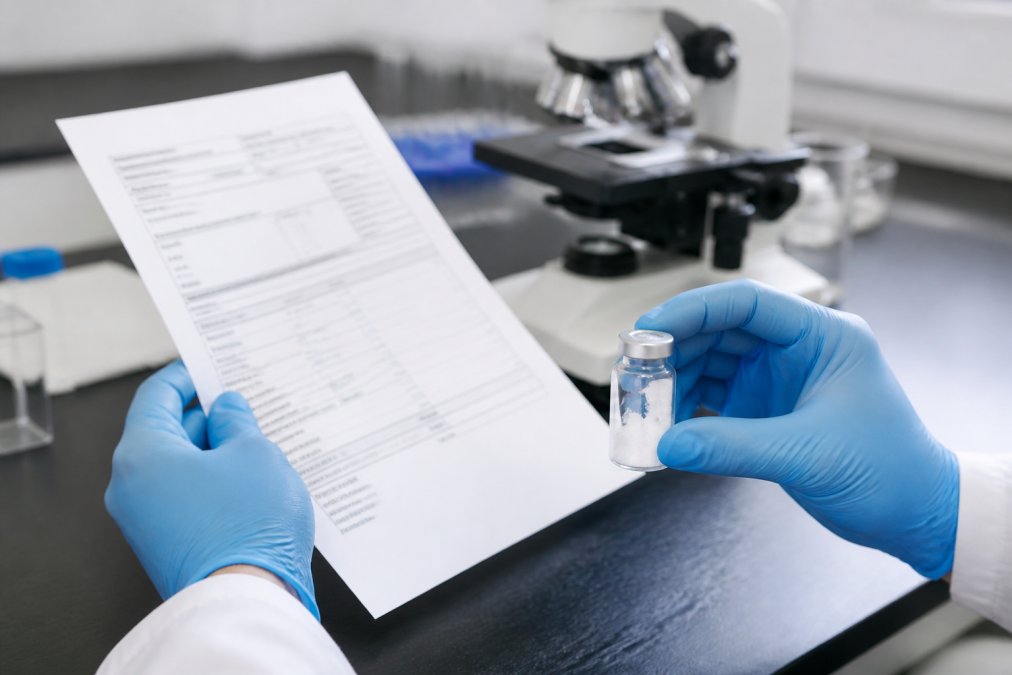
Learning how to read a COA is essential for verifying that the testing was meaningful. Key elements to examine include:
- Batch number: Must match the product you received
- Testing date: Should be recent, not months old
- Purity percentage: Should meet or exceed the product's labeled claim
- Methodology: Look for recognized analytical testing methods like HPLC or mass spectrometry
- Laboratory accreditation: The lab should hold relevant certifications
- Signature: An authorized analyst should have signed the document
A COA only has value if the laboratory that produced it is genuinely independent. Some suppliers generate their own certificates without external verification. This defeats the purpose of third party testing entirely.
How to Verify Peptide Purity Before You Buy
The most reliable method for verifying peptide purity is to demand batch-specific COAs from an independent laboratory and confirm the reported purity matches the product specifications. This verification should happen before payment, not after delivery. Many researchers make the mistake of trusting supplier claims without documentation.
When evaluating a potential supplier, ask these questions:
- Which independent laboratory performed the testing?
- Can you provide the COA for the specific batch I am purchasing?
- How recently was this batch tested?
- What purity level does the certificate report?
- Do you test every batch or only random samples?
A supplier that tests every batch demonstrates commitment to quality control. Batch testing provides confidence that the product you receive matches what was analyzed. Random sampling leaves room for variability between tested and untested production runs.
Label accuracy depends entirely on this verification process. The purity percentage printed on a product label means nothing without laboratory confirmation. Independent testing closes the gap between marketing claims and actual product composition.
The Cost of Skipping Independent Verification
Most discussions of third-party testing frame it as a risk-avoidance expense, but the real financial picture is better understood as an investment with a measurable return. The cost-benefit analysis shifts dramatically when you break down what a single failure actually costs versus the price of verification.
Consider the direct costs of a failed experiment using an unverified compound. A standard research study involving cell cultures or animal models can consume hundreds of hours of labor, thousands of dollars in reagents and supplies, and months of dedicated effort. If the compound is contaminated or mislabeled, that entire investment is lost. The cost of a single batch of research peptides might be a few hundred dollars, but the cost of repeating a ruined study can easily reach five figures when you factor in labor, overhead, and extended timelines.
Beyond the immediate experiment, there are downstream financial consequences that compound the loss. Grant funding is often tied to milestones and publication timelines. A delay caused by a failed experiment can push back a submission deadline, potentially jeopardizing a renewal or a new award. In academic settings, this can mean lost salary support for graduate students or postdocs. In commercial R&D, it can mean missing a product development window that competitors capitalize on.
The less obvious cost is the opportunity cost of chasing bad data. If you run an entire study on a compound that was impure, you may not realize the data is invalid until months later, when you try to replicate the results or when a reviewer questions the findings. The time spent pursuing a false lead is time you cannot get back, and it directly delays the next valid experiment.
A practical way to frame this is to compare the price of testing against the price of a single hour of your research time. If a senior researcher's loaded cost is $100 per hour, and verifying a batch takes 30 minutes of your time to request and review a COA, that is a $50 investment (peer-reviewed research). Compare that to the potential loss of a $50,000 study. The ratio is not close. Even if you only test ten batches per year, the annual verification cost is trivial relative to the risk it mitigates.
There is also the matter of insurance and liability. In regulated research environments, using an unverified compound can expose your institution to liability if something goes wrong, particularly if the study involves human subjects or animal welfare concerns. A documented chain of custody, including third-party test results, provides a defensible position in an audit or an adverse event review. Without that documentation, you are left with an argument that relies on trust rather than evidence.
The takeaway is that skipping verification is not a cost-saving measure; it is a gamble where the downside is disproportionately large. The price difference between a verified and an unverified product is often only a small percentage of the total product cost, and that difference buys you a documented guarantee that the product is what it claims to be. In the context of a research budget, that is the cheapest insurance you can buy.
Conclusion
The decision to prioritize third party testing ultimately protects your research, your funding, and your professional reputation. Every batch of research compounds carries risk, and independent verification is the most effective way to manage that risk. Frontline Peptides provides rigorously third-party tested research peptides with batch-specific COAs available before purchase, backed by competitive pricing and fast shipping for qualified researchers. Continue shopping with Frontline Peptides to ensure your next study begins with verified quality.
Frequently Asked Questions
Is lab tested the same as third-party tested?
No. A supplier's own lab testing is internal quality control. Third party testing means an independent laboratory with no stake in the sale analyzes the product. This unbiased assessment provides a higher level of confidence because the lab has no incentive to report favorable results. Always confirm the testing was done by an outside facility, not just the company selling the product.
What should I look for on a Certificate of Analysis to verify peptide purity?
Check the COA for the lot number that matches your product vial, the testing method such as HPLC, and the reported purity percentage. Look for the independent laboratory's name and the date of analysis. Verify the document is not a generic template by confirming the specific batch number is listed. A valid COA also includes results for residual solvents and heavy metals, not just purity.
How much does third party testing cost for research peptides?
Third party testing costs vary based on the number of batches, the specific tests required, and the laboratory used. For buyers, this expense is typically included in the product price from reputable suppliers. Rather than paying a separate testing fee, researchers should prioritize suppliers who provide independent COAs for every batch, as this reflects a commitment to quality assurance and regulatory compliance.