

Table of Contents
- Why Research Peptide Prices Vary: The Cost Breakdown
- Synthesis Complexity and Sequence Length
- Purification and Purity Grade
- Peptide Purity Standards for Research: What You Are Paying For
- Third-Party Testing for Research Peptides: The Hidden Cost of COA Verification
- Batch-to-Batch Consistency and Lyophilization Costs
- Regulatory Compliance, Manufacturing Overhead, and Economies of Scale
- Buying Research Grade Peptides Online: A Price Comparison Table
- Shipping, Cold Chain, and Storage Logistics
- Frequently Asked Questions
Last Updated: September 17, 2026
Why Research Peptide Prices Vary: The Cost Breakdown
Two vendors can sell the same 10 mg vial of a research peptide, yet one charges $30 and another $120. That gap is rarely a sign of gouging. At Frontline Peptides, we field this question constantly, and the honest answer is that why research peptide prices vary comes down to measurable production and verification costs, not marketing markup.
Peptide prices are driven by synthesis complexity, purification grade, third-party testing, batch consistency, and logistics. Each layer adds cost, and skipping one shows up in the price.
Synthesis Complexity and Sequence Length
Synthesis complexity is the first and largest cost driver. Every amino acid added to a chain requires a separate coupling step, each carrying its own reagents, solvents, and yield loss.
Purification and Purity Grade
Purification and purity grade determine how much of what you pay for is actually the target compound. Crude synthesis produces a mixture of truncated sequences, deletion products, and other impurities; purification removes them.
Peptide Purity Standards for Research: What You Are Paying For
Peptide purity standards for research define the minimum analytical thresholds a compound must meet before it is suitable for controlled experiments. They exist because an impurity profile can alter results independent of the target compound's activity.
What the Percentage Actually Measures
Reverse-phase HPLC purity is reported as the area percentage of the target peak relative to all peaks detected at a given wavelength, usually 214 nm for the peptide backbone. That number is method-dependent: a shallow gradient, short column, or poorly chosen mobile phase can co-elute impurities with the target peak and inflate the reported purity. A supplier running a rigorous method on a longer column with a shallower gradient will often report a lower number for the same material, because the method resolves more.
The Impurity Classes That Matter
Not all impurities affect experiments the same way. The categories worth understanding:
- Deletion and truncation sequences: Peptides missing one or more residues from failed coupling steps. These are the most common synthesis impurities and can act as partial agonists, antagonists, or inert competitors depending on the sequence.
- Insertion and substitution products: Wrong amino acid incorporated at a position. Risk scales with sequence length and with the similarity of the activated derivatives used.
- Diastereomers: Epimerization at chiral centers, typically at cysteine, histidine, or serine residues. These can be chromatographically invisible while altering receptor binding.
- Counterions and residual solvents: Trifluoroacetate (TFA) is the standard counterion from HPLC purification and can be biologically active in cell assays at higher concentrations. Acetate exchange is sometimes offered as an alternative for sensitive work.
- Water and salt content: A vial labeled 10 mg may contain less than 10 mg of actual peptide once counterion and moisture content are accounted for. Net peptide content is the number that matters for dosing calculations.
What to Look For on a COA
A defensible purity claim is supported by more than a percentage. The COA should show the HPLC chromatogram (not just the number), the mass spectrometry result confirming molecular identity, the method parameters, and the net peptide content. If any are missing, the purity figure is a claim rather than a measurement.
Third-Party Testing for Research Peptides: The Hidden Cost of COA Verification
Third-party testing for research peptides is where the least visible costs sit, and it is the most misunderstood line item on a peptide invoice. A certificate of analysis (COA) is only as valuable as the laboratory that issued it.
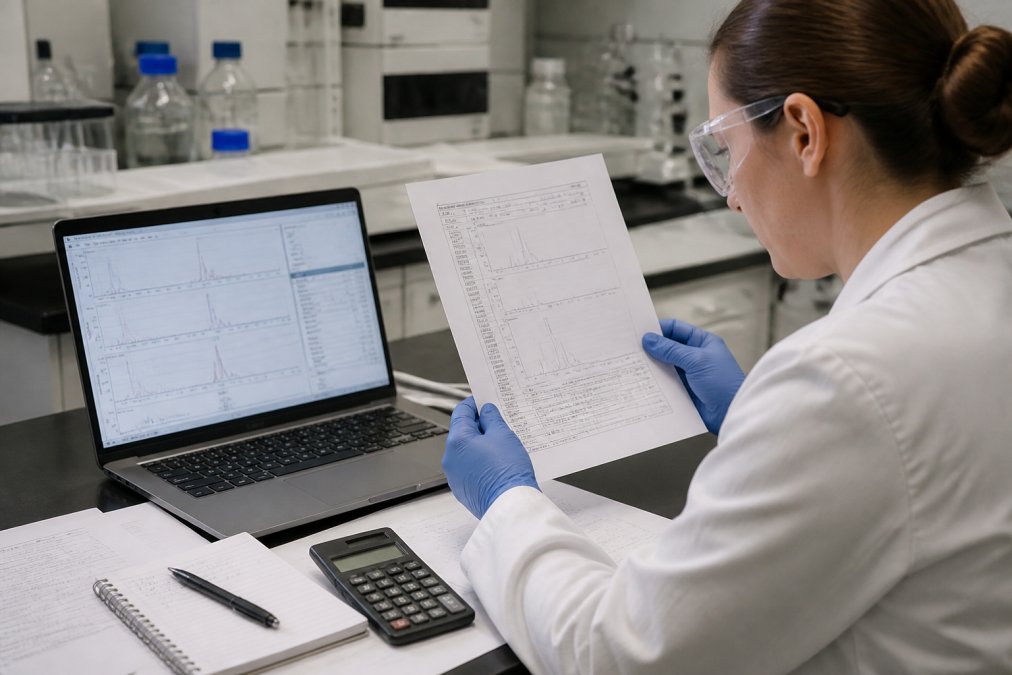
HPLC and Mass Spectrometry Analysis
HPLC and mass spectrometry analysis are the two core methods behind a legitimate COA. HPLC separates and quantifies the compound to establish purity percentage; mass spectrometry confirms molecular identity by measuring mass-to-charge ratio, verifying the sequence matches the label.
Batch-to-Batch Consistency and Lyophilization Costs
Batch-to-batch consistency is the cost driver almost no price comparison accounts for, and where cheap suppliers quietly fail. Producing a compound that performs identically across lots requires tighter process controls, more in-process testing, and more rejected batches.
Why Consistency Costs Money
Solid-phase peptide synthesis is a multi-step chemical process, and small variations compound. Resin loading, coupling reagent quality, deprotection efficiency, and cleavage conditions all shift slightly between runs. A supplier with tight process controls monitors each and rejects out-of-spec batches; a supplier without them ships whatever comes off the resin and lets the COA absorb the variance.
The cost of consistency shows up in three places:
- In-process analytics: Sampling and testing at intermediate synthesis stages, not just at the end, catches problems before an entire batch is wasted.
- Rejected batches: A facility that rejects 1 in 10 batches for out-of-spec purity or mass has effectively priced that rejection into every vial it sells.
- Documentation and traceability: Lot-level records that tie raw materials, synthesis parameters, and analytical results together require staff time and systems that low-cost operations skip.
The Lyophilization Cycle, Step by Step
Lyophilization is not a single step, it is a controlled three-phase process, and each phase has real cost:
- Freezing: The peptide solution is cooled below its glass transition temperature. The rate of freezing affects ice crystal size, which in turn affects how easily water sublimates in the next phase. Slow, controlled freezing produces larger crystals and faster drying; fast freezing produces smaller crystals and a denser cake.
- Primary drying (sublimation): Under vacuum, ice is removed directly to vapor without passing through liquid. This is the longest phase, often running 24 to 72 hours depending on fill volume and formulation. The shelf temperature must stay below the collapse temperature of the formulation or the cake melts and the batch is ruined.
- Secondary drying (desorption): Residual bound water is removed by slowly raising the shelf temperature. Target residual moisture for most research peptides is below 1-3%. Higher residual moisture accelerates degradation in storage.
What This Means for Price
For researchers running multi-week or multi-arm studies, batch consistency is not a luxury, it is the difference between data that replicates and data that has to be thrown out.
Regulatory Compliance, Manufacturing Overhead, and Economies of Scale
Regulatory compliance and manufacturing overhead set the floor under any legitimate price. Research chemical suppliers operate under documentation, labeling, and handling requirements that carry fixed costs regardless of order volume.
Buying Research Grade Peptides Online: A Price Comparison Table
Buying research grade peptides online means comparing quotes across suppliers who are not actually selling the same thing. The table below maps cost drivers to what you should expect, so you can evaluate any quote on substance rather than sticker price.
| Cost Driver | What It Adds to Price | What to Verify Before Buying |
|---|---|---|
| Sequence length | Higher per-milligram cost as residues increase | Stated sequence and molecular weight |
| Purity grade | Step-up cost per purification pass | Measured purity, not a nominal claim |
| Third-party testing | Per-lot analytical cost | Independent lab, lot-specific COA |
| Batch consistency | Tighter process controls, rejected batches | Lot history and reproducibility data |
| Lyophilization | Equipment, energy, processing time | Dry powder form and storage guidance |
| Compliance overhead | Fixed documentation and handling costs | Labeling and traceability standards |
| Order volume | Lower unit cost at scale | Whether pricing reflects batch size |
Shipping, Cold Chain, and Storage Logistics
Shipping and storage logistics are the final cost layer, and they are not optional for compounds that degrade under heat or light. Cold chain handling, insulated packaging, and expedited transit all add cost per shipment.
Frequently Asked Questions
What factors contribute to the price difference in research peptides?
Peptide prices vary based on synthesis complexity, sequence length, purification grade, and testing requirements. A short peptide like BPC-157 (10mg for $30) costs less to produce than a complex multi-receptor compound. Third-party testing for research peptides adds cost because each batch requires HPLC and mass spectrometry verification. Lyophilization, cold-chain shipping, and regulatory compliance also drive up the final price. Suppliers that skip these steps can offer lower prices, but you lose documentation and consistency.
Does purity level significantly impact the cost of research peptides?
Yes. Higher purity grades require more purification steps, which increases manufacturing time and reduces yield. A peptide at 95% purity costs less to produce than one at 98% or higher. Peptide purity standards for research typically require 95% or above for most applications, but some sensitive assays need 98% or better. Always check the COA to confirm the purity grade matches what you need for your study.
How does third-party testing affect the final price of research compounds?
Third-party testing for research peptides adds cost per batch, depending on the number of tests. This covers HPLC for purity, mass spectrometry for molecular weight confirmation, and sometimes sterility or endotoxin testing. Suppliers that test every batch charge more, but you get a verifiable COA. The hidden cost of COA verification is that some suppliers test only once and reuse the same document across batches, which defeats the purpose.
What should researchers look for when comparing peptide prices?
Focus on cost per milligram, not just the total price. A 10mg vial at $40 ($4/mg) may be better value than a 5mg vial at $25 ($5/mg). Check if the supplier provides batch-specific COAs with HPLC and mass spectrometry data. Ask about batch-to-batch consistency and cold-chain shipping. Buying research grade peptides online from a U.S.-based supplier with third-party testing usually costs more upfront but reduces the risk of failed experiments.
Peptide pricing is a transparency problem more than a cost problem. When a quote looks unusually low, the missing money is usually hiding in skipped analytical validation, unverified COAs, or inconsistent batches. Frontline Peptides is a U.S.-based supplier built around the opposite approach: rigorously third-party tested compounds, transparent catalog pricing, and fast shipping backed by real customer support. Browse the full catalog, review the COAs, and see the difference for yourself.