

Table of Contents
- What Peptide Purity Actually Means in 2026
- The Risks of Research Peptide Impurities
- Analytical Testing Methods: HPLC and Mass Spectrometry
- Peptide Third-Party Testing Standards Explained
- How to Read a Peptide Certificate of Analysis
- The Chemistry of Peptide Degradation and Storage
- Frequently Asked Questions
Last Updated: September 24, 2026
What Peptide Purity Actually Means in 2026
Peptide purity is the percentage of a lyophilized or reconstituted peptide sample that consists of the intended amino acid sequence, with the remainder made up of synthesis byproducts, truncated fragments, residual solvents, and moisture. In 2026, why peptide purity matters more than ever comes down to a single reality: a certificate of analysis reporting 98% purity says almost nothing about whether the other 2% is harmless or biologically disruptive.
Purity percentage and impurity profile are two different measurements, and most buyers conflate them.
Purity percentage is a single number produced by high-performance liquid chromatography. It tells you what fraction of the UV signal at a given wavelength eluted as the main peak.
Impurity profile is the qualitative picture: which specific byproducts are present, at what relative concentrations, and whether any of them are known to interfere with the assay you plan to run.
A sample can read 97% pure and still carry a deletion fragment that co-elutes near the target peak, inflating the apparent purity while masking a real problem. This is the single most common mistake we see researchers make when they evaluate a certificate of analysis.
The Risks of Research Peptide Impurities
The risks of research peptide impurities fall into two categories: acute interference with experimental readouts, and slower biological effects that accumulate across repeated exposure. The first is well understood. The second is where most guidance stops short, and where the real depth gap sits.
How Synthesis Byproducts Change Experimental Results
Solid-phase peptide synthesis is never perfectly efficient. Each coupling step leaves behind a fraction of chains that failed to extend, producing deletion peptides that are shorter by one or more residues. A 20-mer synthesized at 99% coupling efficiency per step yields roughly 82% full-length product before purification, the rest is a ladder of truncated fragments. Oxidation of methionine and tryptophan residues creates another class of byproduct, and racemization at each coupling step can flip an L-amino acid to its D-form, producing a diastereomer that is nearly identical in mass but biologically distinct.
These species share enough structural similarity with the target sequence to bind some of the same receptors, which means they can contribute signal you attribute to your compound of interest. A deletion peptide missing one C-terminal residue may retain partial binding affinity while having a different half-life, a different clearance profile, and a different dose-response curve than the full-length sequence.
Batch consistency suffers first. If two vials from different lots carry different impurity profiles, your dose-response curve shifts between experiments for reasons that have nothing to do with your variable. Sequence fidelity, not just purity percentage, is what makes results reproducible.
Long-Term Accumulation of Synthesis Impurities
Three mechanisms deserve attention:
Residual TFA. TFA is the standard cleavage reagent in solid-phase synthesis and is notoriously difficult to remove completely. It can persist as a counterion bound to basic residues. In cell culture, residual TFA is a known irritant and can shift pH in small-volume assays. In repeated in vivo exposure, the concern is cumulative acid load rather than a single-dose effect.
Analytical Testing Methods: HPLC and Mass Spectrometry
Reverse-phase high-performance liquid chromatography separates components by hydrophobicity, and mass spectrometry confirms identity by molecular weight. Together they form the backbone of peptide analytical testing.
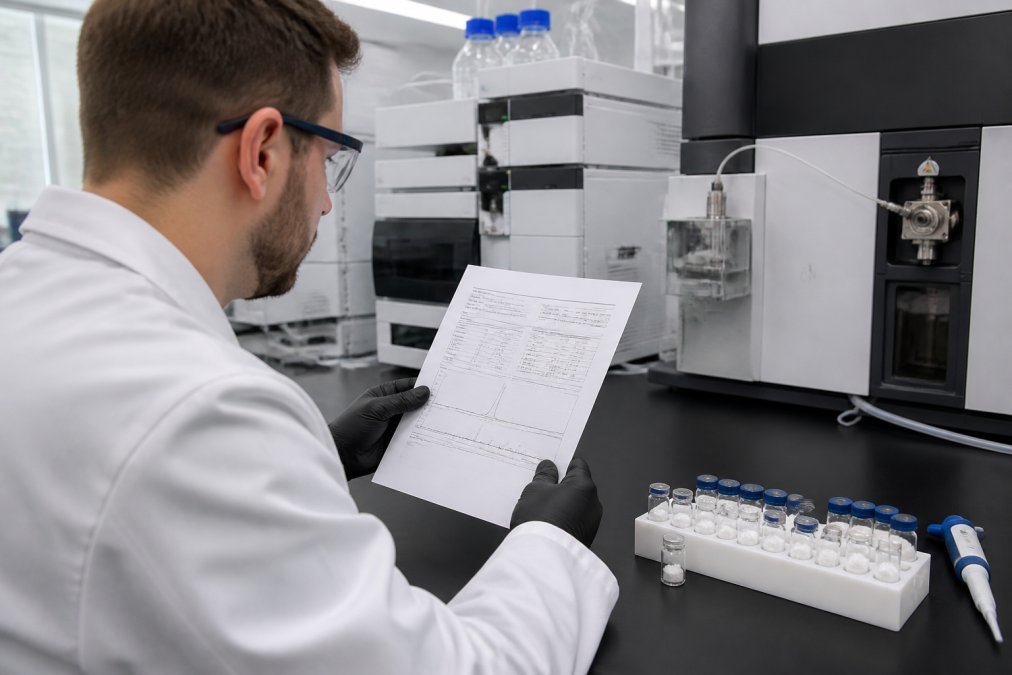
Reading Raw Chromatography Data
Raw chromatograms intimidate people, but the reading is mechanical once you know the format. The x-axis is retention time in minutes. The y-axis is absorbance, usually at 214 or 220 nanometers for the amide backbone. The main peak is your target. Everything else is impurity.
Peptide Third-Party Testing Standards Explained
Peptide third-party testing standards require that the laboratory performing the analysis has no financial relationship with the supplier. That independence is the entire point. An in-house purity claim is a marketing statement; an independent lab report is evidence.
What "Third-Party" Actually Requires
A complete third-party panel for research-grade material typically covers HPLC purity, mass spectrometry identity confirmation, water content by Karl Fischer titration, and endotoxin levels where the intended use requires it. Bacterial contamination testing matters for any compound that will contact cell culture. Sterility and endotoxin testing are separate assays and are not implied by a purity number.
The independence standard has three practical tests:
- The lab is not owned by the supplier. A subsidiary lab is not third-party, even if it has a different name.
- The lab is accredited. In the U.S., look for ISO/IEC 17025 accreditation, which is the international standard for testing and calibration laboratories. Accreditation is verifiable through the accrediting body's public directory.
- The report is lot-specific. A representative batch report is not evidence for the vial in your hand. The lot number on the report must match the lot number on the label.
The Regulatory Landscape in 2026
Research peptides occupy a specific and often misunderstood position in U.S. regulation. They are not approved drugs, and they are not dietary supplements. The Food and Drug Administration (FDA) has stated that peptides intended for research use are not intended for human consumption, and marketing them for human use without an approved new drug application is unlawful. The agency has issued warning letters to suppliers whose marketing crossed that line.
How to Verify a Testing Program
When evaluating a supplier's testing program, ask which laboratory performs the work, whether that laboratory is accredited, and whether you can see results for the specific lot you are buying rather than a representative batch. A supplier that cannot answer all three is asking you to take purity on faith.
- Request the raw chromatogram, not just the summary. A purity percentage is an interpretation. The chromatogram is the data. If the supplier will not send the raw file, the number is unverifiable.
- Cross-check the lab. If the report names an analytical laboratory, that laboratory's accreditation status and contact information should be publicly verifiable. A lab that cannot be found in an accreditation directory is a red flag.
FDA warning letters on peptide marketing
How to Read a Peptide Certificate of Analysis
A certificate of analysis is a lot-specific document that links a physical vial to the analytical data generated from that batch. Reading one takes about two minutes once you know the fields that matter.
| CoA Field | What It Tells You | Red Flag If... |
|---|---|---|
| Lot number | Ties report to your vial | Missing or doesn't match label |
| Purity percentage | Main peak area by HPLC | No chromatogram attached |
| Test method | Which assay was used | Method not named |
| Molecular weight | Confirms sequence identity | Absent entirely |
| Appearance | Physical form of material | Contradicts what you received |
| Storage conditions | Handling requirements | Blank or generic |
| Testing lab | Independence of analysis | Supplier's own facility only |
The Chemistry of Peptide Degradation and Storage
Peptide degradation happens through hydrolysis, oxidation, and aggregation, and each pathway has a different trigger. Hydrolysis cleaves the peptide backbone and accelerates with moisture and heat. Oxidation targets methionine, cysteine, and tryptophan residues and is driven by oxygen exposure. Aggregation occurs when unfolded chains associate into clusters that may not redissolve on reconstitution.
Frequently Asked Questions
Is 95% purity good enough for peptide research?
For most quantitative work, 95% is a floor, not a target. The remaining 5% can include truncated sequences, deletion peptides, and residual solvents, and those contaminants do not behave like your target compound. If your assay measures binding affinity, receptor signaling, or dose response, a 5% impurity load can shift your results enough to make them hard to reproduce. Many researchers treating peptide purity as a hard requirement set 98% as the minimum for cell-based and in vivo work, and reserve 95% material for exploratory or non-quantitative screening only.
What should I look for in a peptide Certificate of Analysis?
Four things decide whether a CoA is worth anything. First, the testing lab's name and a lot or batch number that matches the vial you received. Second, an HPLC chromatogram with a retention time and a purity figure calculated from peak area, not a single number typed into a table. Third, a mass spectrometry result confirming the molecular weight matches the expected amino acid sequence. Fourth, endotoxin and microbial limits if the compound is destined for cell culture. A CoA missing any of these is a marketing document, not an analytical record.
How does third-party testing affect research reproducibility?
Independent testing is what makes batch-to-batch comparison possible. When the same lab, using the same HPLC method, tests every lot, you get an impurity profile you can track over time. If a supplier switches synthesis routes or scales up production without telling you, the chromatogram will show it before your experiment fails. Reproducibility problems in peptide research often trace back to a silent formulation or synthesis change between lots, not to the protocol. Third-party verification is how you catch that change early.
What happens to peptides that are not stored correctly?
Lyophilized peptide powder is stable for extended periods when kept cool, dry, and protected from light. Once reconstituted, the clock starts. Hydrolysis, oxidation of methionine and cysteine residues, and aggregation all accelerate in solution, and freeze-thaw cycles make it worse. The practical protocol is to reconstitute only what you need for a short window, refrigerate the working solution, and freeze the remaining dry powder at roughly -20°C. Degradation shows up as a shoulder on the HPLC peak or a lower purity figure on a later test.