

Table of Contents
- Why Peptide Inventory Stability Starts With Your Supplier
- Research Peptide Storage Guidelines: Temperature, Light, and Moisture
- Shelf Life of Lyophilized Peptides: What Actually Limits It
- How to Verify Peptide Supplier Quality Before You Buy
- Cold Chain Shipping, 3PL Fulfillment, and Thermal History
- Inventory Management: Freezer Logs, Aliquoting, and Storage Vessels
- Troubleshooting Failed Experiments Caused by Storage Problems
- Frequently Asked Questions
Last Updated: September 11, 2026
Why Peptide Inventory Stability Starts With Your Supplier
A peptide supplier inventory stability guide begins with a hard truth: most degradation happens before your vial reaches the bench. This guide from Frontline Peptides covers the storage, handling, and verification practices that protect research-grade compounds from shipping to assay.
Peptide inventory stability is a peptide's ability to maintain sequence integrity, purity, and biological activity from receipt through storage and reconstitution. It depends on three variables you control, temperature, moisture, and light, plus one your supplier controls: how well the cold chain held before delivery.
Many researchers treat the supplier relationship as a transaction and the freezer as the only storage decision that matters. In practice, a vial that spent 48 hours in a warm truck has already begun degrading, no matter how carefully you store it afterward.
This guide covers reading supplier documentation, storing lyophilized and reconstituted material, running freezer logs that hold up to scrutiny, and troubleshooting storage-related failures.
Research Peptide Storage Guidelines: Temperature, Light, and Moisture
Three storage controls determine shelf life: temperature, light, and moisture. Get any one wrong and purity drops faster than the label suggests.
Temperature is the dominant factor. Lyophilized peptides tolerate short ambient periods during shipping, but long-term storage requires consistent cold: -20°C for routine storage and -80°C for extended archival, especially for aggregation-prone peptides (peer-reviewed research).
Light exposure degrades aromatic residues and light-sensitive sequences. Amber vials or opaque storage boxes solve this cheaply.

Moisture is the most underestimated risk. Lyophilized powder is hygroscopic: every time a vial warms with the stopper exposed to humid air, condensation forms inside, and residual moisture accelerates hydrolysis and shortens shelf life.
Lyophilized vs. Reconstituted Storage Conditions
Lyophilized peptide is the more stable form and belongs in the freezer. Reconstituted peptide is more fragile and belongs in the refrigerator, used within a defined window.
| Form | Storage Temperature | Typical Storage Window | Key Risk |
|---|---|---|---|
| Lyophilized powder | -20°C or -80°C | Months to years | Moisture ingress |
| Reconstituted solution | 2-8°C | Weeks | Bacterial growth, hydrolysis |
| Reconstituted, frozen | -20°C | Limited | Freeze-thaw damage |
Reconstitute with bacteriostatic water when the protocol allows it. The 0.9% benzyl alcohol formulation in USP sterile water standards referenced products slows microbial growth in multi-dose vials, which matters when a single vial serves several draws.
Freeze-Thaw Cycles, Aliquoting, and Vial Sealing
Every freeze-thaw cycle costs purity: ice crystal formation disrupts peptide structure, and repeated cycling compounds the damage.
Aliquot before you freeze: split a reconstituted vial into single-use volumes immediately after preparation, then freeze and thaw each aliquot once. Thawing an entire vial to draw a small sample and refreezing the remainder can degrade a batch faster than months of correct storage.
Seal vials properly after every draw. Silicone vial caps protect the stopper from dust and debris during refrigerated storage, and cost almost nothing compared to replacing a compromised batch.
Shelf Life of Lyophilized Peptides: What Actually Limits It
The shelf life of lyophilized peptides is limited less by the calendar than by residual moisture, temperature consistency, and sequence. A well-sealed vial at -80°C stays stable far longer than one at -20°C with repeated temperature swings.
Sequence matters. Peptides containing methionine, cysteine, or tryptophan oxidize more readily and deserve -80°C storage and tighter moisture control. Asparagine or aspartate residues are prone to deamidation, and repeating hydrophobic stretches aggregate more easily.
Salt form matters too: acetate and trifluoroacetate salts behave differently in solution, and buffer compatibility affects degradation speed. If your assay buffer sits far from the peptide's optimal pH range, degradation accelerates regardless of storage.
What most guides miss: "shelf life" on a certificate of analysis reflects controlled storage conditions, not a promise about your freezer. It assumes the vial stayed sealed, dry, and at the stated temperature the entire period. Every deviation shortens the real window.
Estimating Remaining Shelf Life From Your Own Records
You do not need a stability chamber, just your logs and a few rules of thumb.
- Temperature. Reaction rates roughly double for every 10°C increase (peer-reviewed research). A vial held at -20°C degrades faster than one at -80°C, and a week at room temperature consumes a meaningful share of usable life.
- Moisture exposure. Each time a vial warms with the stopper exposed, some moisture enters. Count those events. A vial opened and resealed a dozen times at ambient humidity is not the same product as one opened once.
- Freeze-thaw history. Each cycle adds damage. Two or three cycles is usually tolerable for robust sequences; a dozen is not.
- Time in solution. Reconstituted peptide degrades far faster than powder. Weeks in the refrigerator is the realistic window, not months.
Combine these into a simple score: start with the supplier's stated shelf life, then subtract for temperature excursions, moisture events, and freeze-thaw cycles. The result is a conservative working estimate, far better than assuming the label number still applies.
When to Retest Instead of Guess
If a batch has a documented excursion, long storage history, or fragile sequence, retesting is cheaper than a failed experiment. Retain a small reference aliquot from each lot at receipt; if reference and current material diverge under identical conditions, storage history has caught up with the product.
How to Verify Peptide Supplier Quality Before You Buy
Verification starts with documentation, not the product label. A supplier that cannot produce a current certificate of analysis on request is one you cannot audit.
Ask for three things before your first order:
- A certificate of analysis for the specific lot you are buying, not a generic sample
- The analytical methods used, including HPLC and mass spectrometry results
- A statement of how the product ships and what temperature it holds in transit
Frontline Peptides provides third-party tested products with documentation available before purchase, the baseline any serious researcher should demand. If a supplier hesitates on the COA question, that hesitation is your answer.
Reading a Certificate of Analysis and Purity Verification
A certificate of analysis reports HPLC purity percentage, confirms molecular weight by mass spectrometry, and states lot number, sequence, and salt form. Read the lot number first and confirm it matches the vial in your hand.
Purity verification means checking that the reported HPLC peak area corresponds to the sequence you ordered, not just that a number appears on the page. Mass spectrometry confirms identity. HPLC confirms purity. You need both.
Cold Chain Shipping, 3PL Fulfillment, and Thermal History
Cold chain integrity is the part of stability you cannot fix after the fact. Thermal history, cumulative temperature exposure from packing to delivery, determines whether your peptide arrived intact.
Shipping logistics for research compounds typically involve insulated packaging, phase-change coolants, and expedited transit. A supplier using 3PL fulfillment should describe how the warehouse maintains temperature control and documents excursions.
Ask what happens when a shipment is delayed. A supplier with a real cold chain process has an answer. A supplier without one will say the product is "stable at room temperature," a claim about short-term tolerance, not a shipping policy.
Inventory Management: Freezer Logs, Aliquoting, and Storage Vessels
Inventory management is where most labs lose track of stability. Freezer logs, consistent aliquoting, and appropriate storage vessels turn storage from guesswork into a documented process.
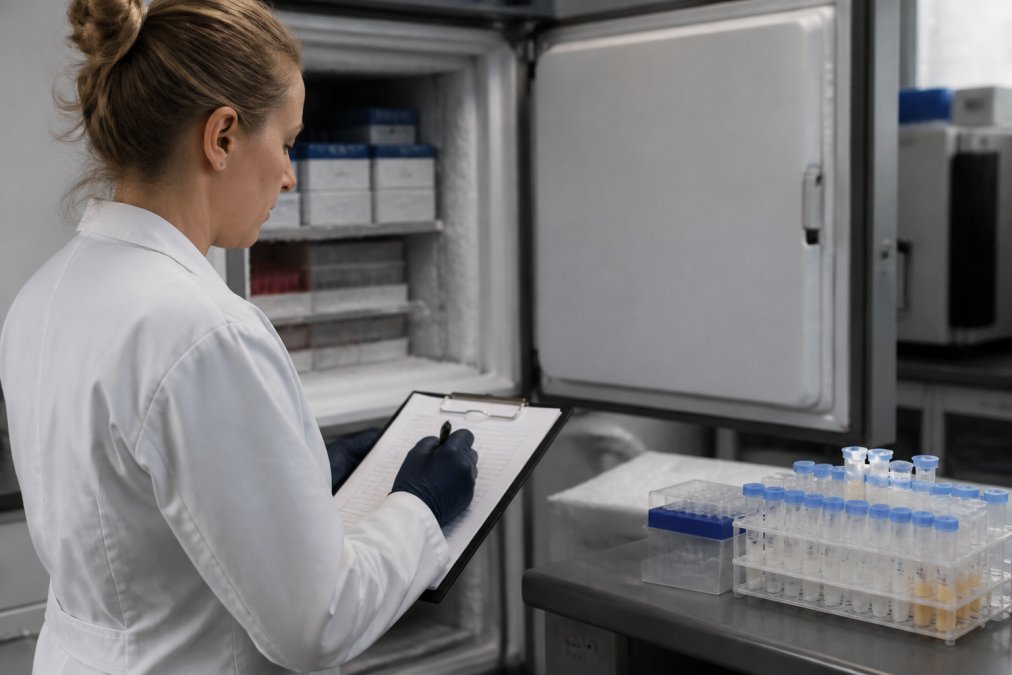
Keep a freezer temperature log with daily readings and a record of any excursions. Note the duration and peak temperature of every deviation, because that record lets you decide whether a batch is still usable. A manual log works, but a continuous data logger with an alarm threshold gives you a defensible record if a batch comes into question.
Chemical Compatibility of Storage Vessels
This is the gap most guides skip, and where quiet failures originate. The container your peptide touches is part of your storage system, not an afterthought.
Glass is the default for good reason. Type I borosilicate glass is chemically inert, resists leaching, and does not adsorb peptides the way some polymers do. Amber or borosilicate vials with PTFE-lined stoppers are standard for lyophilized storage. The trade-off is breakage risk and cost.
Plastic is convenient but variable. Polypropylene (PP) is the most common lab plastic and generally acceptable for short-term storage, but it can adsorb hydrophobic peptides and is more permeable to moisture and oxygen than glass over long horizons. Polystyrene (PS) and polycarbonate (PC) are poor choices for solvent contact because residual monomers and additives can leach into solution. Avoid repurposed containers, food-grade plastics, and any vessel not rated for laboratory use.
Leachables and extractables drive most plastic-related problems: plasticizers, mold-release agents, and stabilizers migrate into reconstituted solution, often invisibly until an assay drifts. The risk rises with organic co-solvents like acetonitrile or DMSO, which accelerate leaching, so if your protocol uses a co-solvent, glass is the safer default.
Adsorption is the mirror problem. Peptides with hydrophobic or aromatic residues can stick to plastic surfaces, lowering the concentration in solution even though nothing degraded. Low-binding polypropylene tubes reduce this, but glass remains the most predictable surface.
A practical rule: store lyophilized powder in glass, aliquot reconstituted material into low-binding polypropylene, and keep everything in a labeled, upright rack inside an opaque storage box.
A Simple Stability Check You Can Run Yourself
Most guides stop at manufacturer storage. A basic end-user stability check flags problems before they ruin an experiment.
- Visual inspection. Reconstitute a small aliquot and look for cloudiness, particulates, or gel formation. A clear solution is a good sign; turbidity suggests aggregation or precipitation.
- pH check. Compare the solution pH against the expected range for your buffer. A drift can indicate degradation or a buffer mismatch.
- Retained-sample comparison. Keep a small frozen reference aliquot from receipt. When results look off, run the suspect aliquot and the reference side by side under the same assay conditions. A divergence isolates storage as the variable.
- Analytical confirmation. If you have access to HPLC, compare the current peak profile against the certificate of analysis. A new shoulder or shifted retention time points to degradation.
These steps will not replace a full analytical panel, but they catch common failures early and cheaply.
Tracking Storage Duration Per Lot
Track storage duration per lot. A simple log with four columns covers almost every need:
- Lot number and receipt date
- Storage location and temperature
- Aliquot dates and volumes
- Freeze-thaw count per aliquot
Add a fifth column for vessel type and a sixth for any observed change at each draw. Those two fields turn a passive log into a diagnostic record you can use when something goes wrong.
Troubleshooting Failed Experiments Caused by Storage Problems
When an assay fails, storage is the last suspect and often the actual cause. Work through degradation symptoms before blaming your protocol.
Start with the physical evidence. A reconstituted solution that looks cloudy, contains visible particles, or shows a gel-like consistency has likely aggregated, pointing to freeze-thaw damage or a pH mismatch in your buffer.
Next, check your logs. Did the freezer experience an excursion? How many times was this aliquot thawed? Was the vial sealed between draws?
Then verify the material itself. If you have analytical testing, HPLC analysis of a retained sample shows whether purity dropped since receipt. Comparing a fresh aliquot against a stored one isolates storage as the variable.
The most common storage-related failure is not a dramatic freezer failure. It is a researcher drawing from a single vial a dozen times over several weeks, each draw adding moisture and contamination, until the peptide is compromised and assay results drift without obvious cause.
Frontline Peptides stocks the consumables that make this process manageable, from bacteriostatic water for reconstitution to vial caps and storage cases that keep your inventory organized and protected.

Storage discipline is the difference between research that reproduces and research you have to explain away. Frontline Peptides supports that discipline with third-party tested compounds, documentation you can review before you buy, and fast shipping that respects the cold chain your work depends on. Browse the full catalog for storage supplies, bacteriostatic water, and research compounds, and get the documentation and consistency your project needs. Continue shopping with Frontline Peptides and build an inventory you can actually trust.
Frequently Asked Questions
How long are lyophilized peptides shelf stable?
Lyophilized peptides stored correctly, meaning sealed, protected from light, and kept at -20°C or colder, generally hold their integrity for 12 to 24 months, and some sequence types last longer. The shelf life of lyophilized peptides drops sharply once a vial is opened, exposed to ambient temperature, or repeatedly warmed and cooled. Keep a freezer temperature log and store vials with a desiccant to limit residual moisture, which is the main driver of degradation.
How long can research peptides stay at room temperature?
Short exposure is usually tolerated, but stability falls off quickly. A sealed lyophilized vial left at ambient temperature for a day or two is typically fine for most research use, while a reconstituted vial degrades much faster and belongs in the refrigerator. If a shipment arrives warm, check the thermal history with the supplier before assuming the compound is compromised. Peptide integrity depends on cumulative exposure, not a single moment.
What indicators suggest a peptide supplier maintains high inventory standards?
Look for third-party testing with a certificate of analysis you can read before purchase, batch-specific purity verification by HPLC analysis, and documented cold chain shipping with temperature monitoring. A supplier that tracks freezer temperature logs, uses proper vial sealing, and can tell you the salt form and storage duration of a batch is managing inventory stability, not just warehousing product. Ask how they handle stock rotation.
What are the best practices for long-term peptide storage?
Store lyophilized vials at -20°C or colder in a sealed container with desiccant, protected from light. Aliquot reconstituted peptide into single-use portions to avoid freeze-thaw cycles, and use bacteriostatic water for multi-dose vials kept in the refrigerator. Label every vial with the reconstitution date and concentration. Track everything in a log so you can trace a failed assay back to a storage event rather than guessing, and replace vial caps after removing the flip-off seal to keep stoppers clean.