

Table of Contents
- What Mass Spectrometry Actually Confirms on a Peptide Order
- HPLC vs Mass Spectrometry for Peptides: Two Tests, Two Jobs
- How to Verify Peptide Purity Before You Buy
- Interpreting Peptide Mass Spec Reports Without a Chemistry Degree
- When Mass Spectrometry Is Not Required
- Cost, Crude Samples, and Small-Scale Orders: The Trade-Offs
- Conclusion
- Frequently Asked Questions
Last Updated: September 13, 2026
What Mass Spectrometry Actually Confirms on a Peptide Order
No, mass spectrometry is not required for all peptide orders. It is the most direct way to confirm a vial contains the molecule you paid for, but whether you need it depends on your use and the supplier's documentation. This guide from Frontline Peptides breaks down when mass spectrometry required testing makes sense, when it's overkill, and how to read the results.
Mass spectrometry measures the mass-to-charge ratio (m/z) of ionized molecules to determine molecular mass and confirm identity (peer-reviewed research). For synthetic peptides, it tells you whether the powder matches the sequence you ordered, not just whether it looks pure on a certificate. That distinction matters more than most buyers realize.
Molecular Mass, Sequence, and the Limits of a Purity Number
A purity percentage tells you how much of the sample is your target peptide versus related impurities. It says nothing about whether the target is the right molecule.
Two vials can both read 98% pure on a high-performance liquid chromatography (HPLC) report while containing entirely different compounds (peer-reviewed research). HPLC separates by retention time; it doesn't weigh molecules. Mass spectrometry does, and that single number catches sequence errors, truncations, and substitutions a purity profile alone will miss.
HPLC vs Mass Spectrometry for Peptides: Two Tests, Two Jobs
HPLC and mass spectrometry answer different questions. HPLC quantifies how much of the sample is your target compound; mass spectrometry confirms what that compound actually is. HPLC is the scale, mass spectrometry is the fingerprint.
What HPLC Measures and What It Misses
High-performance liquid chromatography separates the components of a sample as they travel through a column, then measures how much of each is present, outputting a purity profile as a percentage of the main peak. What it misses is identity: a co-eluting impurity with a similar retention time can hide inside the main peak, and a mis-synthesized peptide with the same hydrophobicity can pass as clean. For sequence verification, HPLC alone is insufficient.
| Test | What It Confirms | What It Misses |
|---|---|---|
| HPLC | Purity percentage, impurity profile | Molecular identity, sequence accuracy |
| Mass spectrometry | Molecular mass, empirical formula match | Purity percentage on its own |
| Both together | Identity plus purity | Nothing significant for routine QA |
How to Verify Peptide Purity Before You Buy
Verification starts before purchase. Ask for a third-party certificate of analysis (CoA) with both an HPLC trace and a mass spectrometry spectrum, and check that the reported molecular mass matches the theoretical mass for the stated sequence. Frontline Peptides provides third-party tested products with documentation available before you buy, removing most of the guesswork.
A Practical Checklist for Reading a Third-Party Report
- The CoA names the testing laboratory, not just the supplier
- HPLC purity is reported with the actual chromatogram, not just a number
- Mass spectrometry data shows the observed mass and the theoretical mass side by side
- The observed mass falls within an acceptable tolerance of the theoretical value
- The lot number on the CoA matches the lot number on your vial
- The report date is recent relative to your order
If any items are missing, ask the supplier to supply them. A supplier that can't produce a complete CoA is telling you something.
Interpreting Peptide Mass Spec Reports Without a Chemistry Degree
You don't need to run the instrument to read the output. Three numbers do most of the work.
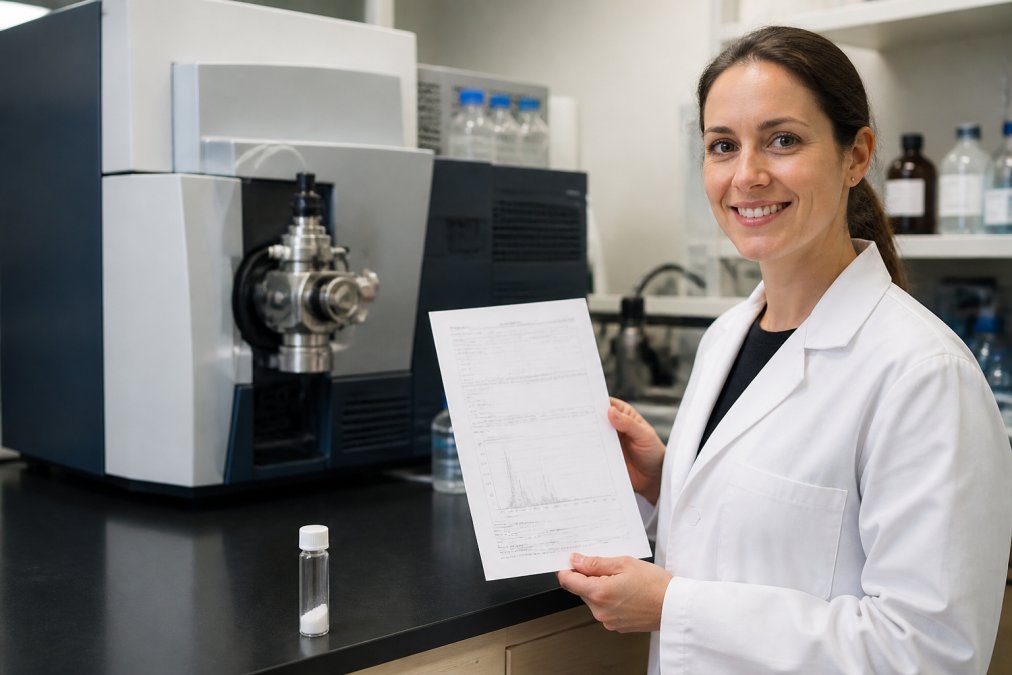
First, find the theoretical mass, calculated from the peptide sequence. Second, find the observed mass the instrument measured. Third, compare them. For most peptides, an observed mass within roughly one unit of the theoretical value passes; the exact tolerance depends on peptide size and instrument (peer-reviewed research).
The base peak should correspond to your peptide's expected m/z. Extra peaks can indicate salt adducts, common and usually harmless, or truncation products, which are not. A supplier should explain any peak that doesn't match the expected pattern.
When Mass Spectrometry Is Not Required
Most guides describe what mass spectrometry does and stop. The more useful question is the inverse: when can a researcher reasonably skip it? The answer depends on three variables, what you already know about the material, what the supplier documents, and what a wrong identity would cost you.
Scenario 1: Reordering a Lot You Have Already Characterized
If you previously received a vial from the same lot, verified its identity against a mass spectrum, and are reordering that lot number, a fresh run adds little. Confirm the new CoA references the same lot number and that its observed mass matches the old report's. If those numbers agree, you have identity continuity without a redundant test.
Scenario 2: Crude Material Headed for In-House Purification
Crude peptides are sold at lower purity by design, and buyers typically purify further before use. A mass spec reading on crude material confirms the target sequence is present but says little about the impurity profile you are about to remove anyway. If your downstream process includes your own HPLC purification and identity check, the supplier's mass spec is a nice-to-have, not a gate. The exception: if a mis-synthesized batch would waste weeks, it's cheap insurance.
Scenario 3: Screening Libraries Where Identity Is Confirmed Downstream
In screening campaigns, dozens or hundreds of compounds are tested in one assay, and any hit is re-ordered and re-characterized before it matters. A misidentified vial usually shows up as a failed hit, not a failed project. Deferring mass spec on the initial screen and requiring it only on confirmed hits is defensible, as long as the deferral is deliberate and documented, not accidental.
Scenario 4: When the Supplier's CoA Already Includes MS
This is the scenario most buyers overlook. If the supplier routinely includes a mass spectrum on every lot's CoA, by default, not on request, then 'is mass spectrometry required for my order' is already answered. You are not choosing whether to test, only whether to verify the test the supplier ran. The only work left is reading the CoA correctly, covered in the checklist above.
The Decision Rule
A simple rule captures most cases: if the cost of a wrong identity exceeds the cost of the test, test. If a failed experiment costs weeks, a misidentified vial will surface in the assay, or the material is headed for your own purification, deferral is reasonable. The rule is not 'always test' or 'never test', it is 'match the documentation to the consequence.'
What You Give Up When You Skip It
Skipping mass spec is not free. You lose the ability to catch sequence errors, truncations, and substitutions HPLC purity alone cannot detect, plus the paper trail that traces a failed experiment to a bad vial rather than a bad protocol. For researchers who publish, that traceability matters, reviewers increasingly expect identity documentation on the materials behind a result. The trade-off is real, but it is a trade-off, not a default.
Cost, Crude Samples, and Small-Scale Orders: The Trade-Offs
Most content on peptide analytics targets industrial and biotech-scale buyers, where a mass spec run is a rounding error against a batch worth tens of thousands of dollars. Small academic labs and independent researchers face different math. This section is for them.
What Actually Drives the Cost of a Mass Spec Run
Third-party mass spectrometry pricing depends on instrument type, turnaround time, and sample preparation. A few structural facts explain most of the variation:
- Instrument class. A simple electrospray ionization (ESI) single-quadrupole or ion-trap instrument is cheaper per sample than a high-resolution time-of-flight (TOF) or Orbitrap system. For routine peptide identity confirmation, the cheaper instruments are usually sufficient; high-resolution is reserved for ambiguous cases or complex mixtures.
- Sample preparation. A clean, desalted, purified sample can often be run directly. A crude sample with salts, solvents, or a complex matrix may require cleanup first, which adds labor and cost.
- Turnaround. Standard queue times are cheaper than rush service. If your experiment can wait, the price drops.
- Batching. Submitting multiple samples together typically lowers the per-sample price, because the instrument setup cost is amortized across the batch.
Per-sample price falls sharply once you move from a single sample to a batch, and again when you accept standard turnaround instead of rush. For a small lab, batching orders and planning ahead is the biggest cost lever.
The Real Trade-Off for Small-Scale Orders
The trade-off is not 'testing versus no testing.' It is 'testing on your budget versus testing on the supplier's budget.' When a supplier includes third-party mass spectrometry documentation with every lot, that cost is already embedded in the price. You are not choosing whether to spend money on mass spec, only whether to spend it as a line item or as part of the purchase price. A supplier that tests routinely and publishes results is not necessarily more expensive than one that tests on request, the routine tester has spread the cost across many lots and customers, while the on-request tester has no such scale.
Why Crude Samples Change the Calculus
Crude peptides are cheaper by design and typically contain a wider impurity profile. A mass spec reading on a crude sample confirms identity but says less about what else is in the vial, because impurity peaks are expected and harder to interpret. If your work requires a defined purity threshold, purified material with full documentation is the safer purchase even at a higher price, the extra cost buys a cleaner baseline and a more interpretable spectrum. If it doesn't, crude material plus a supplier-provided identity check is often most economical. The mistake to avoid is buying crude material and then paying separately for a high-resolution mass spec the crude sample cannot fully justify.
A Practical Budget Framework
For a small-scale order, three questions settle most of the decision:
- Does the supplier's CoA already include mass spec data? If yes, you have identity confirmation at no marginal cost. If no, you are deciding whether to buy it.
- What does a wrong identity cost you? If a failed experiment costs days, deferral is reasonable. If it costs weeks or a grant milestone, the test is cheap by comparison.
- Can you batch? If you have multiple compounds to characterize, submitting them together lowers the per-sample price and makes the decision easier.
What to Ask Before You Buy
Before placing a small-scale order, ask the supplier two questions: does the CoA for this lot include an observed mass and a theoretical mass, and is the testing third-party or in-house? The answers tell you whether you are buying documented material or material you must document yourself. For researchers on a tight budget, that conversation often saves more than any negotiation on price.
Conclusion
The real challenge with peptide orders isn't deciding whether mass spectrometry is worth it in the abstract; it's finding a supplier who documents identity and purity before you ask. Frontline Peptides ships third-party tested research peptides and GLP research compounds with certificates of analysis available, backed by competitive pricing, fast shipping, and exceptional customer service. If you want documentation you can verify before your experiment starts, get started with Frontline Peptides and order with confidence.
Frequently Asked Questions
What is the purpose of mass spectrometry in peptide sequencing?
Mass spectrometry measures the molecular mass of a peptide and its fragments, which confirms the sequence was built as ordered. The instrument converts molecules into gaseous ions and sorts them by mass-to-charge ratio (m/z). That pattern acts as an empirical identification fingerprint. HPLC alone cannot distinguish a correct sequence from a closely related impurity with the same retention time, which is why labs pair the two techniques for sequence verification.
Is HPLC sufficient for confirming peptide identity?
No. HPLC separates components and reports a purity profile, but it does not confirm what those components actually are. Two different synthetic peptides can elute at nearly the same time. Mass spectrometry adds the molecular mass check that HPLC cannot provide. For routine screening, HPLC purity data may be enough. For sequence verification, regulatory compliance, or any order where identity matters, you need both.
Can you perform mass spectrometry on crude peptide samples?
Yes, crude samples can be analyzed by MS, but the resulting spectrum is harder to read. Crude material contains truncated sequences, deletion products, and residual synthesis reagents, so the spectrum shows many peaks. Most suppliers run HPLC purification first, then confirm the purified product by MS. If you specifically need crude sample data, request it before ordering and expect a more complex report that requires careful interpretation.
What are the common quality control requirements for laboratory-grade peptides?
Most research-grade peptides ship with a certificate of analysis showing HPLC purity, mass spectrometry confirmation, molecular weight, and storage conditions. GLP-grade compounds typically require additional documentation: lot traceability, validated analytical methods, and consistent specifications across batches. If your project involves regulatory compliance, confirm the supplier can provide this documentation before you order, not after. Frontline Peptides lists testing details on each product page.
Why is mass spectrometry considered the gold standard for research peptides?
Mass spectrometry provides empirical identification: it confirms the actual molecular mass of the peptide, not just its retention time on a column. This catches synthesis errors that HPLC misses, including sequence deletions and substitutions. For proteomics, biologics, and any application where the exact peptide sequence matters, MS confirmation is the accepted standard. It is the difference between knowing a sample is 98% pure and knowing it is 98% pure and correctly sequenced.