

Table of Contents
- The Real Cost of Lyophilized Peptide Storage
- Best Practices for Peptide Storage: What the Data Supports
- Lyophilized vs. Reconstituted: Stability and Shelf Life
- Peptide Shelf Life After Reconstitution
- How to Safely Transport Research Peptides
- Signs of Peptide Degradation and Risk Assessment
- Environmental Impact of Cold-Chain Storage
- Conclusion
- Frequently Asked Questions
Last Updated: September 16, 2026
The Real Cost of Lyophilized Peptide Storage
Lyophilized peptide storage is worth the cost when it protects sample purity, extends shelf life, and prevents the expensive rerun of a failed assay. This guide from Frontline Peptides breaks down what you actually pay for, when cold storage earns its keep, and when it does not.
The short answer: for most research workflows, yes, with caveats. A $2.00 storage case and a $4.95 pack of vial caps cost less than a single compromised batch. The real expense is not the equipment. It is the freezer, the power, and the discipline required to keep a cold chain intact.

What does peptide storage actually cost? It depends on three inputs: the equipment itself, the energy to run it, and the labor to maintain protocol compliance. Most researchers underestimate the third.
What You Actually Pay For
A basic storage setup includes vials, caps, a case, and a temperature-controlled environment. The equipment line item is small. Freezer storage, desiccator use, and backup power dominate the budget.
The hidden cost is failure. When a lyophilized peptide absorbs moisture, the amino acid sequence can degrade, and analytical accuracy drops. You do not get a warning. You get a bad result weeks later.
A common mistake is buying a freezer before buying a protocol. The freezer is the easy part.
When the Math Favors Cold Storage
Cold storage pays off when three conditions hold: the peptide is expensive to replace, the study timeline is long, and the sample is irreplaceable. Under those conditions, freezer storage is not a cost. It is insurance.
For short-term work with cheap compounds, ambient temperature storage in a sealed desiccator may be sufficient. Lyophilized powder is stable at ambient temperature for short periods when kept dry and dark.
The judgment call is yours, but the framework is simple: if replacing the sample costs more than the storage, store it properly.
Best Practices for Peptide Storage: What the Data Supports
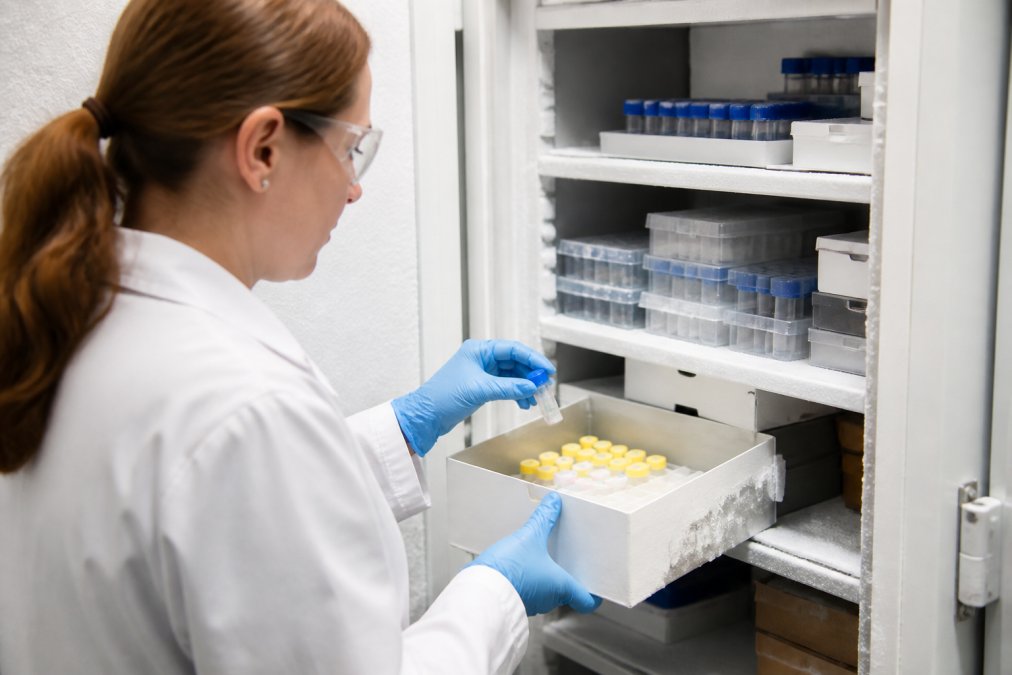
Best practices for peptide storage come down to three variables: temperature, light, and moisture. Control all three and lyophilized peptides remain biochemically stable for years.
Temperature, Light, and Moisture Control
Store lyophilized peptides at sub-zero temperatures for long-term storage, typically -20°C or lower. Short-term storage at refrigeration temperatures is acceptable for working aliquots you will use within days.
Light degrades peptides through oxidation. Amber vials or opaque storage cases solve this. If you use clear vials, keep them inside a closed case.
Moisture is the biggest threat. Lyophilized peptides are hygroscopic, meaning they pull water from the air. Every time you open a vial at ambient temperature, condensation forms. Let vials reach room temperature before opening, and use a desiccator for anything you access frequently.
- Store long-term samples at -20°C or below
- Keep vials in amber or opaque containers
- Let vials equilibrate before opening
- Use a desiccator for frequently accessed vials
- Label everything with date and lot number
Lyophilized vs. Reconstituted: Stability and Shelf Life
Lyophilized peptides are dramatically more stable than reconstituted peptides. A dry powder can last years at sub-zero temperatures. Once you add bacteriostatic water, the clock starts and it moves fast.
Reconstituted peptides typically hold stability for weeks to a few months under refrigeration, depending on the specific amino acid sequence. Some sequences degrade faster than others. There is no universal rule.
Lyophilized peptide storage is the reason dry powder wins on shelf life. Remove the water, remove the hydrolysis pathway. That single variable explains most of the stability gap.
Peptide Shelf Life After Reconstitution
Peptide shelf life after reconstitution is measured in weeks, not years. Refrigeration slows degradation but does not stop it. Freezing reconstituted peptides is possible but introduces freeze-thaw cycles that can damage the molecule.
Z-RESEARCH / PEPTIDE STORAGE CASE - 10 →
Avoid repeated freeze-thaw cycles at all costs. Each cycle stresses the peptide through ice crystal formation and concentration shifts. Aliquot before freezing so you thaw once and use once.
Bacteriostatic water extends reconstituted shelf life compared to plain sterile water because the benzyl alcohol inhibits microbial growth. It does not stop chemical degradation. Nothing does.
How to Safely Transport Research Peptides
How to safely transport research peptides depends on distance and duration. Short trips within a facility need only an insulated case and a cold pack. Cross-country shipping requires validated packaging and dry ice.
For lyophilized powder, transport is forgiving. Keep it dry, keep it dark, keep it cool, and it survives most journeys.
A practical transport checklist:
| Scenario | Container | Temperature Control | Duration Limit |
|---|---|---|---|
| Local handoff | Insulated case | Cold pack | 4-6 hours |
| Overnight shipping | Foam box | Dry ice | 24-48 hours |
| Multi-day transit | Validated shipper | Dry ice plus logger | 48-72 hours |
| International | Validated shipper | Dry ice plus customs docs | Varies by route |
Signs of Peptide Degradation and Risk Assessment
Signs of peptide degradation include cloudiness in reconstituted solutions, visible particulates, a color shift, and unexpected assay results. Lyophilized powder that has clumped or turned tacky has absorbed moisture. But visible signs are the tail end of the problem, not the beginning, and the real risk assessment is financial and scientific, not visual.
Visible vs. Silent Degradation
| Signal | What It Suggests | How Early It Appears |
|---|---|---|
| Clumping or tacky powder | Moisture absorption | Early |
| Color shift | Oxidation | Early to mid |
| Cloudiness in solution | Aggregation or precipitation | Mid |
| Visible particulates | Aggregation, contamination | Late |
| Unexpected assay result | Potency loss | Often the first hard evidence |
What most guides miss is that degradation is frequently silent. A peptide can lose potency without any visible change. By the time a solution turns cloudy, the sample has likely been compromised for weeks. This is why analytical accuracy depends on storage discipline, not on visual inspection.
Quantifying the Risk of Improper Storage
The financial case for proper storage is easiest to see when you frame a failed batch as a stack of costs, not a single line item:
- Replacement cost of the peptide. The direct re-order expense.
- Labor to redo the work. Hours of preparation, assay setup, and analysis that must be repeated.
- Instrument and reagent cost. Consumables used on a run that produced unusable data.
- Timeline slip. Delayed results can push back a publication, a grant milestone, or a product decision.
- Data integrity risk. If degraded material was used in a completed experiment, the validity of that result is now in question, and that is the most expensive outcome of all.
A Simple Risk Scoring Approach
Score each sample on three axes, low to high:
- Replacement difficulty, can you re-order it, and how fast?
- Timeline sensitivity, does a delay matter to the study?
- Downstream dependency, how many other experiments rely on this result?
High scores on any two axes justify the strictest storage tier you can afford. Low scores across all three mean ambient storage is a reasonable bet.
The Storage Discipline Premium
The equipment is cheap relative to the downside. The discipline is what you are really paying for. Logged temperatures, dated labels, single-use aliquots, and a written protocol are what convert a freezer from a box into actual insurance. Without them, the equipment is just an appliance.
Environmental Impact of Cold-Chain Storage
Cold-chain storage carries a real environmental cost. Ultra-low freezers draw significant power, and many labs run them continuously. The environmental impact of cold-chain storage is the angle most peptide guides ignore entirely.
Conclusion
The question of whether lyophilized peptide storage is worth the cost has a clear answer for most research workflows: yes, when the sample matters and the protocol is followed. The equipment is cheap. The discipline is what you are really paying for.
Frequently Asked Questions
How long will lyophilized peptides last in the refrigerator?
Lyophilized peptides stored in a refrigerator at 2-8°C typically remain stable for several months, but the exact duration depends on the specific amino acid sequence and vial integrity. For long-term storage beyond a few months, sub-zero temperatures are recommended. Keep vials sealed with a desiccator to limit moisture exposure. Always check the certificate of analysis for storage guidance specific to your peptide.
Do peptides really go bad after 30 days?
The 30-day rule applies mainly to reconstituted peptides stored in a refrigerator. Once a peptide is in solution, hydrolysis and oxidation can degrade it within weeks. Lyophilized powder, by contrast, can remain stable for months or years when kept cold and dry. If your peptide is still in powder form and stored properly, 30 days is not a hard deadline. Check for cloudiness or particles before use.
What is the optimal temperature for long-term lyophilized peptide storage?
For long-term storage, -20°C or lower is best for most lyophilized peptides. A -80°C freezer offers even greater stability for sensitive sequences. Avoid frost-free freezers that cycle above freezing, as temperature swings drive freeze-thaw cycles. Use a desiccator inside the freezer to keep moisture out. Consistent temperature matters as much as the target number.
How do I transport research peptides without degrading them?
Use an insulated cooler with dry ice or gel packs to maintain sub-zero temperatures during transport. Keep vials in a padded storage case to prevent breakage, and avoid opening the cooler repeatedly. For short trips, a quality cooler with frozen gel packs can hold temperature for hours. Always label vials clearly and include a temperature indicator if the journey is long.