

Table of Contents
- Understand TSA Guidelines for Research Compounds
- Know Peptide Storage Temperature Requirements
- Prepare Your Documentation and Prescriptions
- How to Pack Peptides for Travel
- Maintain Cold Chain During Transit
- Handle International Travel and Customs
- Create Your Pre-Flight Preparation Checklist
- Frequently Asked Questions
Last Updated: September 19, 2026
Understand TSA Guidelines for Research Compounds
The Transportation Security Administration (TSA) permits transport research peptides in both carry-on and checked luggage, but only when they meet specific conditions. Your peptides must be properly labeled, documented, and stored to pass security screening without delays.
TSA regulations treat research peptides as medical necessities when properly documented.
Here's what TSA requires:
- Original packaging or clearly labeled containers with ingredient names
- Documentation proving medical or research necessity
- Proper storage in a secure, temperature-controlled container
- Full transparency during security screening
Know Peptide Storage Temperature Requirements
Lyophilized vs. Reconstituted Stability Profiles
Container Material Compatibility During Transit
-
Glass vials with rubber stoppers: The gold standard for peptide transport. Glass is chemically inert. Ensure stoppers are covered with protective caps (such as Z-Research 3ML Vial Caps) to prevent contamination and minimize air exposure.

Z RESEARCH / 3ML Vial Caps - 12 Pack -
Polypropylene (PP) tubes and containers: Safe for short-term transport (under 48 hours) of lyophilized peptides. Unsuitable for reconstituted peptides during multi-day transport.
-
Polyethylene terephthalate (PET) plastic: Avoid for reconstituted peptides; use only as an outer protective layer.
-
Polycarbonate (PC) containers: Acceptable for short-term transport, but avoid if transport involves freezing or heat exposure.
Temperature Excursion Mechanisms and Timelines
-
0-2°C (freezing range): Lyophilized peptides tolerate freezing. Avoid freezing reconstituted peptides unless they contain cryoprotectants.
-
2-8°C (optimal refrigeration): This is the target range for all reconstituted peptides. Stability is maximized, and bacterial growth is inhibited.
-
15-25°C (ambient temperature): Reconstituted peptides degrade rapidly. Lyophilized peptides tolerate this range for 24-48 hours but begin showing measurable loss after 48 hours.
-
Above 25°C (warm/hot): Both forms degrade significantly. Reconstituted peptides may become unusable within 4-6 hours.
Practical Cold Chain Maintenance During Transit
Reference your peptide supplier's stability data in the Certificate of Analysis for specific transport timelines.
Prepare Your Documentation and Prescriptions
Proper documentation transforms your peptides into legitimate medical research materials and provides TSA and customs agents with proof of valid transport reasons.
Your documentation package should include:
- Prescription or letter from a licensed healthcare provider stating medical necessity
- Original vial labels showing peptide name, concentration, and expiration date
- Certificate of Analysis (COA) from the supplier proving purity and composition
- Travel itinerary showing your destination and duration
- Contact information for your healthcare provider or research institution
How to Pack Peptides for Travel
Packing research peptides correctly means building layers of protection against temperature fluctuations, physical damage, and contamination.
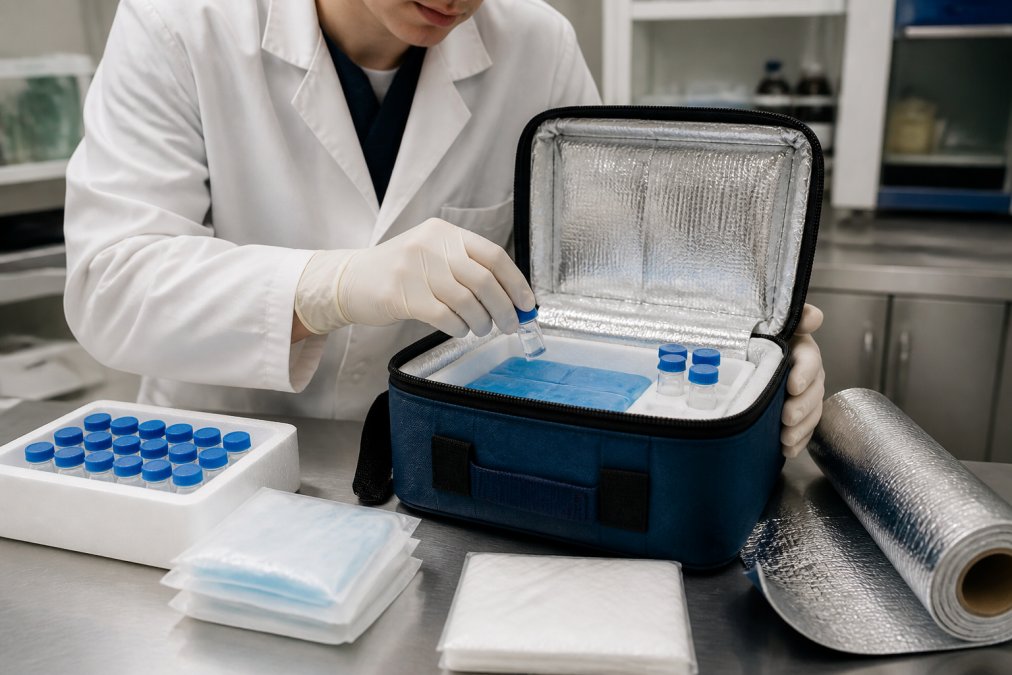
Your packing sequence should follow this structure:
- Secure individual vials in a storage container like the Z-Research Peptide Storage Case (holds 10 vials, $2.00), which keeps vials upright and prevents shifting during transport
- Add protective caps to prevent stopper contamination and protect vial tops from dust and debris
- Wrap the storage case in bubble wrap or foam padding to absorb shock from baggage handling
- Place ice packs around the wrapped case, maintaining a 1-2 inch buffer between ice and vials to prevent direct freezing
- Use an insulated travel case designed for medical compounds, with thermal insulation on all sides
- Add a temperature indicator inside the case to track whether the cold chain remained intact
Maintain Cold Chain During Transit
Cold chain maintenance is the difference between arriving with viable peptides and degraded compounds. The cold chain begins when you seal your insulated case and ends when you place vials in proper refrigeration at your destination.

Practical strategies for maintaining cold chain:
- Pre-cool your insulated case 2-3 hours before packing
- Use high-quality ice packs rated for extended cooling periods
- Avoid placing ice packs directly against vials, use a buffer layer
- Keep your case closed except when absolutely necessary
- Request TSA to inspect without opening the insulated container if possible
- Transport during cooler parts of the day when possible
- Never leave your case in direct sunlight or hot vehicles
Handle International Travel and Customs
International transport of research peptides involves regulatory complexity beyond TSA guidelines. This section covers what to do when declaration doesn't guarantee clearance and how to prepare for worst-case scenarios.
Pre-Travel Regulatory Research and Documentation
-
European Union: Peptides used for research are generally permitted, but some member states require import permits for specific compounds. Germany, France, and the United Kingdom have different classification systems. Contact the destination country's customs authority or use the EU Customs database to verify peptide classification.
-
Canada: Health Canada permits research peptides with prescription or medical documentation.
-
Australia: Import permits are required for most research peptides.
-
Mexico: Customs agents have discretion in determining whether a peptide is permitted. Carry detailed documentation.
Documentation Package for International Travel
Z-RESEARCH / PEPTIDE STORAGE CASE - 10 →
-
Prescription or medical necessity letter: Written by a licensed healthcare provider in your home country, stating the specific peptide name, dosage, and medical or research justification. Include the provider's license number and contact information.
-
Certificate of Analysis (CoA): From your peptide supplier, showing purity, composition, and testing methodology. This third-party verification proves your peptides meet pharmaceutical standards.
-
Import permit (if required): Issued by the destination country's regulatory agency. Keep this in your carry-on bag, separate from your insulated case.
-
Customs declaration forms: Complete these before arriving at the border. Declare the peptide name, quantity, concentration, and intended use. Incomplete or vague declarations trigger secondary screening.
-
Supplier information: Include the name, address, and contact details of the peptide manufacturer. Customs agents may contact suppliers to verify legitimacy.
-
Travel itinerary: Show your destination, duration, and return date. This context helps customs agents understand your trip purpose.
Emergency Contingency Planning: What to Do If Confiscation Occurs
-
Remain calm and cooperative. Do not resist or argue aggressively.
-
Request a written explanation of what was confiscated, why, and contact information for appeals.
-
Contact your embassy or consulate immediately if your peptides are confiscated while traveling abroad.
-
Document everything: agent name, badge number, date, and time for appeals or insurance claims.
-
Contact your peptide supplier. Inform them of the confiscation. Many suppliers offer replacement peptides at reduced cost or free replacement if confiscation occurs due to documentation issues on their end.
-
File a customs appeal (if applicable). Some countries allow appeals of confiscation decisions. Your embassy can guide you through this process.
Emergency Contingency Planning: Cold Chain Failure During Transit
-
Identify backup refrigeration at your destination before you travel. Contact a research institution, hospital, or pharmacy to arrange peptide storage upon arrival.
-
Carry contact information for local peptide suppliers in case emergency replacement is needed.
-
Use temperature indicators to document failure. Photograph any excursion immediately for insurance or replacement claims.
-
Request non-invasive inspection (X-ray, swab testing) rather than opening your insulated case to preserve cold chain integrity.
-
Plan for extended delays. Consider shipping peptides ahead or using a customs broker to pre-clear your shipment.
Shipping vs. Carrying: When to Use Each Method
-
Carrying peptides: Best for single trips under 48 hours with clear destination regulations.
-
Shipping peptides: Better for multi-week trips, ambiguous regulations, or high-value shipments.
-
Using a customs broker: Pre-clears peptides with destination customs before arrival. Costs $200-$500 per shipment but guarantees clearance.
Create Your Pre-Flight Preparation Checklist
A comprehensive pre-flight checklist eliminates last-minute scrambling and ensures you don't forget critical items or documentation. Use this checklist 48 hours before your flight to verify everything is ready.
- Vials are in original packaging or clearly labeled containers
- Certificate of Analysis from supplier is printed and accessible
- Medical necessity letter or prescription is in carry-on bag
- Insulated travel case has been pre-cooled for 2-3 hours
- Ice packs are frozen and ready for packing
- Storage container (Z-Research Peptide Storage Case) holds all vials securely
- Protective vial caps (Z-Research 3ML Vial Caps) are in place on reconstituted peptides
- Temperature indicator is inside the insulated case
- Documentation is separate from insulated case for easy TSA access
- Destination country regulations have been verified
- Customs declaration forms are completed if traveling internationally
- Contact information for healthcare provider or research institution is accessible
- Baggage tags and travel itinerary are prepared
- Backup cooling strategy is planned in case of delays (additional ice, gel packs)
Frequently Asked Questions
Will TSA confiscate peptides during security screening?
TSA does not automatically confiscate research peptides if you follow proper protocols. Declare your peptides as a medical necessity at the security checkpoint, present your prescription documentation, and keep them in carry-on luggage. Peptides intended for legitimate research or medical use with appropriate documentation typically pass screening. However, TSA screening officers have final discretion, so clear labeling and transparency are essential.
How long can research peptides remain stable outside of refrigeration?
Stability depends on the specific peptide and ambient temperature. Most lyophilized peptides can tolerate brief periods (4-8 hours) at room temperature without significant degradation. Reconstituted peptides are more sensitive and should not exceed 2-4 hours unrefrigerated. Transit times under 24 hours with proper insulated cooling solutions typically maintain vial integrity. Check your peptide's stability profile and use thermal insulation to minimize temperature excursions during transit.
What are the best cooling solutions for transporting research peptides?
Insulated travel cases with gel ice packs or reusable cooling elements are industry standard. Choose a case that maintains consistent cold chain temperatures between 2-8°C for refrigerated peptides. For longer transit periods, consider phase-change materials or portable medical-grade cooling solutions designed for pharmaceutical transport. Frontline Peptides offers a Z-RESEARCH peptide storage case designed for secure organization and protection during handling and short-term transport.
How should research peptides be labeled for transport?
Label all vials with the peptide name, concentration, reconstitution status (lyophilized or reconstituted), storage temperature requirements, and expiration date. Include your name and contact information. For air travel, clearly mark the original packaging with 'Research Compound' or 'Medical Necessity' if applicable. Include prescription documentation or medical necessity letters in an easily accessible pocket of your carry-on. Proper labeling prevents confusion at security checkpoints and ensures your peptides are handled correctly throughout transit.