

Table of Contents
- Understanding Peptide Reconstitution Volume
- The Basic Reconstitution Formula
- Step-by-Step Calculation Guide
- Using a Peptide Reconstitution Calculator
- Syringe Calibration and Mathematical Verification
- Best Practices for Peptide Handling and Solvent Selection
- How to Store Reconstituted Peptides
- Common Mistakes and Visual Troubleshooting
- Frequently Asked Questions
Last Updated: September 10, 2026
Understanding Peptide Reconstitution Volume
Peptide reconstitution volume is the amount of diluent you add to a lyophilized powder to reach a specific concentration for research use. Getting this number right determines whether every subsequent measurement is accurate.
Why Precise Volume Matters for Experimental Results
A small error in reconstitution volume compounds through every dose you draw. Add too much diluent and your working concentration drops, forcing larger draw volumes and reducing precision. Add too little and the peptide may not fully dissolve, skewing your actual concentration downward.
The math is unforgiving: concentration equals total peptide mass divided by total solution volume. Change the volume by 10% and you change the concentration by roughly the same proportion, with no way to correct it afterward.
The Basic Reconstitution Formula
The core formula is concentration = total peptide mass ÷ reconstitution volume. If you have 5 mg of peptide and add 2 mL of diluent, your concentration is 2.5 mg/mL. Everything else builds from that relationship.
Most calculation errors trace back to unit mismatches, not bad arithmetic. Work in one unit system throughout, then convert at the end.
Units of Measurement: mcg vs mg
- 1 milligram (mg) = 1,000 micrograms (mcg)
- 1 mL = 1,000 microliters (µL)
- A 5 mg vial contains 5,000 mcg of peptide
Write your target dosage in mcg and your vial mass in mg, then convert the vial to mcg before dividing. This eliminates the most common source of dosage accuracy failures.
Step-by-Step Calculation Guide
Follow these steps in order, recording each number.
- Read the vial label. Note the total peptide mass in mg (for example, 5 mg).
- Convert to mcg. Multiply by 1,000. A 5 mg vial = 5,000 mcg.
- State your target dosage in mcg. For example, 250 mcg per aliquot.
- Decide the concentration you want. Many researchers aim for a concentration where the target dose lands on an easy syringe marking.
- Calculate the reconstitution volume. Volume (mL) = total mass (mcg) ÷ desired concentration (mcg/mL).
- Verify with a reverse check. Multiply your final concentration by the volume. You should get back your starting mass.
Determining Target Dosage and Total Volume
Say you have a 5 mg vial and want 250 mcg per draw at 2,500 mcg/mL. Divide 5,000 mcg by 2,500 mcg/mL to get 2 mL of diluent. Each 250 mcg dose then requires a 0.1 mL draw, which lands cleanly on a standard insulin syringe.
Choose a concentration that produces round draw volumes, and you reduce measurement error at the bench.
Using a Peptide Reconstitution Calculator
A peptide reconstitution calculator removes arithmetic risk but only if you feed it correct inputs and interpret the output against the right syringe. These tools ask for vial mass, diluent volume, and target dose, then return the concentration and draw volume.
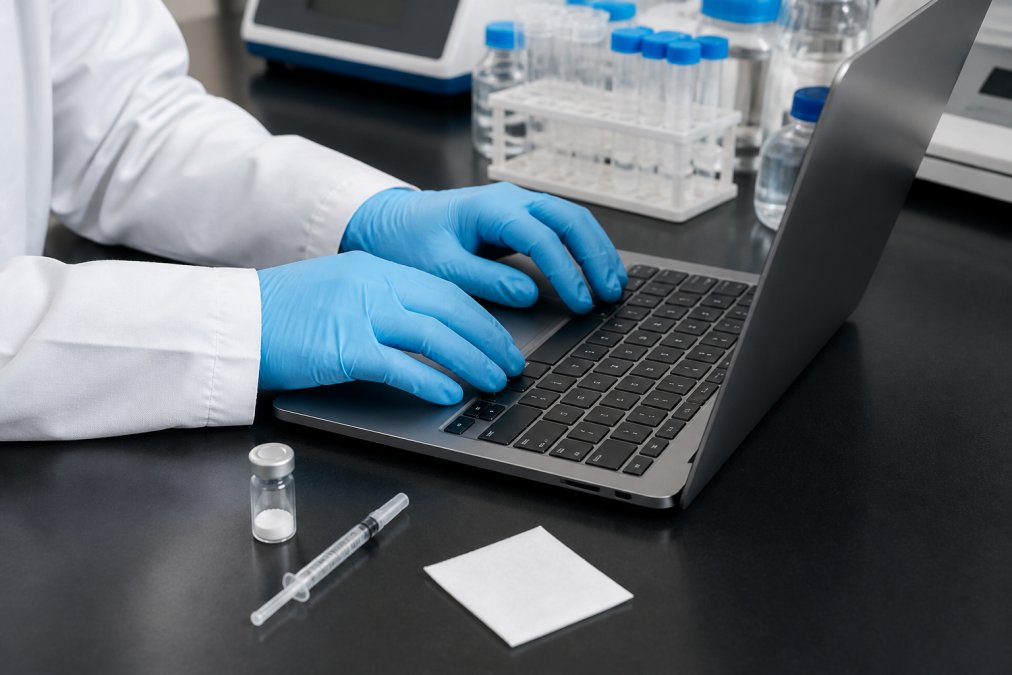
The catch: a calculator cannot catch a unit error you typed in. Enter 5,000 mcg as "5" in a field expecting mcg and the tool returns a confident, wrong answer. Always run the manual formula alongside the calculator for a new vial size.
Syringe Type Compatibility: The Error Most Calculators Hide
A calculator returns a volume in mL. It does not tell you which syringe that volume maps onto, where most real-world dosing errors originate.
Two syringe families dominate bench work, and their markings mean different things:
- U-100 insulin syringes are calibrated so that 100 units = 1 mL. One unit = 0.01 mL. A "10 unit" draw is 0.1 mL.
- Standard tuberculin (TB) syringes are marked in mL and fractions of an mL (commonly 0.01 mL graduations on a 1 mL barrel), not in "units." A "10" on a TB syringe means 0.1 mL only if the barrel is a 1 mL barrel with 0.01 mL ticks, but the number printed is a volume, not a unit count.
The failure mode: a researcher calculates a 0.1 mL draw, then reads "10" on a U-100 syringe and treats it as 10 units of peptide rather than 0.1 mL of solution. If the concentration was set assuming mL, the delivered mass is off by the unit-to-mL conversion silently applied. The reverse error happens when someone used to U-100 units reads a TB syringe's mL scale as units.
Before you trust any calculator output, confirm three things:
- The syringe barrel size printed on the barrel (0.3 mL, 0.5 mL, 1 mL).
- Whether the scale is in units (U-100) or mL (TB).
- What one graduation tick equals in mL.
If your protocol, your calculator, and your syringe do not all agree on the unit system, stop and reconcile before drawing.
Manual Sanity Check Formula
Run this check every time, even when the calculator looks right:
- Step 1: Concentration (mcg/mL) = total peptide mass (mcg) ÷ diluent volume (mL).
- Step 2: Draw volume (mL) = target dose (mcg) ÷ concentration (mcg/mL).
- Step 3: Reverse check: draw volume (mL) × concentration (mcg/mL) should equal target dose (mcg).
- Step 4: Syringe check: convert draw volume to the units your syringe actually displays. On a U-100 syringe, units = mL × 100. On a TB syringe, read the mL scale directly.
If Step 3 does not return your target dose, or Step 4 produces a number not on your syringe's scale, the input was wrong, not the math.
National Institute of Standards and Technology guide to SI unit conversions is a useful reference when you need to confirm a conversion factor rather than trust memory.
For researchers who want fewer variables in play, Frontline Peptides supplies Z-RESEARCH / BACTERIOSTATIC (BAC) WATER in single 3 mL bottles, so the diluent volume is fixed and labeled before you start.

Syringe Calibration and Mathematical Verification
Syringe markings are where correct math meets physical reality. A 1 mL insulin syringe divides into 100 units, so each unit equals 0.01 mL. A 0.5 mL syringe divides 0.5 mL into 50 units, so each unit is still 0.01 mL. The unit-to-volume relationship holds across common sizes, but total capacity does not.
Verify your syringe before every session:
- Confirm the barrel size printed on the syringe matches what your calculation assumed
- Check that your draw volume does not exceed 80% of barrel capacity
- Read the plunger seal, not the liquid meniscus, for the most consistent measurement
Two checks catch nearly every calculation error: reverse-multiply concentration by volume to recover your starting mass, and confirm your draw volume is physically possible in the syringe you're holding. If either fails, stop and recalculate.
Best Practices for Peptide Handling and Solvent Selection
Solvent choice affects solubility, and solubility affects whether your calculated concentration is real. Bacteriostatic water containing 0.9% benzyl alcohol is the standard diluent for most research peptides because the preservative slows microbial growth across multiple draws.
FDA guidance on sterile compounding and preservative use outlines why preserved diluents suit multi-dose research workflows better than plain sterile water.
A few handling rules that prevent most problems:
- Let the vial reach room temperature before adding diluent; cold glass slows dissolution
- Add diluent down the vial wall rather than directly onto the powder to reduce foaming
- Swirl gently; do not shake, which can damage peptide structure
- Vent vial pressure carefully if the stopper resists after mixing
For solvent volume flexibility, Z-RESEARCH / eBac 30 ML covers larger multi-vial sessions, while the Z-RESEARCH / SYRINGES + ALCOHOL WIPES KIT (10 PACK) pairs fine 31-gauge syringes with wipes for aseptic technique at the bench.


| Handling Step | What to Do | Why It Matters |
|---|---|---|
| Temperature | Warm vial to room temp first | Faster, more complete dissolution |
| Diluent addition | Run down the vial wall | Reduces foaming and peptide loss |
| Mixing | Swirl, never shake | Protects peptide structure |
| Draw technique | Read plunger seal, not meniscus | Consistent measurement error control |
| Verification | Reverse-multiply mass and volume | Catches unit errors before use |
How to Store Reconstituted Peptides
Reconstituted peptides are less stable than lyophilized powder and need cold storage immediately after mixing. Refrigeration at 2-8°C is standard for short-term use, and benzyl alcohol in bacteriostatic water helps hold back microbial growth during that window.
Freeze reconstituted solution only if your protocol requires it, and avoid repeated freeze-thaw cycles, which accelerate degradation. For multiple sessions, aliquot into single-use portions before freezing so each thaws once.
Solvent Selection Drives Stability More Than Temperature
The diluent you chose at reconstitution determines how long the solution survives, and most guides treat all water as interchangeable. It is not.
- Bacteriostatic water (0.9% benzyl alcohol): the default for multi-dose research workflows. The preservative suppresses microbial growth across repeated draws, which is why it pairs with refrigerated storage. Not appropriate for every peptide, some sequences are sensitive to benzyl alcohol, and the preservative can interfere with certain assays.
- Sterile water for injection: no preservative. Use it when the peptide is incompatible with benzyl alcohol or when the entire vial will be consumed in a single session. Once opened, it offers no microbial protection, so a multi-draw vial reconstituted with sterile water has a much shorter safe window.
- Acetic acid (dilute, typically 0.1%-1% in water): used for peptides that are poorly soluble in plain water or that aggregate at neutral pH. Some sequences only dissolve cleanly under mildly acidic conditions. Acetic acid is not a preservative; it is a solubility aid, and it can shift assay pH if not accounted for.
Match the solvent to the peptide's solubility behavior first, then to your workflow (single-use vs. multi-draw), then to storage duration. If the solvent preference is unknown, start with bacteriostatic water for multi-draw work and sterile water for single-use work.
Visual Troubleshooting: Reading the Vial Before You Draw
Most reconstitution failures are visible before you draw a single dose. Learning to read the vial saves material and time.
- Cloudy solution after mixing: often incomplete dissolution. Swirl longer at room temperature before concluding the peptide is degraded. If cloudiness persists after 10-15 minutes of gentle swirling, the solvent may be wrong for that peptide.
- Persistent particles or flakes: the peptide may need a different diluent (acetic acid is common here) or a longer hydration period. Do not force it by shaking.
- Foam ring at the top: caused by aggressive mixing or adding diluent too fast. Let it settle; do not draw through foam, which introduces air and skews volume.
- Gel-like or viscous appearance: some peptides form gels at high concentration. Dilute further with additional solvent rather than warming, which can degrade the sequence.
- Volume higher than expected: check whether you misread the syringe barrel or added diluent twice.
- Draw volume off by a fixed amount: usually a syringe calibration mismatch, not a concentration error.
Keep a simple log for every vial:
- Reconstitution date, diluent type, and diluent volume used
- Calculated concentration
- Storage location and temperature
- Observed clarity at reconstitution and at each draw
- Expected discard date
That log turns a storage question into a lookup instead of a guess, and captures solvent-related failures temperature alone will not explain.
CDC guidance on safe laboratory specimen handling and storage provides useful background on temperature control for sensitive biological materials.
Common Mistakes and Visual Troubleshooting
Most reconstitution failures are visible before you draw a single dose. Learning to read the vial saves material and time.
- Cloudy solution after mixing: often incomplete dissolution. Swirl longer at room temperature before concluding the peptide is degraded.
- Persistent particles or flakes: the peptide may need a different diluent or a longer hydration period. Do not force it.
- Foam ring at the top: caused by aggressive mixing or adding diluent too fast. Let it settle; do not draw through foam.
- Volume higher than expected: check whether you misread the syringe barrel or added diluent twice.
- Draw volume off by a fixed amount: usually a syringe calibration mismatch, not a concentration error.
Frequently Asked Questions
How do you calculate reconstitution volume for research peptides?
To calculate reconstitution volume, divide the total peptide mass (in mg) by the desired concentration (in mg/mL). For example, 10 mg of peptide at 5 mg/mL requires 2 mL of diluent. Use the formula: Volume (mL) = Total Mass (mg) / Desired Concentration (mg/mL). Always verify with a peptide reconstitution calculator and double-check your math before mixing.
What is the standard formula for peptide reconstitution?
The standard formula is: Volume of diluent (mL) = Total peptide mass (mg) / Desired concentration (mg/mL). Alternatively, if you know the target dosage per injection and the number of doses, multiply dose volume by number of doses to get total volume. Always use calibrated syringes and maintain aseptic technique throughout the process.
How much bacteriostatic water is needed for 10 mg of peptide?
The amount of bacteriostatic water depends on your desired concentration. For a 10 mg peptide, adding 1 mL gives 10 mg/mL; 2 mL gives 5 mg/mL; 5 mL gives 2 mg/mL. Choose based on your target dosage and syringe calibration. For example, a 250 mcg dose from a 5 mg/mL solution requires 0.05 mL, which is easier to measure with a 0.3 mL insulin syringe.
Why is precise reconstitution volume critical for experimental results?
Precise reconstitution volume ensures accurate dosage delivery, which directly affects experimental reproducibility and data integrity. Even small measurement errors can lead to significant deviations in concentration, potentially skewing results. Using calibrated syringes, verifying calculations, and following best practices for peptide handling minimize variability and support reliable research outcomes.
Reconstitution volume errors are quiet. They don't announce themselves, they just shift every downstream measurement by a fixed percentage until your results stop making sense. Frontline Peptides supports researchers with third-party tested compounds, U.S.-based fast shipping, and a full supply line of bacteriostatic water and syringes so the diluent and hardware match the calculation. Continue shopping with Frontline Peptides and start your next protocol with materials you can verify.