

Table of Contents
- What GLP Grade Compounds for Research Actually Mean
- FDA Regulations on Research Use Only Compounds
- Third-Party Testing for Research Chemicals: What to Demand
- GLP-1 Receptor Agonists in Metabolic Disease Research
- Chain of Custody and Storage Requirements for Research Peptides
- Buying Research Grade Peptides Online: A Sourcing Checklist
- GLP Grade Compounds Available for Qualified Researchers
- Frequently Asked Questions
Last Updated: September 2, 2026
What GLP Grade Compounds for Research Actually Mean
GLP grade compounds are research-quality substances manufactured and documented to meet standards required for legitimate scientific investigation, distinct from consumer products or pharmaceutical formulations for human use. The term gets used loosely across the industry, creating real confusion. Some suppliers apply it to mean "pretty pure." That's not what it means.
Good Laboratory Practice, as defined by the FDA's Good Laboratory Practice regulations for nonclinical studies, is a formal quality system governing how nonclinical safety studies are planned, performed, monitored, recorded, archived, and reported. Compound grade is one piece of that system, not a standalone marketing claim. GLP grade is not a single purity number, it's a documentation and process standard. A compound can test at 99% purity and still fail GLP requirements if batch records, impurity profiles, and chain of custody don't hold up.
Laboratory, GLP, and GMP: The Three Tiers of Compound Quality
The three tiers exist on a continuum of rigor, cost, and documentation burden.
Laboratory grade compounds meet basic purity specifications for general bench work with minimal documentation. These are appropriate for exploratory experiments where compound identity matters but traceability doesn't.
GLP grade compounds are manufactured and tested under conditions satisfying Good Laboratory Practice standards for nonclinical studies. Batch records are maintained, impurity profiles are characterized, and every lot is traceable from synthesis to delivery. This is the minimum standard for preclinical safety data intended to support regulatory submissions.
GMP grade (Good Manufacturing Practice) applies to compounds intended for human clinical trials. GMP requirements are substantially more demanding: validated manufacturing processes, environmental controls, personnel qualifications, and full audit trails. Most research peptides are not GMP grade and don't need to be for nonclinical work.
| Grade | Primary Use | Documentation Level | Impurity Profiling | Regulatory Basis |
|---|---|---|---|---|
| Laboratory | General bench research | Minimal | Not required | None formal |
| GLP | Nonclinical safety studies | Full batch records | Required | FDA 21 CFR Part 58 |
| GMP | Human clinical trials | Validated processes | Comprehensive | FDA 21 CFR Parts 210/211 |
If your research feeds into a drug development pipeline, GLP grade compounds are the floor, not the ceiling.
Analytical Purity, Impurity Profiles, and Why They Matter
Analytical purity is the percentage of the target compound in a sample, typically measured by high-performance liquid chromatography. A result of 98% means 2% is something else. What that something else is matters as much as the number itself.
Impurity profiling identifies and quantifies residual components: synthesis byproducts, degradation products, residual solvents, and in peptide work, amino acid sequence variants that differ from the target molecule. A compound with a clean purity number but an uncharacterized impurity profile is a liability in any serious study. For synthetic peptides, common impurity concerns include deletion sequences, truncated chains, and oxidized variants, which can have their own biological activity and may reflect the mixture rather than the target compound alone.
FDA Regulations on Research Use Only Compounds
What 'Research Use Only' Labeling Legally Requires
"Research Use Only" (RUO) indicates a product is intended solely for laboratory research and is not approved, cleared, or authorized for human use. The designation does not mean a product is unregulated. It means the product falls outside the drug approval pathway and must not be promoted or used as a diagnostic or therapeutic.
The FDA guidance on research use only and investigational use only products makes clear that RUO labeling is not a loophole. Suppliers who market RUO compounds for human consumption violate federal law regardless of labeling. Researchers who purchase RUO compounds for personal use rather than legitimate scientific investigation are similarly outside the law.
Legitimate RUO use includes compounds used in controlled laboratory settings by qualified researchers, studies with documented protocols and institutional oversight, no direct claims about human health outcomes in supplier marketing, and clear separation between research inventory and clinical product supply.
Unapproved Drug Alerts and the Risks of Non-Compliant Sourcing
The FDA has issued multiple unapproved drug alerts targeting compounded semaglutide and tirzepatide products marketed outside the approved drug framework. For researchers, sourcing from non-compliant suppliers creates threefold risk: the compound may not meet stated purity or identity specifications, purchasing creates institutional liability, and data generated using substandard compounds is scientifically compromised and potentially unpublishable.
The safest sourcing practice is straightforward: buy from suppliers who provide third-party analytical testing documentation for every batch and can demonstrate operations aligned with applicable FDA guidance.
Third-Party Testing for Research Chemicals: What to Demand
Supplier self-testing is not sufficient for serious research. Third-party testing means an independent, accredited laboratory has analyzed the compound and issued a report the supplier cannot alter.

The minimum testing package for GLP grade compounds should include HPLC purity analysis with full chromatogram, mass spectrometry for molecular weight verification, endotoxin testing (LAL assay or equivalent), residual solvent analysis, and amino acid sequence confirmation for peptides. Any supplier who cannot provide all five on request is not operating at the standard the label implies.
How to Read a Certificate of Analysis (CoA)
A Certificate of Analysis is the primary documentation artifact for any research compound. A compliant CoA should contain compound identity (IUPAC name, CAS number, molecular formula, molecular weight), lot or batch number, test methods used, results with method detection limit stated, impurity data with individual peaks identified and quantified, endotoxin result expressed in EU/mg with acceptance criterion, testing laboratory name and accreditation number with analyst signature, and analysis date corresponding to the batch.
HPLC, Mass Spectrometry, and Endotoxin Testing Explained
High-performance liquid chromatography separates compound components by their interaction with a stationary phase. The resulting chromatogram shows each component as a peak; area under each peak corresponds to relative concentration. For peptide purity work, reverse-phase HPLC is standard.
Mass spectrometry confirms molecular identity by measuring mass-to-charge ratio of ionized molecules. LC-MS (liquid chromatography coupled with mass spectrometry) can simultaneously confirm purity and verify amino acid sequence by fragmenting the peptide and reading the resulting ion series. A compound passing HPLC purity but failing mass spectrometry identity confirmation is not what the label claims.
Endotoxin testing detects bacterial lipopolysaccharides that contaminate peptides produced in non-sterile conditions. Even at low concentrations, endotoxins cause significant biological effects in cell-based assays, invalidating entire experimental series. The Limulus Amebocyte Lysate assay is the standard method.
GLP-1 Receptor Agonists in Metabolic Disease Research
GLP-1 (glucagon-like peptide-1) is an incretin hormone that stimulates insulin secretion, suppresses glucagon release, slows gastric emptying, and reduces appetite. Synthetic GLP-1 receptor agonists replicate or extend these effects, making them useful tools for studying type 2 diabetes mechanisms, obesity-related metabolic dysfunction, and cardiovascular risk factors.
The research landscape extends beyond single-receptor agonism. Dual agonists targeting both GLP-1 and GIP (glucose-dependent insulinotropic polypeptide) receptors, such as tirzepatide analogs, allow researchers to study coordinated incretin signaling. Triple agonists adding glucagon receptor activity, such as retatrutide analogs, open investigation into energy expenditure pathways.
For this research to produce reliable pharmacokinetic and pharmacodynamic data, compound quality is non-negotiable. Peptide stability affects bioavailability, impurities affect receptor binding kinetics, and batch-to-batch inconsistency makes longitudinal studies unreliable. Researchers using GLP grade compounds from documented, third-party-tested sources produce data that can be replicated and built upon.
According to NIH's National Institute of Diabetes and Digestive and Kidney Diseases research resources, metabolic disease affects a substantial portion of the adult population, making well-designed preclinical research directly relevant to public health outcomes.
Frontline Peptides offers compounds relevant to this research area: GLP-1SM (Semaglutide analog) at $40.00 for foundational metabolic signaling work, GLP-3RT (Retatrutide analog) at $40.00 for multi-receptor agonism research, and GLP-2TZ (Tirzepatide analog) at $50.00 for dual GIP/GLP-1 receptor agonism studies.
Chain of Custody and Storage Requirements for Research Peptides
Chain of custody is the documented, unbroken record of who handled a compound, when, and under what conditions from synthesis through delivery. For GLP grade compounds, documentation should include manufacturing date, lot number, storage conditions during transit, and any temperature excursion events recorded during shipping. A compound that spent 48 hours above its recommended storage temperature is not the same compound that left the manufacturer.
Peptide stability is highly sensitive to storage conditions. Most research peptides require lyophilized storage at -20°C or colder, protection from light and humidity, reconstitution in appropriate solvent immediately before use, and single-use aliquots to avoid repeated freeze-thaw cycles. Repeated freeze-thaw cycles degrade peptide bonds, increase aggregation, and generate sequence variants that impurity profiling detects.
Buying Research Grade Peptides Online: A Sourcing Checklist
Before placing any order, confirm the following:
- Third-party CoA available for the specific lot you are purchasing
- CoA includes HPLC chromatogram, mass spectrometry confirmation, and endotoxin result
- Supplier can identify the testing laboratory by name and accreditation
- RUO labeling is present and supplier does not make human health claims
- Batch number on CoA matches product label
- Storage and shipping conditions are documented with cold-chain options available
- Supplier has verifiable physical address and accessible customer support
- Returns or replacement policy exists for verified quality failures
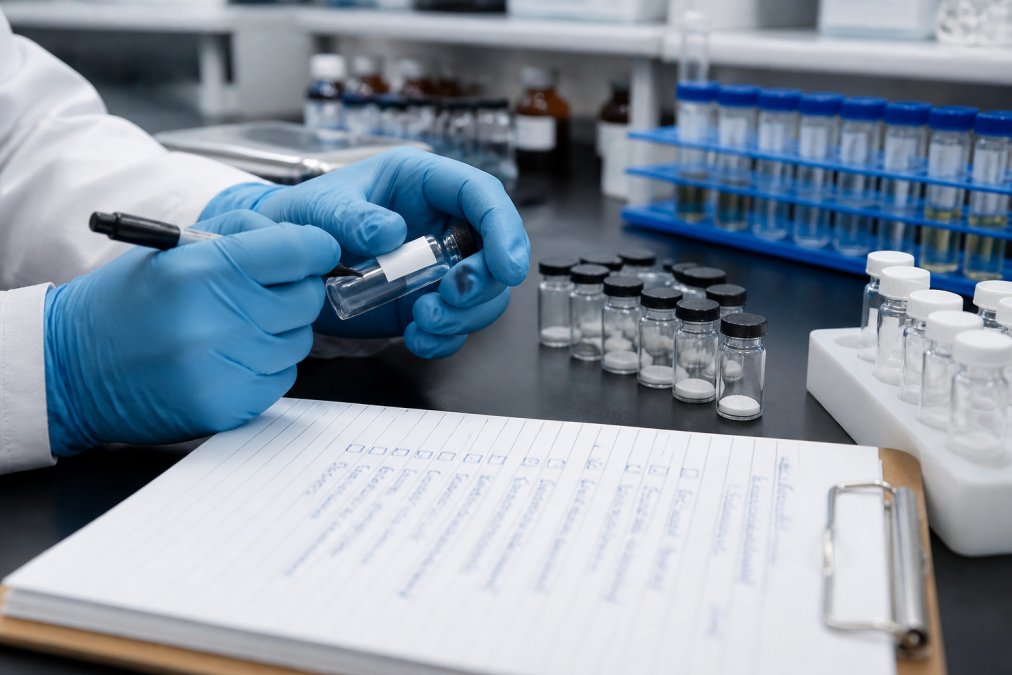
The cheapest peptide supplier is almost never operating at GLP standards. The cost of a failed experiment far exceeds any savings on compound cost.
Supplier Documentation and Batch Consistency Red Flags
Batch consistency measures whether a supplier produces the same compound to the same specification across multiple production runs. Red flags indicating a supplier is not maintaining batch consistency include significantly different impurity profiles between lots without explanation, inability to provide historical lot data, purity results varying by more than 2% between lots, testing laboratory changes without explanation, and shipping documentation lacking lot-specific labeling.
As noted in USP guidelines on analytical procedures for pharmaceutical compounds, validated analytical procedures and documented batch records are the foundation of compound reliability. Suppliers who cannot meet this standard are not operating at the level the research community requires.
GLP Grade Compounds Available for Qualified Researchers
Frontline Peptides supplies third-party tested GLP grade compounds to qualified researchers with full CoA documentation for every batch. U.S.-based operations mean faster shipping and direct customer support from people who understand the research context.
GLP-1SM (Semaglutide analog) - $40.00 A GLP-1 receptor agonist for foundational metabolic signaling research. Browse GLP-1SM
GLP-3RT (Retatrutide analog) - $40.00 A multi-receptor agonist engaging GLP-1, GIP, and glucagon pathways for examining complex signaling interactions. Browse GLP-3RT

GLP-2TZ (Tirzepatide analog) - $50.00 A dual GIP/GLP-1 receptor agonist for research into coordinated incretin signaling. Browse GLP-2TZ

CAGRILINTIDE - $50.00 A synthetic amylin analog for metabolic signaling and appetite regulation research. Browse CAGRILINTIDE

All products ship with third-party CoA documentation. Researchers with questions about documentation requirements can reach our support team directly. Supplier qualification is a researcher's responsibility. A supplier confident in their product quality makes testing data easy to find.
Frequently Asked Questions
What is the difference between research grade and GLP grade compounds?
Research grade compounds meet basic analytical purity thresholds sufficient for exploratory studies, typically verified by a single HPLC run. GLP grade compounds for research go further: they require documented batch consistency, full impurity profiles, endotoxin screening, residual solvent testing, and chain-of-custody records that satisfy Good Laboratory Practice standards. The difference matters most when data from your study will feed into a regulatory submission or a drug development pipeline, where substandard compounds can invalidate entire datasets.
Are GLP-1 research compounds legal for human consumption?
No. GLP-1 receptor agonists sold under a 'Research Use Only' label are not approved by the FDA for human administration. The RUO designation legally restricts their use to controlled laboratory environments. Administering these compounds to humans outside an approved clinical trial violates federal law and exposes researchers to serious regulatory and liability consequences. The FDA has issued multiple unapproved drug alerts specifically targeting compounded and research-labeled GLP-1 peptides sold for personal use.
How do you verify the purity of research-grade peptides?
Request a Certificate of Analysis from the supplier before purchasing. A credible CoA will include HPLC chromatograms confirming analytical purity (typically ≥98%), mass spectrometry data verifying the correct molecular weight and amino acid sequence, endotoxin levels measured in EU/mg, and residual solvent results. Third-party testing for research chemicals adds an extra layer of confidence because the testing lab has no commercial interest in the outcome. Always confirm the CoA is batch-specific, not a generic document reused across multiple lots.
What does 'Research Use Only' (RUO) mean for laboratory procurement?
RUO labeling means the compound has not been reviewed or approved by the FDA for diagnostic or therapeutic use in humans or animals. For procurement purposes, it signals that the product is intended solely for in vitro or in vivo preclinical studies conducted by qualified researchers. Institutions procuring RUO compounds should maintain internal documentation showing the compounds are used exclusively within approved research protocols, since regulatory audits may examine purchasing records and end-use justifications.
What should I look for when buying research grade peptides online?
Prioritize suppliers who publish batch-specific Certificates of Analysis from ISO-compliant, independent laboratories. Check that each CoA includes HPLC purity data, mass spectrometry confirmation, endotoxin testing, and residual solvent results. Verify the supplier stores peptides under appropriate conditions and ships with cold-chain packaging when required for peptide stability. Consistent inventory, clear documentation, and responsive customer support are equally important, especially for multi-phase projects where running out of a specific batch mid-study can compromise data integrity.
How can researchers ensure the reliability of their chemical supply chain?
Establish a relationship with a single, well-documented supplier rather than switching sources between experiments, since batch-to-batch variability across different vendors can introduce confounding variables. Request advance notice on stock levels for long-running studies. Confirm the supplier follows documented storage and handling protocols, and keep your own receiving records including lot numbers, receipt dates, and storage conditions. For GLP-compliant work, this chain-of-custody documentation is not optional; it is a core requirement of Good Laboratory Practice.
Sourcing reliable GLP grade compounds is one of the most consequential decisions a research team makes, and it's also one of the easiest to get wrong under time pressure. Frontline Peptides provides third-party tested research peptides with full batch documentation, U.S.-based shipping, and direct customer support for researchers who need answers, not autoresponders. Browse the current catalog and continue shopping for the compounds your study requires.