

Table of Contents
- Why the Vendor You Choose Determines Your Research Outcomes
- Peptide Certificate of Analysis Verification: Reading the Document That Matters Most
- Why Third-Party Tested Research Peptides Beat In-House Claims
- Red Flags in Peptide Suppliers: Warning Signs That Predict a Bad Batch
- Cold Chain Logistics, Shipping Integrity, and Storage Conditions
- RUO vs. GMP Certified: Matching Vendor Standards to Your Research
- A Vendor Audit Checklist: Pricing Transparency, Support, and Stability Testing
- Conclusion: Building a Due Diligence Habit That Protects Your Work
- Frequently Asked Questions
Last Updated: September 23, 2026
Why the Vendor You Choose Determines Your Research Outcomes
Choosing a reliable peptide vendor is the single most consequential decision in any peptide research protocol. A certificate of analysis (CoA) is the document that proves a supplier's purity and identity claims, and without one you are trusting marketing copy over evidence.
Peptide Certificate of Analysis Verification: Reading the Document That Matters Most
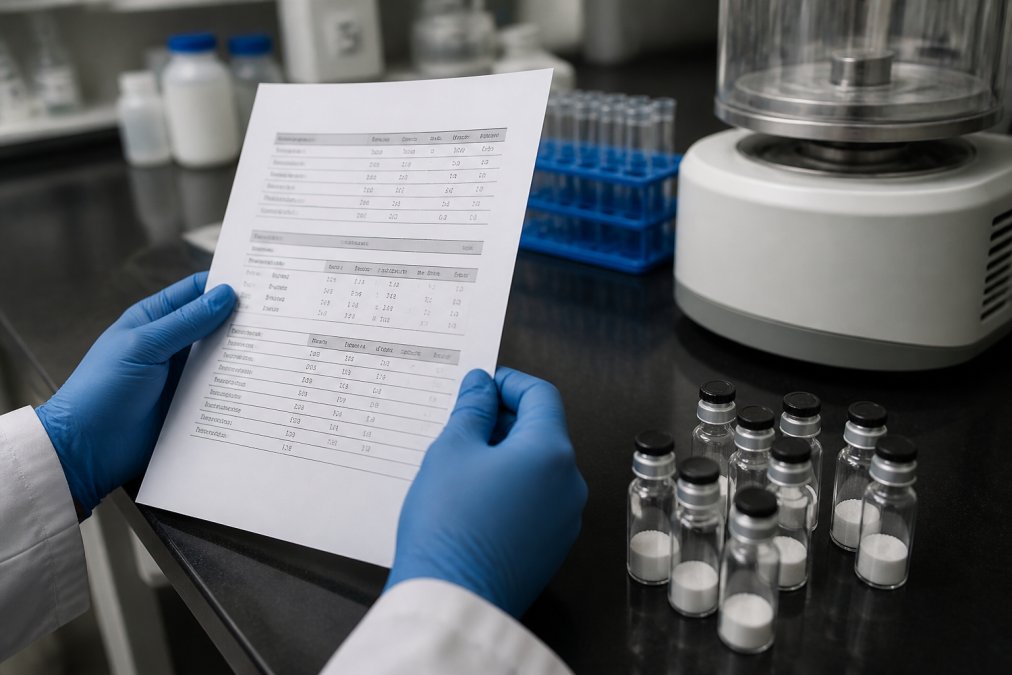
Peptide certificate of analysis verification means confirming that a CoA matches the batch you actually received, not just that a document exists. A CoA should list the batch number, test date, method used, and the specific result for each parameter.
How to Read HPLC and Mass Spectrometry Data on a CoA
High-performance liquid chromatography (HPLC) reports purity as a percentage from the area under the main peak. Mass spectrometry (MS) confirms molecular weight, verifying the compound is what the label claims.
Batch Testing, Traceability, and What a CoA Should Never Hide
Every batch should have its own CoA. If a vendor sends a generic document that covers an entire product line rather than a specific lot number, that is not traceability.
Why Third-Party Tested Research Peptides Beat In-House Claims
Third-party tested research peptides carry independent verification from a laboratory with no financial stake in the result. In-house testing, by contrast, is self-reported and unauditable.
Red Flags in Peptide Suppliers: Warning Signs That Predict a Bad Batch
Red flags in peptide suppliers usually appear before you order, not after. The warning signs cluster around documentation, communication, and pricing.
- No CoA available before purchase
- Purity claims without supporting chromatograms
- Prices far below the market without explanation
- Vague or evasive answers about testing labs
- No batch numbers on product listings
- Pressure to buy before you can review documentation
Cold Chain Logistics, Shipping Integrity, and Storage Conditions
Cold chain logistics determine whether a compound arrives intact or degraded. Lyophilized powder is more stable than reconstituted solution, but heat exposure during transit still compromises peptide stability, and the damage is often invisible on arrival.
What Actually Happens to a Peptide in Transit
Peptides degrade through three primary mechanisms: hydrolysis (water-driven cleavage of the peptide bond), oxidation (particularly at methionine, cysteine, and tryptophan residues), and aggregation (unfolding that causes molecules to clump and lose activity). Each is accelerated by heat, moisture, and light.
Temperature Ranges and What They Mean
Most research peptides are stable long-term at -20°C, stable for weeks to months at 2-8°C, and degrade progressively above roughly 25°C. The practical implication: a vendor who ships without temperature control in July is exposing your material to a risk they cannot measure after the fact.
Good practice looks like this:
- Insulated mailers with phase-change coolant packs rated for the expected transit window
- Overnight or 2-day service rather than ground, especially in summer
- Tracking that lets you intercept a package before it sits on a porch in the sun
- A vendor who will tell you the coolant rating and the expected transit time before you order
How to Verify Shipping Integrity Yourself
You cannot un-degrade a peptide, but you can document what arrived:
- Photograph the vial and packaging immediately on arrival, before opening.
- Note the coolant pack state, still frozen, partially thawed, or fully warm.
- Check the lyophilized cake for discoloration, melting, or shrinkage from the vial walls.
- Log the outdoor temperature at delivery if you can.
- If anything looks off, request a replacement before reconstituting, most reputable vendors will honor this if you have documentation.
Storage After Delivery
Once in your hands, storage conditions matter as much as shipping. Most lyophilized compounds should stay cool, dry, and protected from light. Refrigerate after reconstitution and freeze at approximately -20°C for extended storage. Avoid repeated freeze-thaw cycles, aliquot before freezing if you plan to use a vial more than a few times.
| Stage | Risk | What Good Practice Looks Like |
|---|---|---|
| Packaging | Heat, light, and moisture exposure | Insulated, light-protected containers with rated coolant |
| Transit | Extended time in uncontrolled temperature | Overnight or 2-day service, tracked delivery |
| Pre-reconstitution storage | Moisture and light degradation | Cool, dry, light-protected environment; -20°C for long-term |
| Post-reconstitution storage | Rapid hydrolysis and aggregation | Refrigerate short-term; freeze aliquots at -20°C |
| Handling | Freeze-thaw cycling | Aliquot before first freeze; avoid repeated cycling |
RUO vs. GMP Certified: Matching Vendor Standards to Your Research
Most guides gloss over the RUO versus GMP distinction, treating it as a label rather than a legal and quality-system boundary. That is a mistake, because the label determines what documentation you can demand, what the vendor is legally allowed to claim, and whether your work will survive an institutional or client review.
What "Research Use Only" Actually Means
Research use only (RUO) is a labeling designation, not a quality grade. It signals that the compound is sold for laboratory investigation and is not intended for human or veterinary use. RUO material is not required to be manufactured under pharmaceutical good manufacturing practice, and vendors selling RUO peptides are generally not permitted to make diagnostic or therapeutic claims about them.
What GMP Adds, and What It Costs
GMP (current good manufacturing practice) is a regulatory framework enforced by the FDA guidance on current good manufacturing practice. Material produced under GMP carries:
- Documented manufacturing controls at every step, from raw material to finished vial
- Validated analytical methods, not just results
- Stability testing protocols with defined shelf-life claims
- Batch records and audit trails that survive third-party inspection
- Deviation and out-of-specification handling procedures
The Stability Testing Question Nobody Asks
Here is the gap most buyers miss: a CoA proves a batch was pure on the day it was tested. It does not prove the batch will still be pure in six months. That is what stability testing establishes, and it is one of the clearest markers of a vendor operating at GMP-adjacent discipline versus one just running a purity check.
Stability testing protocols typically include:
- Accelerated studies at elevated temperature and humidity to model degradation
- Real-time studies at the intended storage condition, run over months to years
- Assay at multiple time points, not just at release
- Defined acceptance criteria for purity, potency, and appearance
Matching the Standard to the Study
Before you order, answer three questions:
- Will anyone outside your lab review the provenance of this material?
- Does the study require a defined shelf life, or will you use the material within weeks?
- Are you prepared to defend the vendor's documentation if challenged?
If the answer to any of those is yes, RUO may not be sufficient. Matching the standard to the study is a due diligence step, not a formality.
A Vendor Audit Checklist: Pricing Transparency, Support, and Stability Testing
Run this checklist before committing to any supplier. It takes about 20 minutes and prevents most bad sourcing decisions.
- CoA available before purchase, tied to a specific batch number
- Independent lab named on the CoA
- HPLC and MS data both provided
- Pricing published clearly, no hidden fees
- Customer support reachable by phone or chat, not email only
- Stability testing data available on request
- Shipping method and temperature handling explained
- Return or resolution policy stated in writing
Conclusion: Building a Due Diligence Habit That Protects Your Work
Verifying a peptide supplier is not a one-time task. Batch quality shifts, labs change, and a vendor that was reliable last year may not be next year. Building a habit of checking CoAs, confirming third-party verification, and auditing shipping practices protects every study you run.
Frequently Asked Questions
What documentation should a reliable peptide vendor provide before I buy?
A vendor should supply a batch-specific certificate of analysis showing high-performance liquid chromatography and mass spectrometry results, plus purity levels, molecular weight verification, and contaminant screening. Ask for the CoA for the exact lot you are purchasing, not a generic sample. Reputable suppliers also provide storage conditions, reconstitution guidance, and traceability back to raw material sourcing. If a vendor cannot produce these documents on request, treat that as a serious warning sign.
How do I verify a peptide certificate of analysis is genuine?
Check that the CoA lists the testing laboratory by name, includes a unique batch or lot number that matches your vial, and shows actual chromatogram and spectra data rather than a summary table alone. Cross-reference the reported molecular weight against the theoretical value for the compound. Peptide certificate of analysis verification also means confirming the testing lab is independent of the vendor. When in doubt, contact the lab directly to confirm the report is authentic.
Why is third-party testing important for research peptides?
Third-party tested research peptides are analyzed by a laboratory with no financial stake in the result. In-house testing lets a vendor grade its own work, which creates an obvious conflict of interest. Independent batch testing catches underdosed vials, wrong sequences, residual solvents, and endotoxin levels that in-house screening may miss. For anyone running repeatable experiments, that outside verification is the difference between data you can publish and data you have to throw out.
What are the most common red flags in peptide suppliers?
Watch for vendors who refuse to share batch-specific CoAs, quote purity above 99% without supporting chromatograms, or sell at prices far below market without explanation. Other red flags in peptide suppliers include no physical U.S. address, no verifiable customer support channel, vague shipping terms that ignore cold chain logistics, and stock that disappears mid-project. A supplier that cannot answer basic questions about raw material sourcing or stability testing is not worth the risk.
How should research peptides be shipped and stored to maintain stability?
Lyophilized powder should arrive in sealed vials with desiccant, shipped under conditions that protect it from heat and light. For longer transit, cold chain logistics with insulated packaging and gel packs preserve peptide stability. Once received, store dry compound in a cool, dark, dry place. After reconstitution, refrigeration is recommended, and freezing at approximately -20°C supports extended storage. Frontline Peptides ships from within the U.S. to reduce transit time and temperature exposure.
What is the difference between RUO and GMP certified peptides?
Research Use Only compounds are sold for laboratory investigation and are not manufactured under pharmaceutical quality systems. GMP certified peptides are produced under documented manufacturing practices with stricter control over raw material sourcing, batch testing, and regulatory compliance. If your work supports a pharma client or requires an audit trail, you need GMP-level documentation. For basic in vitro research, a well-documented RUO compound with a full CoA is often sufficient and more affordable.
How much should I expect to pay for quality research peptides?
Pricing varies by compound and vial size. As a reference point, Frontline Peptides lists BPC-157 10mg at $30.00, Ipamorelin 5mg at $25.00, GLP-3RT 10mg at $40.00, TB-500 10mg at $48.00, and GLP-2TZ 10mg at $50.00. Suspiciously low prices usually mean skipped analytical testing or underdosed vials. Compare the cost against the documentation you receive: a CoA from an independent lab is part of what you are paying for.
Can I reach a real person if something goes wrong with my order?
Customer support responsiveness is one of the most reliable signals of a vendor worth keeping. Before your first order, send a question about testing or shipping and time the response. A supplier that answers within a business day with specific information is likely to handle problems well. A supplier that routes you through automated replies or takes a week to respond will be far harder to work with when a shipment is delayed or a batch needs replacing.
Sourcing decisions get easier once you know which documents to demand and which answers should make you walk away. Frontline Peptides offers third-party tested compounds, transparent pricing, and fast shipping so your verification process starts with a supplier that expects to be checked. Browse the catalog and confirm the CoA before your next order.