

Table of Contents
- Why Peptide Storage Conditions Decide Your Results
- Lyophilized vs. Reconstituted: Two Different Storage Problems
- How to Reconstitute Peptides Without Compromising Stability
- Peptide Degradation Factors: What Breaks Down Your Compound
- Peptide Shelf Life After Mixing: What to Expect and How to Extend It
- Aliquoting and Vial Handling Best Practices
- Troubleshooting Degraded Peptides: Signs and Solutions
- Conclusion
- Frequently Asked Questions
Last Updated: September 25, 2026
Why Peptide Storage Conditions Decide Your Results
Peptide storage is the set of handling and environmental controls that keep a research compound intact between the day it arrives and the day you use it. Get those controls right and your results stay repeatable. Get them wrong and you are running experiments on a compound that quietly changed before you opened the vial.
This guide from Frontline Peptides walks through the practical side of storage, the part that lab manuals often skip. Below, we show you exactly how to store powder and liquid forms, how to reconstitute without wrecking the compound, and what to do when something already looks off.
The core tension in peptide storage is simple: powder and liquid fail for different reasons. Treat them the same and one of them loses.
Lyophilized vs. Reconstituted: Two Different Storage Problems
Lyophilized peptides are freeze-dried powders, and they are the more forgiving form. Reconstituted peptides are dissolved in liquid, and they are far more fragile. Each form needs its own plan.
A lyophilized powder is stable because almost all the water is gone. Water drives most breakdown reactions, so removing it slows everything down. Once you add liquid, those reactions restart.
A common mistake is assuming a mixed vial keeps as long as the powder it came from. It does not. The clock starts the moment the solution forms.
Temperature Requirements for Powder and Liquid Forms
Powder and liquid have different temperature needs. A standard freezer works for most dry peptides. Mixed peptides usually need colder, more consistent conditions.
Lyophilized powder:
- Short term, a few weeks: refrigerator is acceptable
- Long term, months or more: freezer at -20°C is the common choice
- Certain fragile sequences: -80°C for maximum stability
Reconstituted solution:
- Store in the refrigerator, typically 2°C to 8°C
- Use within a shorter window than powder
- Avoid repeated warming and cooling
Temperature cycling does more damage than a steady cold temperature. Every warm-up and cool-down adds stress. Pick a spot and leave the vial there.
How to Reconstitute Peptides Without Compromising Stability
Reconstitution is the process of adding a sterile liquid to a lyophilized powder to dissolve it. Do it gently, in the right order, and the compound stays intact. Rush it and you risk foaming, clumping, and loss.
Here is the sequence that works:
- Let the vial reach room temperature before opening it
- Wipe the stopper with an alcohol swab and let it dry
- Draw your sterile liquid, such as bacteriostatic water, into a syringe
- Aim the stream at the vial wall, not directly at the powder
- Add the liquid slowly and let it run down the glass
- Swirl gently until the powder fully dissolves
- Do not shake the vial at any point
Bacteriostatic water is a common choice for reconstitution because it contains 0.9% benzyl alcohol, which helps limit microbial growth during multi-use handling. Frontline Peptides supplies BAC Water in a 3 mL bottle for small batches and a 30 mL multi-dose bottle for larger workflows.


Dissolution Technique: Swirl, Don't Shake
Swirling is the single technique that separates a clean solution from a damaged one. Shaking introduces air and shear force. Both can unfold a peptide and cause it to clump out of solution.
Swirl the vial in a slow circle between your fingers. Let the liquid do the work. If the powder resists, give it more time rather than more force.
If a vial will not dissolve after gentle swirling, do not escalate to vortexing. Vortexing is a known cause of foaming and surface denaturation. Set the vial aside and reassess the buffer and pH instead.
STORAGE CASE - 10 VIALS / 1 KIT →
Peptide Degradation Factors: What Breaks Down Your Compound
Peptide degradation is the breakdown of the peptide chain through chemical or physical routes. The main culprits are water, heat, light, oxygen, and pH. Control those five and you control most of the risk.
The chemistry matters less than the practical takeaway. Each factor has a simple countermeasure.
- Water: drives hydrolysis, so keep powder dry and mixed vials cold
- Heat: speeds every reaction, so store cold and avoid cycling
- Light: breaks down certain residues, so use amber vials or dark storage
- Oxygen: causes oxidation, so limit headspace and air exposure
- pH: shifts charge and solubility, so match the buffer to the peptide
Light, Moisture, and Oxygen Exposure
Light, moisture, and oxygen are the three quiet threats. None of them announce themselves, and all three work slowly.
Ultraviolet light can oxidize sensitive residues such as methionine, cysteine, and tryptophan.
Peptide Shelf Life After Mixing: What to Expect and How to Extend It
Peptide shelf life after mixing is shorter than most people expect, and it depends on the peptide, the buffer, and the storage temperature. There is no single number that fits every compound, but there are useful ranges you can plan around.
Stability by Peptide Class
Most guides treat every peptide the same. In practice, stability after reconstitution tracks with a few structural traits:
- Hydrophobic peptides (rich in leucine, isoleucine, valine, phenylalanine) tend to aggregate in aqueous solution, especially at higher concentrations. Aggregation, not chemical breakdown, is usually the limiting factor. Keep concentrations modest and store cold.
- Hydrophilic peptides (rich in serine, threonine, asparagine, glutamine) dissolve readily but are more exposed to hydrolysis and deamidation. Buffer choice and pH matter more here.
- Peptides with methionine, cysteine, or tryptophan are oxidation-prone. Light and dissolved oxygen are the main threats; store in the dark and limit headspace.
- Peptides with asparagine or glutamine are prone to deamidation, which shifts charge and can reduce activity. Lower pH (slightly acidic) often slows this.
- Short peptides (under ~10 residues) generally hold up better than long sequences, which have more sites for breakdown.
What Actually Extends Shelf Life
What you can control is the pattern. Refrigerate mixed vials, keep them sealed, protect them from light, and avoid repeated temperature swings. Those four habits extend usable life more than any single trick.
A few practical habits help:
- Mix only what you need for the near term
- Keep a written mix date on every vial
- Store the smallest practical volume
- Check clarity before each use
- Match the buffer to the peptide's pH stability window
- Use bacteriostatic water (0.9% benzyl alcohol) for multi-use vials to slow microbial growth
Aliquoting and Vial Handling Best Practices
Aliquoting is dividing a batch into single-use portions so you thaw only what you need. It is the highest-value habit in peptide storage, because it protects the rest of your batch from repeated freeze-thaw cycles.
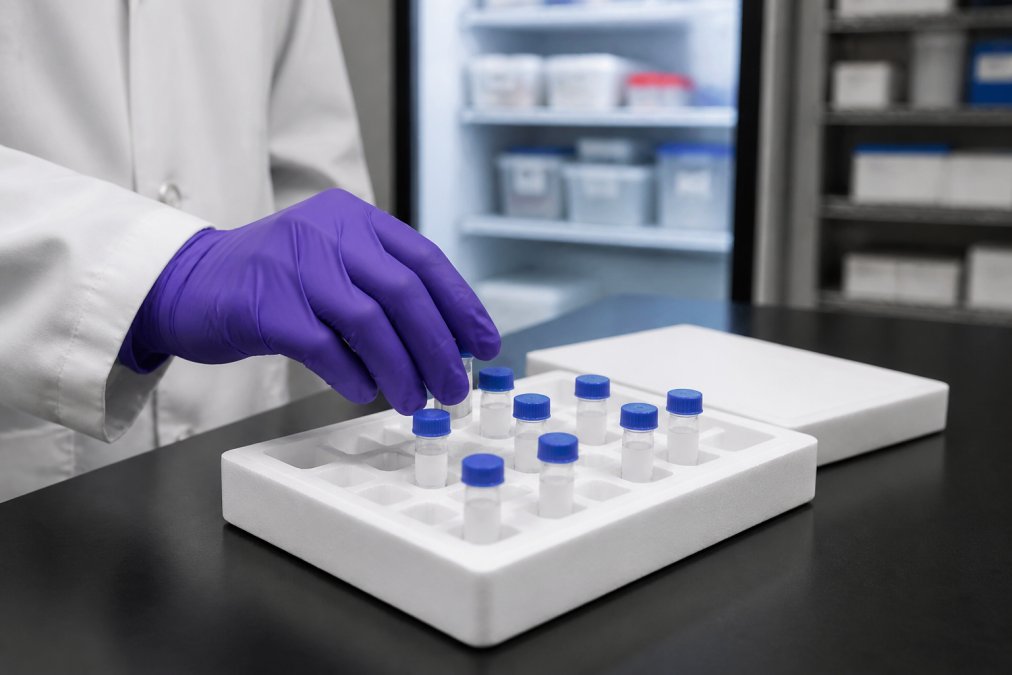
A few handling rules keep aliquots clean:
- Work in a clean, draft-free space
- Label every vial with contents and date
- Keep vials upright at all times
- Cap vials once the flip-off top is removed
- Store in a rack or case, not loose in a drawer
Troubleshooting Degraded Peptides: Signs and Solutions
Degraded peptides usually announce themselves visually before they fail in an assay. Cloudiness, particles, color shift, and gel formation are the common signs. Each points to a specific cause.
| Sign | Likely Cause | What to Do |
|---|---|---|
| Cloudy solution | pH out of range or aggregation | Check buffer and pH |
| Visible particles | Aggregation or contamination | Discard the vial |
| Color change | Oxidation | Protect from light and air |
| Gel formation | High concentration or cold | Dilute and rewarm gently |
| Poor solubility | Wrong buffer | Switch to a suitable buffer |
Conclusion
Peptide storage rewards consistency more than any single product or technique. Keep powder dry and cold, mix gently, aliquot before freezing, and protect every vial from light, heat, and air. Those habits carry more weight than any one piece of equipment.
Frequently Asked Questions
Do peptides really go bad after 30 days?
Not automatically, but 30 days is a common conservative marker for reconstituted peptides stored at refrigerator temperatures. Lyophilized powder can remain stable for months or years when kept at -20°C. Once you add BAC water and store the vial at 2°C to 8°C, degradation accelerates. Peptide shelf life after mixing depends on the specific sequence, buffer, and contamination control. Some peptides hold potency for 4 to 6 weeks; others lose measurable activity sooner. Label your vials with the reconstitution date and inspect for cloudiness or particles before each use.
What environmental factors destroy peptide stability?
The main peptide degradation factors are heat, light, moisture, oxygen, and repeated freeze-thaw cycles. Temperatures above 25°C speed hydrolysis and oxidation. UV light breaks aromatic residues. Moisture promotes aggregation in lyophilized powder. Oxygen drives oxidation of methionine and cysteine. Each freeze-thaw cycle forces the peptide through phase changes that can cause aggregation and precipitation. Store vials in a dark, desiccated container at a stable temperature and aliquot before freezing to minimize these risks.
How long can peptides be left unrefrigerated?
Lyophilized powder can typically tolerate 1 to 3 weeks at room temperature without major loss, but this varies by peptide. Reconstituted peptides should not stay above 8°C for more than a few hours. If a vial sits out overnight, inspect it for cloudiness, gel formation, or visible particles. When in doubt, discard it. For shipping, use insulated packaging with cold packs. Once the vial reaches your bench, move it to the refrigerator or freezer promptly and log the exposure time.
What equipment do I need for proper peptide storage at home or in a small lab?
You need a calibrated freezer that holds -20°C for lyophilized stock, a refrigerator at 2°C to 8°C for reconstituted vials, and an airtight desiccant container for moisture protection. A vial storage case with precision-molded wells keeps vials upright and organized. Use bacteriostatic water with 0.9% benzyl alcohol for reconstitution to inhibit microbial growth. Add silicone vial caps to protect stoppers from dust after the flip-off cap is removed. A thermometer inside each storage unit confirms temperature stability.