

Table of Contents
- What 95% Peptide Purity Actually Means
- How to Verify Peptide Purity Before You Buy
- Impact of Peptide Purity on Assay Results
- Third-Party Peptide Testing: What the COA Tells You
- 95% vs. 98% Purity: When to Step Up
- Common Impurities in Research-Grade Peptides
- Decision Framework: Is 95% Right for Your Screening?
- Frequently Asked Questions
Last Updated: September 18, 2026
What 95% Peptide Purity Actually Means
When you order a peptide at 95% purity, you're getting a compound that's 95% the target sequence and 5% everything else, a reality that makes peptide purity screening essential for reliable research. That "everything else" matters more than most researchers realize.
How to Verify Peptide Purity Before You Buy
Don't trust the purity number alone. Request the Certificate of Analysis (COA) before purchase, this is non-negotiable for serious research.
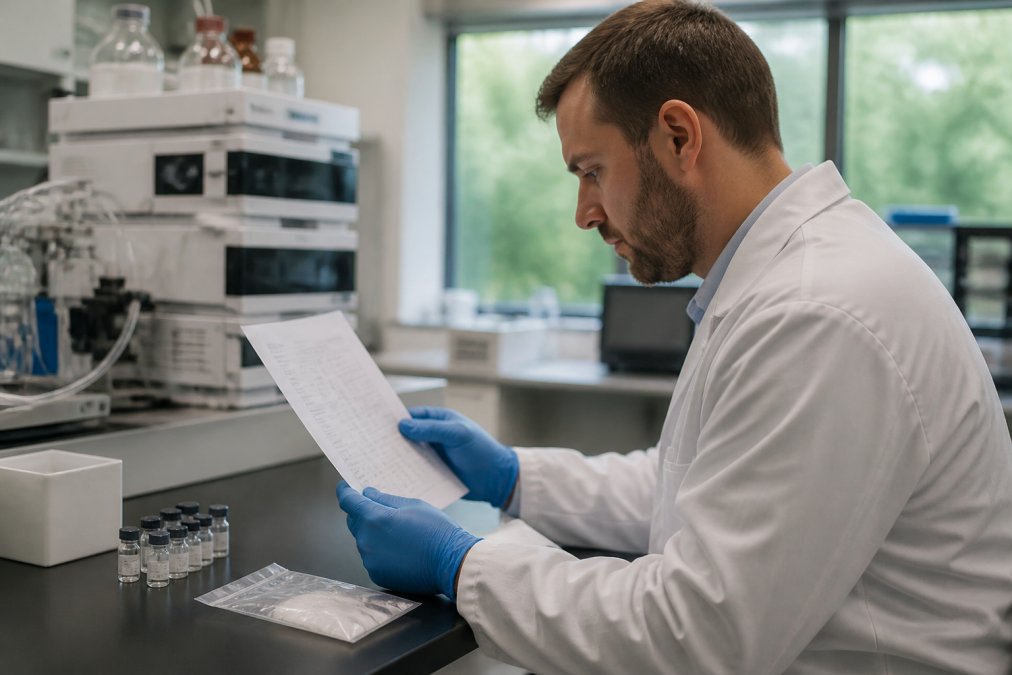
Look for these specific details on the COA:
- HPLC method and conditions used (column type, solvent, wavelength)
- Retention time of your target peptide
- Peak area percentages for all detected peaks, not just the main one
- Batch number that matches your order
- Testing date (ideally within 6 months of shipment)
- Identity confirmation, often via mass spectrometry
Impact of Peptide Purity on Assay Results
Truncated peptides and binding competition
TFA and residual solvents in cell-based assays
Related peptides and sequence variants in NMR and crystallography
Counter-ions and salt content in mass spectrometry-based assays
Water content and lyophilization artifacts in dose-response studies
Practical decision rule by assay type
-
Cell-based assays (proliferation, apoptosis, migration): 95% purity acceptable if TFA content is <1%. Cells tolerate truncated peptides and related sequences because they're testing biological activity, not binding kinetics. Impurity-driven noise is lower than biological variability.
-
Binding affinity assays (ELISA, SPR, FP, ITC): 98%+ purity required. Truncated peptides and variants directly compete for binding sites, artificially inflating Kd values. A 95% peptide can produce Kd values 15-25% higher than the true value.
-
Structural assays (NMR, crystallography, cryo-EM): 98%+ purity required. Sequence variants and truncations create spectroscopic noise that corrupts structure calculations. High-resolution mass spectrometry confirmation is essential.
-
LC-MS quantification: 97%+ purity required with specified counter-ion form. Water content must be <5%. Counter-ion exchange and water content errors accumulate in quantitative workflows.
-
Exploratory screening (multiple peptides, preliminary hits): 95% acceptable. You're ranking candidates, not characterizing them. Noise tolerance is high because you're eliminating obvious non-binders and will re-test hits at higher purity.
The key insight is that "95% purity" is a single number hiding a complex impurity profile. What matters is not the total purity, but which impurities are present and whether they interfere with your specific assay. Request the COA, examine the chromatogram, and match purity level to your assay's sensitivity to impurities.
Third-Party Peptide Testing: What the COA Tells You
The Certificate of Analysis is your window into whether the supplier is being honest about purity.
95% vs. 98% Purity: When to Step Up
The 3% difference between 95% and 98% purity sounds small. In practice, it determines whether your screening data is clean or noisy.
Use 95% purity when:
- You're doing preliminary binding assays to identify leads
- You're running cell-based assays where minor impurities don't interfere
- You're testing multiple peptides and need to keep costs down
- Your assay has high signal-to-noise ratio already
Step up to 98% or higher when:
- You're characterizing binding kinetics or calculating Kd values
- You're running dose-response curves for publication
- You're working with sensitive assays (fluorescence polarization, surface plasmon resonance)
- Impurities might trigger off-target effects in your model
- You're preparing for in vivo studies and need pharmaceutical-quality material
Common Impurities in Research-Grade Peptides
The 5% of impurities in a 95% purity peptide isn't random contamination, it's a predictable byproduct of synthesis chemistry. Understanding what's actually in that 5%, how much of each impurity is present, and how to read it from the Certificate of Analysis transforms purity from an abstract number into actionable information.
Truncated sequences: the dominant impurity
A typical impurity profile for a 20-amino-acid peptide at 95% purity might look like:
- 95% full-length (20 amino acids)
- 2.5% 19-amino-acid truncation
- 1.2% 18-amino-acid truncation
- 0.8% 17-amino-acid truncation and shorter
- 0.5% unidentified peaks
Related peptides and sequence variants
Common variants include:
- Deamidation: Asparagine or glutamine loses its amide group, converting to aspartate or glutamate. This is common in peptides stored at room temperature or in aqueous solution. It shifts the mass by 1 dalton and changes the charge.
- Oxidation: Methionine oxidizes to methionine sulfoxide, adding 16 daltons. This is common in peptides containing methionine, especially if exposed to air during storage.
- Misincorporation: An amino acid similar in structure (leucine vs. isoleucine, aspartate vs. asparagine) gets incorporated in the wrong position during synthesis. This is rare but possible with certain sequences.
TFA (trifluoroacetic acid) and desalting residue
TFA affects your peptide in several ways:
- Mass: TFA adds molecular weight. A peptide supplied as the TFA salt is heavier than the free base. The COA should specify "supplied as trifluoroacetate salt" so you can account for this in concentration calculations.
- Solubility: TFA makes peptides more soluble in aqueous solution because it provides a counter-ion. Peptides supplied as the TFA salt dissolve more readily than the free base.
- pH: TFA is acidic. If your peptide contains residual TFA and you dissolve it in a neutral buffer, the TFA will lower the pH slightly. For cell-based assays, this can trigger unwanted pH effects.
- Assay interference: In some assays, TFA interferes with detection. Fluorescence assays can be affected if TFA quenches fluorescence or shifts the excitation/emission wavelengths.
Counter-ions: acetate, chloride, phosphate
Peptides are synthesized and purified as salts. The counter-ion depends on the purification method and desalting process. Common counter-ions include:
- Acetate: Often used because it's volatile and easy to remove. Acetate salts are common in research-grade peptides.
- Chloride: Results from HCl desalting. Chloride is less volatile and can remain in the final product.
- Phosphate: Used in some purification methods. Phosphate-buffered peptides are common for cell-based assays.
- Trifluoroacetate: The default if desalting is incomplete.
Water content and lyophilization quality
Salts and inorganic residue
Salts affect your assay in several ways:
- Osmolarity: High salt content increases the osmolarity of your assay buffer, which can affect cell behavior in cell-based assays.
- Ionic strength: Salt affects protein-peptide binding by screening electrostatic interactions. High salt can weaken binding.
- Assay interference: Some assays (conductivity-based assays, ion-selective electrode assays) are sensitive to salt content.
Reading the impurity profile from the COA
- Identify the main peak: This should be your target peptide. The retention time should match the expected value (the COA should state this).
- Identify secondary peaks: These are impurities. The COA should label them (e.g., "Peak 2: 19-amino-acid truncation, 2.3%"). If peaks are unlabeled, ask the supplier what they are.
- Calculate the total: All peak areas should sum to 100%. If they don't, the analysis is incomplete.
- Assess the profile: A clean profile has one dominant peak (your target) and a few small, well-characterized peaks (truncations, variants). A messy profile has many unidentified peaks, suggesting incomplete purification or synthesis problems.
Predicting impurity composition by peptide characteristics
The impurity profile depends on the peptide's properties:
- Long peptides (>25 amino acids): Higher truncation content because synthesis yield decreases with chain length. Expect 3-5% truncations in a 95% purity batch.
- Peptides with methionine: Higher oxidation content if not stored under inert atmosphere. Expect 1-2% methionine sulfoxide.
- Peptides with asparagine or glutamine: Higher deamidation content if stored in aqueous solution. Expect 1-3% deamidated variants.
- Hydrophobic peptides: May have higher aggregation during purification, leading to higher impurity content. Expect 4-6% impurities in a 95% purity batch.
- Charged peptides (many lysine or arginine residues): Easier to purify, lower impurity content. Expect 3-4% impurities in a 95% purity batch.
Decision Framework: Is 95% Right for Your Screening?
Use this framework to decide whether 95% purity is adequate or whether you need to step up.
| Your Screening Goal | Purity Requirement | Why | Example |
|---|---|---|---|
| Preliminary lead identification | 95% acceptable | Noise tolerance is high; you're eliminating obvious non-binders | Testing 50 peptides to find 3-5 hits |
| Binding kinetics characterization | 98%+ required | Impurities skew Kd calculations; confounding variables matter | Measuring Kd for 10 leads before in vivo testing |
| Cell-based assays | 95-97% acceptable | Cell assays have built-in noise; minor impurities often don't interfere | Testing peptide effects on cell proliferation |
| Fluorescence-based assays | 98%+ required | Impurities fluoresce or quench signal; high-sensitivity methods need clean material | FRET or fluorescence polarization binding assays |
| Exploratory in vitro screening | 95% acceptable | Early-stage work tolerates higher noise | Testing peptide stability across pH and temperature |
| Preparation for in vivo studies | 98%+ required | Impurities might trigger immune response or alter pharmacokinetics | Moving 3 leads into mouse efficacy models |
Frequently Asked Questions
What does 95% peptide purity actually mean?
95% purity means the peptide compound is 95% the target sequence by mass, with the remaining 5% composed of impurities such as truncated sequences, residual solvents, or counter-ions like TFA (trifluoroacetic acid). This measurement is determined through analytical chromatography, typically HPLC, which separates and quantifies each component. For exploratory screening, 95% purity is often sufficient because the active peptide concentration remains high enough to observe biological responses in controlled in vitro assays.
Does peptide purity affect screening results?
Yes, peptide purity directly impacts screening results. Lower purity introduces contaminants that can interfere with assays, cause confounding variables, or produce false positives. For example, truncated sequences may compete for binding sites, skewing binding affinity measurements. Impurities can also trigger unexpected immune responses in in vivo studies or reduce experimental reproducibility. Higher purity minimizes these variables, making results cleaner and more reliable, especially critical for peer-reviewed research where data integrity determines publication acceptance.
When should I choose 98% or higher purity instead of 95%?
Step up to 98% or higher purity when conducting in vivo studies, running quantitative assays sensitive to contaminants, or preparing work for pharmaceutical-quality applications. Immunology and antibody production research benefit from higher purity because impurities can trigger off-target immune responses. If your assay relies on precise binding affinity measurement or you're screening compounds for therapeutic potential, 98%+ purity reduces noise and strengthens your conclusions. For basic exploratory in vitro screening with robust readouts, 95% often suffices.
How do I know if a supplier's purity claims are real?
Request the Certificate of Analysis (COA) before purchasing. A legitimate COA includes HPLC chromatography data showing the purity percentage, identifies specific impurities detected, and lists the testing method used. Third-party tested peptides provide independent verification, Frontline Peptides uses rigorous third-party testing and provides COAs with every product. Cross-check the COA against your assay requirements: if you need sequence verification, confirm mass spectrometry data is included. Avoid suppliers who cannot produce detailed COAs or who test only in-house without independent verification.